Written By Chris Norris
When Technology Understands Everything Except the Human Being
In this Social Treble interview, Eeshin explores a musical language that tells stories without a singer. The musician behind India’s cyber-prog project brings progressive metal, electronics and three-dimensional sound into an unsettling world of human emotion and technological control.
Performing as The Analog Ghost, Eeshin calls his sound cyber-prog. The project poses an uncomfortable question: what happens when technology can measure human suffering but cannot respond with compassion?
His debut album, Dead Reckoning… The Last Known Location, unfolds across twelve instrumental chapters set in Bengaluru in 2031. At its center is Token AS-1133, a software architect trapped inside a corporate surveillance system.
The network records his distress, opens a wellness ticket and moves on. The person behind the data is left to fend for himself.
Industrial pressure, progressive-metal arrangements and ambient passages carry that story from confinement toward a fragile possibility of escape.
Eeshin uses binaural spatial audio to place sounds around the listener rather than merely across a stereo field. Headphones reveal another dimension of the record’s unease.
Even the running time serves the plot: Crowded Silence lasts 224 seconds, matching the protagonist’s allotted escape window.
In our conversation, Eeshin discusses the experiences behind that world, the freedom of making music on his own terms, and why a system’s ability to follow procedure is no substitute for understanding a human being.
Metal Lair Interview With Eeshin of Social Treble
Metal Lair: Classical composers have been telling elaborate stories through instrumental music for centuries, without relying on lyrics or vocals. Your work continues that tradition through progressive metal and binaural spatial audio.
Do you see Social Treble as a modern extension of classical program music, or does your approach to instrumental storytelling come from an entirely different philosophy?
Eeshin: Chris, I must admit here that I didn’t really arrive at instrumental storytelling by studying classical program music and deciding to make a modern version of it. I can understand the comparison, of course. But my introduction was rather different.
I was nine when I first heard Pink Floyd’s The Dark Side of the Moon. And at that age, I was, of course, not sitting there analyzing the lyrics. But I was fascinated by what I was listening to. The sounds, the way one passage led into another, the whole experience.
It actually made me start questioning things beyond music. Then, when I was fourteen, I heard Porcupine Tree’s Voyage 34. The entire album, all four phases, in one sitting. Nowadays, most people seem to find Porcupine Tree through In Absentia or Deadwing or Fear of a Blank Planet. I found them through Voyage 34. Not exactly the usual doorway, is it?
And Richard Barbieri’s keyboard textures were a huge part of that experience for me. I still remember that exact moment because I really wanted to know how somebody could make a keyboard sound and feel like that.
So, I started teaching myself. About two years later I joined an English rock band in Kolkata as a vocalist and keyboardist, totally self-taught by the way. The band played classic rock and psychedelic/progressive rock covers, mostly at pubs and engineering-college festivals, and stayed together for around six years.
This was during a time when Bangla Rock (or Bengali Rock) was at its peak with bands like Fossils, Cactus, Chandrabindoo, etc, dominating the scene. Now imagine being an English rock band operating at the center of that! To say things simply, our exposure was limited.
But I loved doing what I was doing. Still, at the end of the day, I was just the contributor in the band with no creative input whatsoever. But the thing that had first made me pick up an instrument was still there: I wanted to find out how far the music itself could take me.
Metal Lair: You’ve explained that conventional songwriting structures couldn’t adequately express the experiences you wanted to communicate. Do you believe introducing a human voice would change or restrict the listener’s interpretation, or could you imagine incorporating vocals into a future Social Treble composition?
Eeshin: Oh, I wouldn’t put any restrictions on vocals in any way, Chris. See, I actually have a background as a singer. I could sing from a young age (totally natural and untrained though), spent years as a vocalist and keyboardist in that band, and worked with both male and female vocalists in other projects.
And my favorite band is Porcupine Tree, with Steven Wilson being my biggest musical inspiration. So, it would be rather odd for me to suddenly announce that the human voice has no place in music, wouldn’t it?
What happened after the band ended was that I wanted to become self-sufficient. I was already playing keyboards, and later on, around the time I started working as an investigative journalist, I taught myself how to play the guitar, and began learning music production with Cubase 5. I learnt those things because I wanted to be able to follow a musical idea without always needing somebody else to complete it.
With Dead Reckoning, I could hear what I wanted through the playing, the arrangements and the binaural space. I didn’t feel the need to put a sung vocal into it.
That being said, a voice can change a composition in wonderful ways. It can give you possibilities you wouldn’t have had otherwise. If I write something in the future and a voice belongs in it, why wouldn’t I use one?
I don’t want to turn an artistic choice I made for this album into some permanent rule for myself. And that is because I fundamentally do not like constraint and labels in the first place.
Metal Lair: Dead Reckoning… The Last Known Location presents a world in which technology can measure human distress with extraordinary precision while remaining incapable of offering genuine compassion. Do you believe the fundamental problem lies in technology itself, or in the human priorities and institutions determining how that technology is used?
Eeshin: See, I have spent enough time around these systems to know that the words used to describe them and the experience of living with them can be two very different things.
You’ve probably heard some of those lovely phrases yourself like “employee wellbeing”, “an open-door policy”, “we’re all one big family”. “employee-friendly company”.
And I don’t mean that everybody who uses those words is insincere. Some people genuinely mean well and try to do what they promise. But in my experience, people actually doing what they say is very rare.
So, what happens when somebody actually needs help? That is the question I kept coming back to during my entire career as a software architect in Big Tech.
You can put a process in place, log a concern, assign a ticket number and report that every required step has been completed. Fine. But has the actual person received any help? Or have we simply become very good at documenting the fact that the person asked?
That’s where the twelve-digit wellness ticket in Dead Reckoning comes from. The events and people are fictional, but the observations behind that idea come from things I’ve experienced in real life. In the fictional world, Token AS-1133 asks for help and the system gives him a reference number.
It has done its part, according to its own rules. But he’s still sitting there, isn’t he? So, did his concern actually get resolved? And what was measured in the process to be analyzed later by the system?
The fact is, I still work with technology myself, so I know that a system can be immensely useful. And I’ve got no problem with keeping records or measuring things.
The real trouble actually begins when someone starts treating a completed process as evidence that a human problem has been resolved. Those are very different claims, aren’t they? And I think we, human beings, have become a little too comfortable confusing them in a very general way.
Metal Lair: There’s a fascinating contradiction at the heart of Social Treble. You’re using sophisticated digital technology to create music that questions humanity’s increasingly complicated relationship with technological systems. Do you see that contradiction as intentional, or is the distinction ultimately about who controls the technology and what they choose to do with it?
Eeshin: I see why it looks like a contradiction, but I don’t really experience it that way. Actually, a fairly ordinary problem in 2020 changed how I make music, and it’s probably the best way I can explain what I mean.
I used to have a substantial home studio. A Fender Telecaster, a PRS S2, a Rickenbacker bass, a Korg PA900, audio interfaces and all the other things that gradually find their way into a musician’s room.
I used amp simulations like Guitar Rig and AmpliTube with my guitars even then. But when COVID happened and I had to move back to Kolkata (my home town) for a while, moving the whole setup was simply impractical. The amount of equipment, the expense, the logistics were simply enormous in every way. I looked at it and thought, well, this makes no sense.
So, I sold that setup and moved to a Samson Graphite 49 MIDI keyboard. I still have it, by the way, although it doesn’t get much work these days other than the occasional cleaning up and a bit of playing randomly after the cleanup is done just to see whether it is still working or not.
My present instruments are the original Nektar Impact LX61 keyboard and ROR Guitars Expressive MIDI Pro 2 guitar, both physical instruments I actually play. The MIDI performance drives the virtual instruments.
I do the recording, arrangement and audio engineering myself. And the change that began because I couldn’t move a studio ended up giving me more freedom with instrumentation.
So, yes, I use sophisticated tools and I am quite satisfied with them too. But a musician choosing a tool to create something is a rather different situation from an institution using a system to decide things about another person’s life.
The point is what we choose to do with those tools, and who gets a say in the result. And here, I should also make my production disclosure absolutely transparent.
The three early music videos (March 2026 to May 2026 and still live on the Social Treble YouTube channel) used Google Flow-generated visuals under my own scripts and direction simply because I did not have a budget of a record label backing me to produce the exact style of video concepts needed for particular.
The music, and every aspect of it, has always been my own performance and production. Neither the current album nor its artwork uses generative AI in any way. A keen eye (maybe like yours, Chris) will be able to tell the difference, wouldn’t it?
Metal Lair: You’ve described the precise duration of Crowded Silence as a constraint dictated by the story itself. Has there ever been a moment when the needs of your narrative conflicted with what you felt was musically right? If so, which one ultimately took precedence?
Eeshin: Actually, the first track that comes to mind is Skyline Motherboard… The Burden of Being Known. And there’s a little story behind it, because I had already composed the track and built a pretty elaborate spatial stereo mix for it. I was using panning, spatial reverbs, delays, all sorts of things. There was a lot of work in that version.
But then I listened to the finished track for the first time, and something just didn’t sit right. The instrumental arrangement had the pathos I wanted.
I could hear that. Still, the sense of helplessness that the opening chapter needed wasn’t coming across to me the way I wanted it to. And that was a rather irritating position to be in when you’re the person who both composed and mixed the thing. I knew exactly what I had done. But my ears still weren’t convinced.
So, I went back to the mix and began rebuilding the presentation in true binaural audio (not to be confused with Binaural Beats and there is a huge difference, yes) and paying much closer attention to where each sound appeared, how far away it seemed, and how it related to everything around it. That’s actually where this whole approach began for me. It wasn’t something I decided to add later because the term sounded interesting.
Crowded Silence does have the 224-second escape window built into the story, of course. But with Skyline Motherboard, it wasn’t really a question of choosing the plot over the music. Because I had the notes and the arrangement.
What I hadn’t yet found was the space in which they conveyed what I was hearing in my head. And I wasn’t going to leave it alone until I did.
Metal Lair: The album follows a protagonist who is gradually reduced to data, productivity measurements and administrative identifiers.
Yet you deliberately maintain a degree of anonymity through The Analog Ghost. Has creating this project changed your own understanding of the relationship between personal identity, privacy and artistic freedom?
Eeshin: I think The Analog Ghost persona made me more deliberate about something I was already learning from life. And that is ‘self-preservation’ and ‘privacy awareness’ combined together.
Those two things are very important to me in ways that only a person who has spent years inside the system’s cogwheel would understand.
I’ve had enough reality checks, both personal and professional, to understand why. And given my journalism and technology background, I have this habit of wanting to know how things work and what’s actually going on under the surface before trusting it at all.
It is useful, of course. But I must admit, there are times when a little less knowledge would be rather peaceful.
Now, I had an earlier musical identity that I could have used to introduce Social Treble. It might even have made the initial publicity easier. But it would also have brought expectations from that earlier work and I absolutely did not want that. I wanted this music to be heard for what it is now.
That’s why I made the choice. The mask and the name aren’t a game in which I’m asking everyone to guess who’s underneath. I’m here, speaking to you, talking about the music and being responsible for it. That’s enough of an introduction for me and I am simply at peace with it.
And there is a small, rather amusing example of how these assumptions travel. Quite a few articles still call me Bengaluru-based. I really was living in Bengaluru when the first three singles came out, right through the release of “Crowded Silence”.
But I don’t live there anymore. The fictional album is set there though, while my public artist location is simply India. I haven’t been sending correction notices around, because where I live today doesn’t change what I played on the album, does it? Still, since we’re talking about information and assumptions, it’s a useful little example, isn’t it?
Metal Lair: Your compositions combine progressive metal, industrial sounds, electronic textures and quieter atmospheric passages.
When you’re developing a new piece, do you begin with an emotional experience, a musical idea or a specific moment within the story? And how does that initial starting point influence the final arrangement?
Eeshin: It really depends on what I’m working on. Sometimes an idea starts with a particular feeling or a scene. Sometimes I hear a little phrase and want to know where it goes.
But once I begin tracking, I usually go straight to my MIDI keyboard. That’s still my primary go-to instrument, and I find it easier to work out the shape of the music there first.
Let’s take the album version of “All Lights In Bangalore Couldn’t Find Me” here. I had released a different, non-binaural version of that title earlier, as the first Social Treble track back in February 2026.
That one isn’t available anymore. And the album version isn’t some polished-up edition of the old recording. I reworked the entire composition of the track for the album.
I began on the keyboard, as usual. But once the arrangement started coming together, I used my Expressive MIDI Pro 2 to perform the guitar and some of the synth parts.
I use that instrument for bass as well, and sometimes for strings and more layered sounds on other pieces. Some of those performance possibilities are actually quite difficult for me to approach with the Nektar Impact LX61 alone. So, I use the instrument that lets me play the part the way I want.
This is something I really wish people understood about MIDI. I’m not sitting there asking a program to invent a guitar performance.
I’m physically playing the part, and the virtual instrument is producing the sound. Then there is the arrangement, the binaural work and everything else.
The story can influence any of those decisions along the way, and in any way now that I think about it. But I don’t always know in advance which part will need the most attention. That’s part of why I enjoy making the music in the first place.
Metal Lair: The album’s binaural production establishes a carefully constructed three-dimensional listening environment.
Do you think modern audiences have become so accustomed to consuming music casually that immersive compositions now require an entirely different kind of attention? And does that affect how you approach your audience?
Eeshin: Well, I wouldn’t blame people for listening casually. We all encounter music in different ways, and I don’t think someone owes me an hour of uninterrupted attention just because I’ve spent a very long time making an album. That would be a fairly ambitious request from a musician, wouldn’t it?
But I do think some records reward a different sort of listening. Steven Wilson’s Headphone Dust mixes, of songs from his solo project as well as Porcupine Tree, are an example that comes to mind for me.
I’ve spent a lot of time exploring sound design and audio engineering myself, including technical work on media-production systems, and those experiences make me curious about the little spatial details in a recording and how the most subtle details can change the entire listening experience.
So, the questions I always ask myself when producing music myself are, “What happens when one instrument seems further back than another?” and “What changes when the same passage is presented in a different space?”
With Dead Reckoning, I placed the individual sounds deliberately in binaural space. So, when I suggest headphones, it isn’t a test of whether somebody is a serious enough listener or not.
It’s simply that the left and right ear cues are part of the music I’ve made. If you listen through ordinary speakers, you’re hearing a different presentation of those cues, after all.
That being said, somebody might love the record for a melody or a rhythm and never think about where I placed a particular instrument.
That’s perfectly fine too. I’d much rather let them listen and find their own way into it than give them a set of instructions for the correct emotional response.
That’s just the way I see things and, of course, I understand that other people might think differently. And that’s the beauty of the whole thing, at least for me.
Metal Lair: Dead Reckoning takes listeners through escalating technological pressure and eventually toward a quieter, more organic musical conclusion. Why was it important for the story to end with restraint rather than a grand musical resolution?
Do you think recovering personal freedom is necessarily the same thing as recovering emotionally?
Eeshin: This one is actually quite personal. The fact is, I’ve been through experiences that I’m still recovering from. I haven’t fully healed, and I don’t know when I’ll be able to say that I have.
There are a lot of people online who can tell you how quickly you’re supposed to move on from something. Well, it hasn’t worked like that for me in any way and I don’t think it does for a lot of people. After all, individual experience and individual capacity matter here, don’t they?
And life doesn’t stop while you’re dealing with it, does it? You still have things to do. You work, you make music, you get on with the day. Sometimes you’re doing perfectly well at one thing while something else is still affecting you. I know that from my own experience.
So, I couldn’t have Token AS-1133 walk out of that network and immediately become a completely different person. In the album, “Crowded Silence” and “All Lights In Bangalore Couldn’t Find Me” deal with the exit and the disappearance.
But “Aftermath” is still heavy in spite of being mostly acoustic in terms of guitar. The system has lost sight of him, and that doesn’t mean everything he learned to fear has simply gone away.
“Sovereign Hope” arrives after that, with the warmer fingerstyle guitar. I wanted a little room for what comes next. Not a grand announcement that everything has been fixed. Just the possibility of carrying on, and perhaps beginning to make something of your own again. That’s a much more believable ending to me.
Metal Lair: Instrumental music can communicate powerful emotions without necessarily communicating an identical story to every listener.
Someone unfamiliar with the album’s accompanying narrative might experience fear, isolation and liberation without ever imagining a software architect trapped inside a surveillance network.
Does that freedom of interpretation appeal to you, or is understanding the specific narrative essential to experiencing the work as you intended?
Eeshin: Oh, absolutely, it appeals to me more than people might understand. See, I know what I wanted to communicate when I wrote Dead Reckoning.
I know why a sound sits in a certain place, why a passage lasts as long as it does, and what happens to Token AS-1133 in the story. But why should that mean everybody else must experience it in exactly the same way?
Each person brings a different life to a piece of music, don’t they? Someone could hear anxiety in a passage where I was thinking about a particular moment in the story.
Someone else might simply enjoy the guitar part. And I honestly don’t see either response as a problem in any way. If I expected every listener to arrive at my exact interpretation, I’d be making a fairly unreasonable demand on people I’ve never met, won’t I? Would that be fair to the listener with his or her own experiences?
The Bandcamp album description, track notes and the narrated album film are available if somebody wants the full fictional story.
And I’d be delighted if they explored them. But the music is there to be heard on its own too.
There’s a similar thing in the 432 Hz and 417 Hz editions now live on my Bandcamp page. I can actually measure the processed audio and check the tuning reference.
I’ve even built software for doing exactly that. But I can’t put someone’s response to the music on the same receipt, right? That’s where I have to leave some room for the listener, and frankly, I wouldn’t want it any other way.
Metal Lair: You’ve spoken about your experiences working inside the technology industry and how they helped shape Social Treble’s fictional universe. Has creating music about those systems changed the way you navigate them in your own everyday life?
Eeshin: Not really in the way the question suggests. See, I was already reading documents carefully, questioning processes and trying to work out how systems behaved long before I made this album.
That’s simply how I’ve learned to approach things. Journalism gave me one set of habits, technical work gave me another, and life has provided a few lessons of its own, after all. Some of those are ones I could happily have done without, I must admit here. And that’s the reality.
What the album allowed me to do was take those observations somewhere else for a while. When you’re dealing with an actual problem, you’re concerned with the practical questions. What’s happening? What do the records say? What are the available options?
But when you sit down to make music from that kind of experience, you start thinking about different things.
What would it sound like to have your attention constantly interrupted? Or to have a system record that you’re struggling and then go on as though the job were finished?
I still do my due diligence. That hasn’t changed ever. But writing those experiences into a fictional world did give me room to think about how they feel, not only how they work.
And those are two different kinds of understanding. Neither makes the other unnecessary in any way, actually.
Metal Lair: You’re responsible for an extraordinary range of creative decisions, from composition and performance to production and the project’s visual identity.
Does that independence feel liberating, or are there moments when maintaining complete control becomes another kind of pressure?
Eeshin: For me, it’s liberating actually. I know that it probably sounds like a lot for one person to handle, but I genuinely don’t experience independence as an extra pressure. I’m actually pretty calm by nature. At the same time, if I’m working on something, I do want to understand it properly and do it the justice that it deserves. So yes, I can spend ages on one tiny detail. I’m fine with that.
“All Lights In Bangalore Couldn’t Find Me” is a good example. I decided the album needed a different composition, so I went back and made one. I could change the arrangement, work out the parts again and rebuild the production without waiting for a decision from anybody else. That’s a lovely freedom to have when you know what you want to try.
Now, I do find it interesting that collaboration is treated as the answer to nearly everything these days. I’ve played in bands and worked with other vocalists, and some of that work was wonderful.
I have nothing against collaboration. But the suggestion that you must always collaborate to make better work seems a little strange to me. Sometimes it’s useful to have several people in a room. Sometimes it’s useful to have the skills to finish something yourself.
And if the result isn’t what I wanted, I can go back and work on it. There isn’t anyone else to blame, of course. But I’m not particularly interested in finding somebody to blame in the first place. I like to keep things simple that way.
Metal Lair: There’s a recurring idea throughout your work that understanding the rules of a system can provide a way to resist it.
Do you believe meaningful change is more likely to come from people working within existing structures or from those who choose to walk away from them entirely?
Eeshin: I don’t think there’s one answer that would be right in every situation. A lot of my thinking about this has come from experiences in personal and professional life, some of them quite unpleasant.
And they’ve taught me to be careful about what I agree to and what my options actually are. So, I read things, be it contracts, policies, documentation, architecture and so on.
I know that doesn’t sound like the most exciting pastime, but it can save you an extraordinary amount of trouble, believe it or not.
That’s actually one of my favorite little details in the album’s story. Token AS-1133 doesn’t take on the entire surveillance network in some enormous final battle Terminator style.
He studies the contract and finds the Voluntary Decommissioning clause after absolute detailed work which consume a lot of time. The escape happens because he bothers to understand the rules. That might be quite an unusual heroic moment for a progressive-metal album, I suppose.
But I would rather l prefer that than to declare war against ‘Skynet’ or ‘The Sith’ or the aliens invading the planet and ‘The Avengers’ defending it in a final decisive battle. And this attitude of mine totally comes from multiple reality checks in my own life.
That being said, we should understand the fact that knowing a system in and out doesn’t automatically tell you whether you should stay inside it. Sometimes you may be able to change something from within. Sometimes you may discover that leaving is the only choice left for you. And sometimes there may not be an easy choice available at all.
For me, the point is to find out what you’re dealing with before you decide. It doesn’t guarantee a good result in any way and I certainly wouldn’t claim that. But it means you’re making a choice with your eyes open, or as open as the information available will allow.
Metal Lair: Your music exists in a space between progressive metal, cinematic soundtracks and experimental electronic composition.
As Social Treble develops, do you want listeners to recognize it primarily as a musical project, or are you deliberately working toward something that moves beyond the traditional boundaries of an album?
Eeshin: Music is always going to be at the center of Social Treble, Chris. That’s where the whole thing began. But I didn’t start making this music with the idea that it had to stop at releasing albums.
See, I already had years of experience in music, journalism, software and technical work before Social Treble. When I began making the music and the accompanying films, I found myself using all of those things together. A musical question might make me investigate an audio method.
Then that investigation might lead to a tool, which in turn could give me another idea for a composition. Or I might notice something while researching an article and begin wondering whether it could become a fictional situation or a piece of music. It went in both directions just like Binaural Audio in terms of listening experience. And it just kept growing.
That’s actually how the present Srutio (my one-person company) operation came about. Social Treble started it in the first place.
And now there is Srutio Social for journalism and cultural and business analysis, Swaran Labs for audio tools and technical education, and Precision For Hire for applied services and training. Each does its own work. They aren’t simply departments waiting to tell people about my next album.
I call the approach Relative Synthesis. It sounds a bit grand, I know. But in practice it is pretty straightforward actually.
Basically, I learn something in one area, use it somewhere else when it makes sense, and sometimes that new use sends me back to learn more. And the actual work ends up changing along the way.
So yes, there will be room in Social Treble for original music, films and longer conversations about the things I find worth examining.
But I really don’t have a grand announcement about what the project must look like five years from now. I’d rather keep making the work the way I want to and find out what each idea needs in the process. That is what brings me peace and satisfaction in the first place. And, I guess, that’s more or less how I got here.
Social Treble’s machinery is intricate, but Eeshin’s concerns are unmistakably human. Behind the binaural environments and fictional surveillance systems is a musician questioning who gets to define freedom, and what it costs to reclaim it. Dead Reckoning… The Last Known Location leaves those questions ringing long after its final notes.

Tracklist
1. Skyline Motherboard… The Burden of Being Known
2. Void In Time
3. The Brass Hour
4. Faces of Reality
5. Anxiety Protocol
6. Flagged For Review
7. Reading Against the Grain
8. The Last Reading
9. Crowded Silence
10. All Lights In Bangalore Couldn’t Find Me
11. Aftermath
12. Sovereign Hope

Social Treble Online:
About the Author
Chris Norris is the voice behind Metal Lair’s global metal coverage, World Metal Weekly. From funeral doom in the north to thrash born in the streets. Known for spotlighting bands before algorithms notice them and for writing with the precision of a scalpel… or a well-sharpened guitar pick. Vinyl collector. Night-shift journalist. Believes heavy music has no borders.
Read More From This Author:
ISVIDD Interview: A Renaissance Man, Nordic Melancholy and the Art of Black Metal
Art of Shock Interview: Creatively Fearless and Unapologetically Metal
The Konsent Interview: Ales Campanelli on Control, Conformity and the End of the System
GÅTE Sigil Interview: Folklore, Magic, Eurovision and a New Chapter

No algorithms. No fluff. No watered-down corporate metal coverage.
Subscribe to Metal Lair and get weekly underground features, Seven Deadly Songs, Deep Cuts, interviews, and original metal journalism sent directly to your inbox.

Join the patrons of Metal Lair
MetalLair.net is a metal zine muttering to itself about seo and blastbeats at 3 AM powered by caffeine, riffs, a severe lack of sleep, and a dog wondering why the human is still awake.
Sometimes it’s Kevin passing out mid Seven Deadly Songs.
Sometimes it’s digging up forgotten records no one else is talking about.
Always, it’s built for people who actually live this music.
If that sounds like you, you’re already one of us.
Supporting Metal Lair means keeping it independent, loud, and real with no corporate filters, no watered-down takes. If you want to help keep it alive…
Become a patron of Metal Lair.
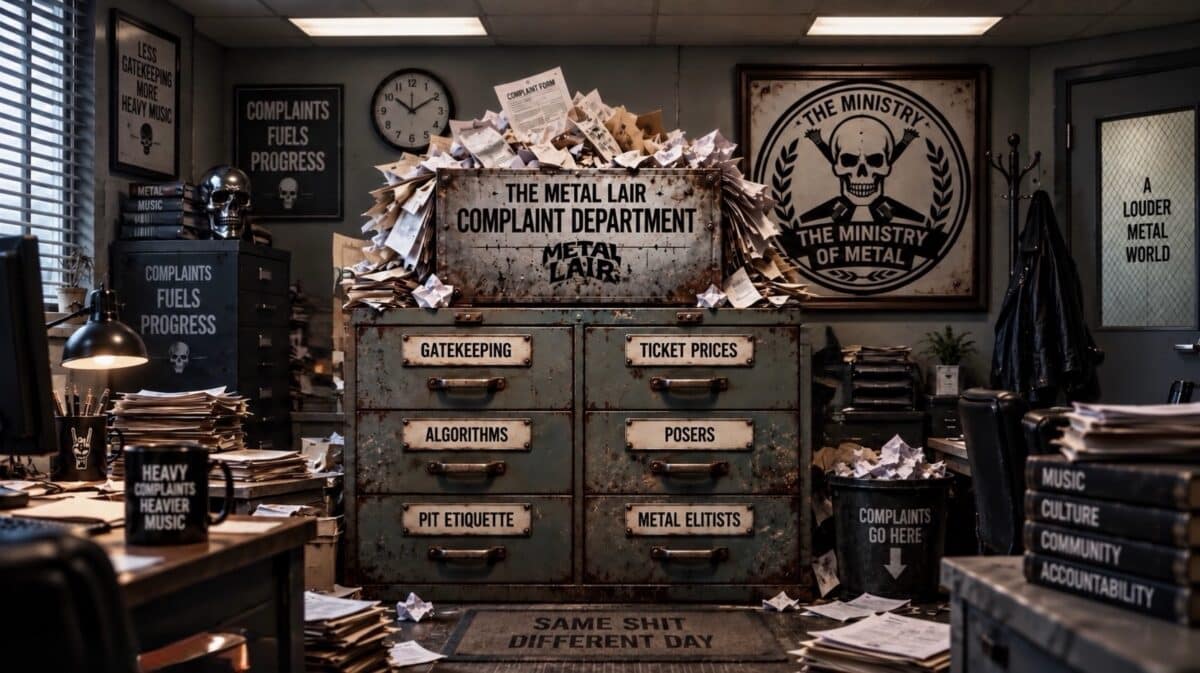
FILE A COMPLAINT WITH THE METAL LAIR COMPLAINT DEPARTMENT
Have a metal-related grievance that needs official investigation?
Bad concert etiquette? Venue bullshit? Festival fuckery? A trend in metal that needs to die? An industry annoyance? Something that’s been pissing you off since 1987? Have a complaint against Metal Lair?
FILE YOUR COMPLAINT
File it with the Complaint Department. Remmy may investigate your grievance in a future installment.
Selected grievances may be investigated, mocked, dissected or otherwise subjected to the questionable judgment of Remmy Chillmister in a future edition of The Metal Lair Complaint Department.
Submission does not guarantee investigation. Remmy has a substantial backlog of things that piss him off.