Written By Lucien Drake | Metal Lair
Ministry Hate to Go review: Al Jourgensen is shutting down the factory. Again. The difference this time is that Hate to Go (Take Out or Delivery) arrives as one last attempt to make the whole political machine rattle apart. Jourgensen has never been one to soothe anyone.
He writes music for the moment when you look at the news and wonder whether the people running things have mistaken the country for their personal demolition derby.
Released October 30, 2026, through Cleopatra Records, Ministry’s seventeenth studio album has ten tracks in its digital and CD configuration, a returning Paul Barker, and more grievances than an entire congressional hearing.
Its appeal is obvious. So is the danger: the challenge for a band that helped reshape heavy music is finding fresh impact in a sound it has spent decades perfecting.
Ministry Hate to Go Review: Does the Farewell Earn Its Noise?
A proper Ministry record has always been more than distorted guitars and an angry bastard shouting at the news.
The essential chemistry was stranger: the twitchy electronics, dub and dance-floor discipline of Twitch; the diseased sample collages of The Land of Rape and Honey; the grinding repetition of The Mind Is a Terrible Thing to Taste; the thrash-metal detonation of Psalm 69; and, later, the stubbornly ugly crawl of Filth Pig.
Plenty of industrial metal bands copied the weight. Fewer understood the groove, and fewer still made the machinery feel genuinely dangerous.
That history is the standard this record must face. Not nostalgia, but the question of whether a familiar riff has something new to say beyond the immediate rush of another politically charged Ministry anthem.
Ministry Hate to Go Review: Ten Tracks from the Industrial Machine
Crickets
A perverse name for an opening statement from a band constitutionally incapable of being subtle. Cricket samples, abrasive vocals and a grimy electronic pulse drag the track back toward Ministry’s EBM ancestry without asking the listener to dress for an eighties revival night.
That is a promising instinct. The Ministry DNA was synthesized long before it was drop-tuned. Beneath every good mechanized riff is a body-music beat trying to escape the factory.
Voices of Hate
The classic Ministry toolkit returns: cycling riffs, broadcast-style samples, snarling vocals, and the sound of political outrage being dragged through a meat grinder.
This is where Ministry’s fury belongs: not tucked behind polite metaphors, but soldered into the rhythm. The repeated riff and samples turn that fury into a claustrophobic mechanism, which is exactly where this band has always thrived.
This is the kind of track a Ministry obsessive will instinctively measure against The Mind Is a Terrible Thing to Taste, an unfair comparison that Ministry themselves invited.
Clown Car
The title practically arrives wearing oversized shoes, but the musical attack is deadly serious: urgent rhythms, thrash velocity and the tightly clipped aggression of the mid-2000s Ministry records.
The political caricature is part of the pleasure. Ministry has never required permission to mock an administration, and a title this pointed is a reminder that ridicule can be a weapon.
The refrain keeps circling after its point has landed. Bluntness isn’t the problem; the risk is that repetition can turn confrontation into routine.
We Hate
Here the band understands the assignment: blunt-force satire riding the cyclical momentum that made Psalm 69 a weapon rather than simply a record.
Its attack on Trump-era online rhetoric is not remotely subtle, nor should anyone have expected a sudden conversion to delicate allegory. That refusal to soften the message is precisely what I want from Ministry.
The best protest songs outlive the politicians they target because the arrangements are viciously inventive.
A record can be fiercely topical and musically enduring. Uncle Al has made a career out of proving that the two are not mutually exclusive.
Delete
A song about the absurdity and corrosion of digital life fits a band that helped make cut-and-paste sound like impending civil collapse.
It’s a dense reliance on samples and a chaotic editing style recalling Ministry’s old TV Song experiments.
At their strangest, Ministry sounded less like a rock band commenting on media than media devouring itself. The sample-heavy attack on digital culture draws on that same diseased wit, turning the song’s subject into part of its sound.
Grifter
A slower-burning arrangement and more melodic choruses offer a breather from the jackhammer. Even a demolition crew needs to change tools.
A record made entirely of the same gallop can feel curiously static, particularly when its author has shown an appetite for dub, sludge, electronics and ugly little rhythmic detours.
The reservation is structural: the track finds an effective atmosphere without quite knowing where to take it. For a band built on obsessive loops, that difference between tension and stagnation is everything.
The White Man Lied
This is more than another blunt political broadside. The English-language verse confronts the destruction of Indigenous nations, the desecration of their cultures and the lies used to excuse it. Against that direct accusation, the song’s chant-like passages and recurring invocations of prayer, grief and evil create an unsettling sense of ritual and mourning. The source and language of those vocal passages are not established by the available lyric transcription, and guessing would do them a disservice.
Then there is the strangest detail of all: “The White Man Lied” is missing from the vinyl and cassette editions, which contain nine tracks instead of the ten on CD and digital. A song confronting the suppression of Indigenous histories is itself absent from two physical versions of what is billed as Ministry’s final album.
Was that exclusion a practical decision, or an intentional comment on which histories survive and which are left out of the record? Nothing we have seen establishes Jourgensen’s reason, so it would be dishonest to present the symbolism as fact. But the coincidence is too striking to dismiss as merely a collector’s inconvenience. Whether intended or not, the missing track gives the song’s subject an eerie second life beyond the music.
Singularity
Industrial music has always flirted with the fear that the machine might one day swallow its operator. On ‘Singularity,’ that old tension gets a contemporary AI-apocalypse costume.
It has a metallic repetition and a robotic narrative, the most on-the-nose possible subject for a genre named after machinery.
But the concept contains a real irony: the people who spent decades making instruments sound inhuman now warn that humanity may become obsolete. If that is not a Ministry-sized existential joke, what is?
Burned Out
Immigration enforcement, war, scandal, environmental crisis: the song packs an entire doomscroll into a pounding industrial framework.
The title is a useful double meaning. It names the exhausted state of the public and, perhaps inadvertently, the risk haunting Ministry’s latter-day formula. Fury is not a defect here, it’s the fuel.
Ministry’s gift has always been making abstract abuses of power feel physical: the clipped speech, the repeated command, the riff that keeps coming back like a threat you cannot vote away.
‘Burned Out’ works best when outrage and industrial impact fuse, letting the pounding arrangement communicate urgency rather than merely announcing it.
We’re Still Here (featuring Paul Barker)
And suddenly the machinery has a pulse. Paul Barker’s appearance on the closer is not just a nostalgic cameo for liner-note archaeologists. Barker helped define the band’s most consequential years, and the long shadow of his absence has hung over every Ministry record since 2003.
The closing track is dark, anthemic and unexpectedly affecting, a farewell with something approaching grace buried beneath the corrosion.
Its title is a beautiful contradiction for a final album. They are leaving; they are still here. That emotional ambiguity sounds more interesting than any number of slogans.
The Verdict: A Legacy Bigger Than a Farewell
The temptation with Hate to Go (Take Out or Delivery) is to grade the sentiment instead of the work. Forty-five years of provocation deserve respect.
They do not entitle the last album to a free pass. The strongest opening tracks make the case for Ministry’s continuing ferocity, even if parts of the middle stretch are less adventurous. Barker’s return gives the finale unusual weight.
That debate is worth having. What is not a meaningful criticism is that Jourgensen remains political. Asking Ministry to stop attacking powerful institutions would be like asking the machinery to keep running with the power switched off.
What cannot be disputed is the scale of the inheritance. Ministry made the distance between the club, the metal pit and the noise basement feel negotiable.
A generation of musicians walked through the hole they tore in the wall. The later records did not always push that frontier forward, but there is something almost perversely appropriate about Jourgensen wanting to leave the stage still angry at the world he helped soundtrack.
If this really is the last Ministry album, the lasting achievement is not that Uncle Al learned to be agreeable. Thank fuck he didn’t. The miracle was turning anger into rhythm, satire into a serrated hook, and political disgust into something you could head bang to while the walls shook.

Metal Lair Awards Hate To Go 4 Out of 5 Metal Horns
Buy Ministry – Hate To Go – Take Out Or Delivery Here:

Hate To Go Tracklist (digital/CD):
1. Crickets
2. Voices of Hate
3. Clown Car
4. We Hate
5. Delete
6. Grifter
7. The White Man Lied
8. Singularity
9. Burned Out
10. We’re Still Here
Album: Hate to Go (Take Out or Delivery) | Artist: Ministry | Release: October 30, 2026 | Label: Cleopatra Records | Metal Lair Rating: 4 out of 5 Metal Horns.

More Ministry Coverage at Metal Lair
Ministry Final Album Hate to Go: Al Jourgensen Confirms Farewell
Why Paul Barker Appears on Just One Ministry Farewell Track
Album and tracklist references: Ministry official Bandcamp release and Cleopatra Records edition details.
About The Author:
Lucien Drake is a writer and archivist at Metal Lair, contributing across features, essays, cultural commentary, and long-form series including Deep Cuts, Road Riffs and editorial projects exploring music, memory, and resistance.
Known for treating heavy music as living history rather than nostalgia, Drake focuses on influence over canon, context over hype, and the stories that survive outside official timelines.
Read More From Lucien Drake
GTA VI Turns Up the Metal: Slayer Hosts, 22 Killer Tracks and a Vice City Worth Exploring
Halestorm Set the CMA Awards on Fire, and Country Fans Lost Their Minds
Rock & Metal Website Directory: 192 Publications Worldwide
Wacken Open Air 2027 Lineup Bloodstock Festival 2027
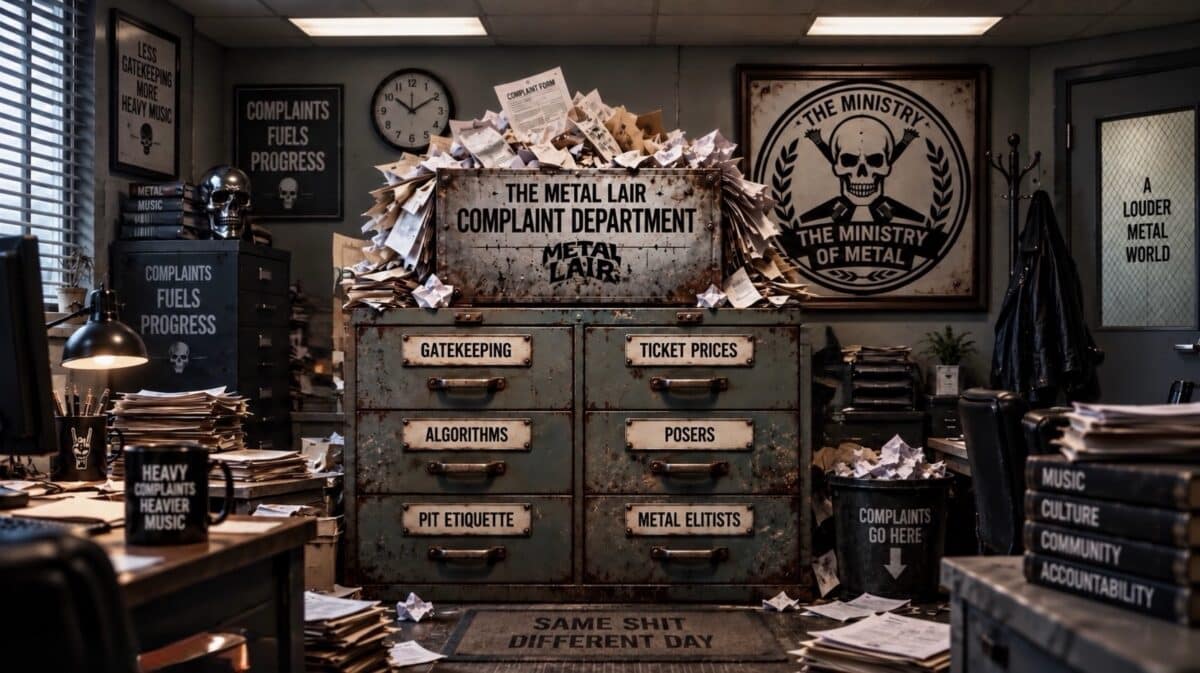
FILE A COMPLAINT WITH THE METAL LAIR COMPLAINT DEPARTMENT
Have a metal-related grievance that needs official investigation?
Bad concert etiquette? Venue bullshit? Festival fuckery? A trend in metal that needs to die? An industry annoyance? Something that’s been pissing you off since 1987? Have a complaint against Metal Lair?
FILE YOUR COMPLAINT
File it with the Complaint Department. Remmy may investigate your grievance in a future installment.
Selected grievances may be investigated, mocked, dissected or otherwise subjected to the questionable judgment of Remmy Chillmister in a future edition of The Metal Lair Complaint Department.
Submission does not guarantee investigation. Remmy has a substantial backlog of things that piss him off.

No algorithms. No fluff. No watered-down corporate metal coverage.
Subscribe to Metal Lair and get weekly underground features, Seven Deadly Songs, Deep Cuts, interviews, and original metal journalism sent directly to your inbox.

Join the patrons of Metal Lair
MetalLair.net is a metal zine muttering to itself about seo and blastbeats at 3 AM powered by caffeine, riffs, a severe lack of sleep, and a dog wondering why the human is still awake.
Sometimes it’s Kevin passing out mid Seven Deadly Songs.
Sometimes it’s digging up forgotten records no one else is talking about.
Always, it’s built for people who actually live this music.
If that sounds like you, you’re already one of us.
Supporting Metal Lair means keeping it independent, loud, and real with no corporate filters, no watered-down takes. If you want to help keep it alive…
Become a patron of Metal Lair.