Written By Caine Blackthorn
For years, the music industry couldn’t stop writing heavy metal’s obituary. Rock was dead, metal was dying.
Young people supposedly had the attention span of a goldfish surviving exclusively on energy drinks, thirty-second TikTok clips and disposable pop hooks manufactured by an algorithm. Funny thing, nobody bothered to tell Gen Z.
Go stand at the barricade during Iron Maiden. Walk through the campgrounds at Wacken. Wander the merch lines at Hellfest. Spend twenty minutes on metal TikTok or Reddit.
The faces staring back aren’t the same ones that were there twenty years ago.
They’re younger, they’re buying vinyl and band merch. They’re discovering Mercyful Fate, Dio, Judas Priest, and Candlemass for the first time.
They’re packing festivals, collecting patches, arguing over the best Black Sabbath lineup, and somehow keeping both Iron Maiden and Lorna Shore in the same playlist without suffering an identity crisis.
The old stereotype said young listeners skipped from trend to trend without ever forming a real connection to music. Heavy metal appears to be proving the exact opposite.
Spotify’s Culture Next research found that Gen Z uses streaming to dive deeper into the artists and communities they love rather than simply consuming whatever is trending. Heavy metal fits that behavior remarkably well. Fans follow artists, revisit albums, and spend years exploring back catalogs instead of chasing the newest single.
Spotify has previously reported that heavy metal listeners rank among the platform’s most loyal audiences. They follow artists instead of simply adding songs to playlists, returning to the same bands and albums more consistently than listeners in many other genres.
They consume complete albums. They dig through decades of back catalogs instead of chasing the newest single. In an era obsessed with disposable content, heavy metal has quietly become one of the internet’s least disposable genres.
Attention spans aren’t dead. People just have to find something worth paying attention to.
The New Gateway Isn’t MTV. It’s the Algorithm.
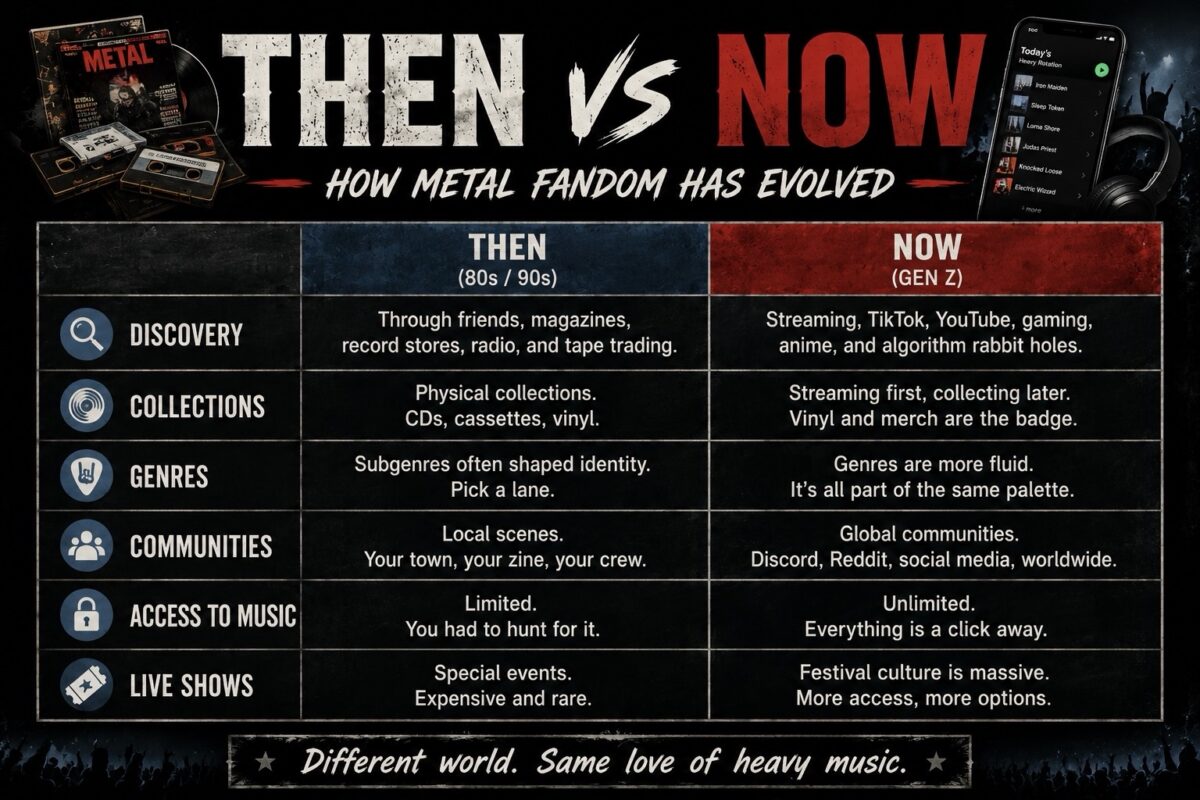
Ask someone over forty how they discovered metal and you’ll probably hear the same stories.
A friend handed them a dubbed cassette. An older sibling blasted Master of Puppets through a bedroom wall.
They wandered into a record store looking for one band and walked out with three. Discovery was slow and mostly local. It depended on who you knew.
Gen Z inherited an entirely different ecosystem. Instead of a record store clerk, they have Spotify’s recommendation engine.
Instead of Headbangers Ball, they have TikTok. Instead of waiting for MTV to play one video after midnight, they have YouTube rabbit holes that never end.
One viral moment becomes an entire musical education.
When Eddie Munson played Metallica’s “Master of Puppets” on Stranger Things, millions of teenagers didn’t just hear one song, they found a gateway.
The same thing happens through Doom soundtracks, Cyberpunk, anime, gaming culture, reaction channels, and short-form social media. A thirty-second clip becomes a Spotify search. Spotify recommends another band. Then another.
Before long, someone who arrived looking for Metallica is debating whether Painkiller or Screaming for Vengeance is Judas Priest’s greatest album. That’s not algorithmic manipulation, that’s digital crate digging.
Metal Without Borders
For older generations of metalheads, identity often came with invisible borders.
You were the thrash guy, the death metal girl, the black metal purist, the glam fan or the progressive metal nerd.
Every subgenre had its own tribe, its own unwritten rules, and usually at least one gatekeeper insisting everything outside that circle wasn’t “real metal.” It wasn’t entirely irrational. Back then, music was scarce.
Records were expensive. Magazines covered only so much ground. Discovering a new band often required luck, tape trading, or a recommendation from someone whose taste you trusted. Scarcity naturally created tribes.
Streaming destroyed scarcity
In the ’80s, finding a demo from an underground Swedish death metal band took effort. That effort became part of your identity. Today, the same band is two taps away on Spotify.
That changes the culture whether people like it or not.
Today’s younger fans grew up with virtually every metal album ever recorded sitting inside the same app. The result isn’t confusion, it’s curiosity.
To a nineteen-year-old metalhead, Iron Maiden, Sleep Token, Knocked Loose, Electric Wizard, Spiritbox, and Type O Negative aren’t competing for territory. They’re simply different colors on the same palette.
One playlist can jump from traditional heavy metal to deathcore, synthwave, gothic rock, doom, hardcore, and alternative pop without anyone feeling obligated to defend the transition.
Some metal fans see that as a lack of identity. I see something else: freedom.
Ironically, the generation accused of having the shortest attention span may also be the least interested in putting music inside neat little boxes.
What changed isn’t that Gen Z invented eclectic taste. Plenty of older metalheads have always had it. What changed is access.
In 1987, if you bought Reign in Blood, that was probably your album for the week because you had just spent twenty bucks. Today, a teenager can listen to Reign in Blood, Sunbather, Take Me Back to Eden, and a Japanese blackgaze demo before lunch without spending a dime beyond a streaming subscription.
Metalheads have been arguing over what counts as “real metal” since before half of us were born.
Somewhere, an old-school gatekeeper just muttered, “that isn’t real metal.”
Looking for the artists leading this new generation? Check out our guide to 23 Gen Z Metal Bands Breaking Metal’s Rules in 2026.
About The Author
Caine Blackthorn writes music news, trending topics, commentary, and feature pieces for Metal Lair with a focus on the shifting culture surrounding rock and heavy metal. From rising ticket prices and touring collapse to legacy artists, industry absurdity, and the changing soul of live music, his work blends sharp observation with the grit, humor, and frustration of the scene itself. Whether covering modern chaos or metal history, Caine approaches heavy music as something lived through, not simply reported on.
Read More From This Author:
EVERY BAND IS NOW A CONTENT CREATOR
Digital DNA or Artificial Sacrilege? The Battle Over Ozzy’s Immortal Avatar
No algorithms. No fluff. No watered-down corporate metal coverage.
Subscribe to Metal Lair and get weekly underground features, Seven Deadly Songs, Deep Cuts, interviews, and original metal journalism sent directly to your inbox.
Join the patrons of Metal Lair
MetalLair.net is a metal zine muttering to itself about seo and blastbeats at 3 AM powered by caffeine, riffs, a severe lack of sleep, and a dog wondering why the human is still awake.
Sometimes it’s Kevin passing out mid Seven Deadly Songs.
Sometimes it’s digging up forgotten records no one else is talking about.
Always, it’s built for people who actually live this music.
If that sounds like you, you’re already one of us.
Supporting Metal Lair means keeping it independent, loud, and real with no corporate filters, no watered-down takes. If you want to help keep it alive…
Become a patron of Metal Lair.
6 thoughts on “The New Wave of Metalheads: How Gen Z Fell in Love With Heavy Metal”
Comments are closed.