Written By Metal Lair Mick
The Synthetic Ceiling: Why Al Music Is Hitting a Hard Limit
The End of the Honeymoon
The AI music revolution was sold to us as the ultimate democratization of art. It was pitched as a zero barrier studio that would let anyone manifest their internal soundtrack.
For a while, the hype felt justified. The speed of generation was a rush, and the novelty of hearing a machine conjure a melody from a few lines of text was enough to mask the underlying cracks.
But as we move further into 2026, that initial thrill is rapidly fading, replaced by a growing realization that we have walked into a digital cul de sac.
The technical bubble is not just leaking. It is hitting a hard ceiling. We are witnessing a form of technical insolvency, where these models have essentially spent their creative capital (that vast, stolen treasure trove of human history) and are now forced to live off their own interest by training on their own synthetic output. The cracks in that foundation are now impossible to ignore.
The Maze of Dead Ends
I started using these tools years ago, genuinely curious to see if they could act as a partner in the creative process. I wanted to see if I could push them toward styles that were underdeveloped or did not quite exist yet.
I wanted the fringe sounds that human producers might overlook. What I found was that the more effort you put into pushing these boundaries, the faster the fuel runs out.
I expected the platform to lead me down an exciting rabbit hole with infinite possibilities. Instead, I found a maze of dead ends.
The Sybreed Paradox
I spent at least a hundred hours experimenting with mixing metal into other genres to make hybrids, or conceptualizing what a defunct band might sound like if they dropped a surprise comeback album.
I have no intention of ever releasing these into the wild, as it is all for amusement/ experimenting only. I challenged these platforms to capture the nuance of bands that define complex architecture.
Take Sybreed, for instance; a band so uniquely difficult to replicate that I would rate them a 9.7 out of 10 on an AI resistance scale.
Their sound is a masterclass in the “Industrial Human Paradox,’ marrying rigid, cold industrial percussion with vulnerable, emotive vocals that an AI simply cannot reconcile.
Their proprietary “Death Wave” groove, a rhythmic elasticity that possesses a human led bounce, constantly causes AI models to trigger logic errors; the platforms either “quantize’ the life out of the beat, turning it into a sterile grid, or fail to capture the malicious, calculated aggression of their compositions.
Even across four distinct album eras, from the raw architecture of Slave Design to the high definition, machine like cruelty of God Is an Automaton, the AI consistently fails to handle the “vicious precision” and the co dependent frequency management where synths and guitars fight for space in a singular, dystopian blast of sound. (Thankfully, they are back in the studio making new music, can not wait to hear it!). The struggle extends to giants of complexity.
I pushed for the erratic, through composed insanity of Between the Buried and Me, which earns an AI resistance rating of 9.7, but the platforms always folded, unable to handle the non repeating melodic arcs and jarring transitions that define their work.
Similarly, I attempted to capture the cinematic, slow burning crescendos of Godspeed You! Black Emperor, an absolute titan of resistance that I rate at 9.8, only to watch the AI lose the plot entirely, drifting into repetitive, looping textures that lack the structural patience and haunting, organic development that makes their long form movements human.
Pushing these platforms to their absolute limit eventually felt like kicking a dead horse. After years of extracting what essence I could, the limitations have become glaring.
As the developers hack the platforms apart to appease legal teams and simplify their models, the experience has shifted from creative exploration to a frustrating encounter with the inevitable bubble burst.
Every time I tried to nudge the AI toward a genuinely new or complex musical structure, it reverted to the statistical mean. It is a recurring frustration. These tools do not lead to unfound territory. They lead back to the center of the road.
Does the ease of AI music creation actually raise the bar for what we consider valuable, or are we simply becoming desensitized to the process of creation itself?
The Hybrid Illusion
To be clear, the bubble bursting does not mean AI music is going to disappear. For some, these tools have found a home as digital sketchpads. We are seeing a shift toward agentic workflows, where the goal is not just one click generation, but iterative refinement.
But make no mistake: this is a long way from the creative partner we were promised. For any musician who actually values the manual, tactile process of building a song, these tools feel less like a studio and more like a high tech coloring book.
Sure, you can use them to extract stems or test a structure before moving to a real DAW, but it is a cold, clinical shortcut. The tech has not solved the creative process. It has just accelerated the boring parts, often at the cost of the very soul that a human producer pours into every frequency.
The hybrid reality is not a beautiful marriage of tech and art; itis a survival mechanism for a market now flooded with generic, undifferentiated synthetic slop that makes it harder for real work to get noticed.
Static Engines vs. Human Consciousness
The broader hype cycle is undoubtedly hitting a plateau. Much like social media in its early days, AI music was treated as a transformative breakthrough.
But here is the difference: social media succeeds because it relies on the infinite variety of human consciousness, a shifting, unpredictable pool of diverse thoughts, ideals, and experiences. Al models, by contrast, are static engines of probability.
They cannot replicate the chaotic, messy, and ever evolving nature of human consciousness, which is exactly why they struggle to remain fresh over time.
The Myth of the Pro-Grade Studio
The platforms have banked their entire business model on the seductive promise that anyone can make something amazing, and they have spent millions marketing that fantasy.
By hiring legendary producers to endorse their tools, they have managed to dress up a basic statistical engine as a pro grade studio.
It is a compelling sell for a subscriber, but it devalues the very thing it claims to provide. You are paying for a service that promises unlimited creative potential, but you are receiving a tool that is being systematically lobotomized.
As these platforms mature, they attempt to mask this loss of control by introducing advanced features like personas and creative sliders. They invite you to dial in your intent, giving you a toggle to oscillate between random, unhinged experimentation and focused, safe production.
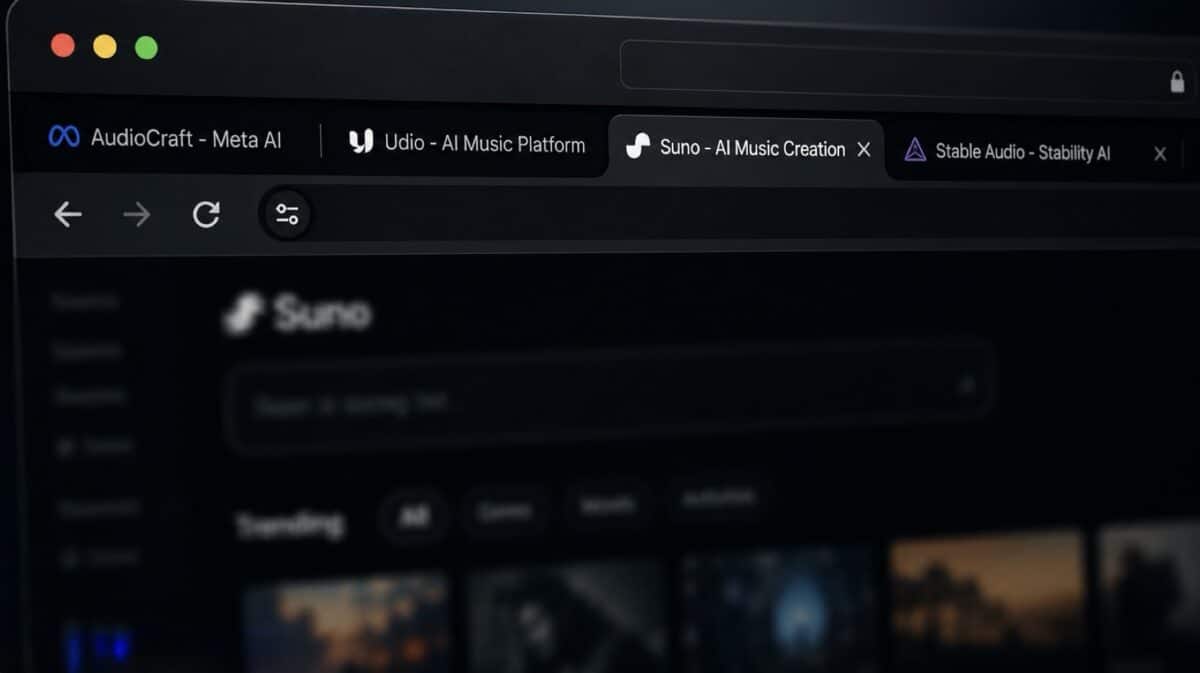
But it is a gilded cage. No matter how far you push these sliders, whether on Suno, Udio, or the latest agentic music suites, the final output always remains partly outside your control.
These controls are merely suggestions to the underlying engine; they act as a guide, never a strict instruction. Its rules are not yours to bend. Therein lies the fundamental limitation: you are always working within the narrow confines of the model’s preprogrammed probability.
The extinction of variety is not a bug; it is an inherent design choice that the marketing material conveniently ignores.
The Crisis of Digital Inbreeding
This brings us to the inbreeding crisis. Think of the model training data like a family tree. In the beginning, these systems were fed a wide, diverse forest of human music. They had rhythms, textures, and quirks learned from thousands of real world artists.
That initial, aggressive ingestion of human ingenuity was the engine of their success. It had a massive genetic pool to draw from.
But now, as companies face legal pressure and tighten their guardrails to appease record labels and artists, they are demolishing that diverse forest and focusing into finding their single perfect tree, which they can genetically play with. They are purging the unlicensed complexity and retraining their models on their own Safe, synthetic output.
By cutting off access to the rich, human authored branches of the family tree, they are forcing the model to reproduce based on a narrow, sterile pool of its own echoes. The tree is literally cutting off the limbs it needs to grow.
Every successive version becomes more predictable and more average because it is no longer learning from the wild, messy edges of human expression. It is only learning from its own previous generations.
If an AI model is restricted to learning only from safe and compliant data, can it ever produce anything truly transformative, or is it destined to become a mirror of our own industry’s caution?
The Hallucination of Coherence
This collapse in diversity is compounded by a persistent technical failure: the AI hallucination effect. Even as the audio quality reaches higher fidelity, these models still struggle to grasp the concept of a song.
They are masters of the microsecond but failures at the macro structure. You will get a track with stunning production values that nonetheless fails to maintain any logical identity.
The melody drifts, the instrumentation loses its anchor, and the structure devolves into a disjointed mess because the model forgets the beginning of the track by the time it reaches the bridge. There is no overarching intentionality, no narrative arc, and no human ingenuity.
There is just a series of algorithmic next best guesses that eventually lose the plot. For the experienced user, it is becoming clear that these tools appear to be losing their impressiveness.
We are witnessing a slow motion collapse where the refined models increasingly seem less capable of the genre bending, experimental work than their wilder, early stage predecessors.
The companies seem to be effectively training their tools into mediocrity. As the novelty of instant music wears off, we are left with a service that costs money but offers less and less creative utility.
The Illusion of Infinite Choice
The more these platforms try to force a machine to be an artist, the more they prove that human ingenuity is the one thing they simply cannot replicate.
We have spent years chasing the idea that technologicalscale could bypass the human experience, but the result is a landscape littered with hollow, repetitive artifacts.
The bubble is bursting because the industry is finally reaching the limit of what statistical probability can achieve. As long as these tools work as a sketchbook for a musician, people will pay for them. But the polish is buffing off for the power users who have discovered that the value ends when the tool devolves into limited samplings, sounds, and styles.
This is the exact same exhaustion we see in AI voice cloning. Just as AI content generators have ground the novelty of Morgan Freeman, David Attenborough, Ice Cube, or Scarlett Johansson esque voices into the dirt by overusing them until they sound like caricatures, AI music platforms are narrowing their vocal and instrumental range to a handful of commercially safe archetypes.
You start to hear the same programmed breaths, the same synthetic rasp, and the same predictable cadence in every track. The system is limiting the pool of sounds through its compliance constraints, becoming homogeneous and stale. It is a digital echo chamber where every new song is just a slight remix of the last one.
Where do you draw the line between using a tool to accelerate your workflow and letting the tool dictate the boundaries of your creativity?
A Final Thought on the Future of Sound
Ultimately, this is not the end of music, but it is the beginning of the end for the AI artist as a viable commodity. As the hype dies, the market is realizing that cheap, fast, and infinite is not the same as good.
We are trading the messy, imperfect, and deeply human heart of music for a polished, sterile loop. If this article has a purpose, it is to serve as a reminder that tools are only as good as the intention behind them.
When we prioritize the production of content over the process of creation, we lose the very thing that made us want to create in the first place.
Whether you are a proponent of AI generated music or a vocal skeptic, it is worth asking yourself what you are actually listening for, and whether you are okay with a future where the music is generated, but never truly heard.
About The Author:
Metal Lair Mick has been part of the Metal Lair journey since its earliest days, helping support the project long before the website existed.
Based in Australia, he combines a lifelong love of heavy music, gaming, and underground culture with an eye for bands that challenge expectations.
Whether covering established legends or discovering the next beautifully chaotic act, he believes the best metal should always leave an impression.
Read More From This Author:
Netherwilds: Return The Goat Review – The Soundtrack for Your Next Mount & Blade Campaign
Sybreed Reawakens: Drop and Ben Reflect on Antares, Pulse of Awakening, and God Is an Automaton
Enter Cybrid: A Look into Sybreeds Evolution

No algorithms. No fluff. No watered-down corporate metal coverage.
Subscribe to Metal Lair and get weekly underground features, Seven Deadly Songs, Deep Cuts, interviews, and original metal journalism sent directly to your inbox.

Join the patrons of Metal Lair
MetalLair.net is a metal zine muttering to itself about seo and blastbeats at 3 AM powered by caffeine, riffs, a severe lack of sleep, and a dog wondering why the human is still awake.
Sometimes it’s Kevin passing out mid Seven Deadly Songs.
Sometimes it’s digging up forgotten records no one else is talking about.
Always, it’s built for people who actually livethis music.
If that sounds like you, you’re already one of us.
Supporting Metal Lair means keeping it independent, loud, and real with no corporate filters, no watered-down takes. If you want to help keep it alive…
Become a patron of Metal Lair.