An Op-Ed Written By Lucien Drake
Gatekeeping in Metal Culture
Metal has historically positioned itself as music for outsiders. The misfits, the misunderstood, the people who didn’t conform to conventional society. Yet certain corners of its community have constructed their own rigid hierarchies of acceptable appearance, identity, musical taste and behavior.
The counterculture becomes its own establishment. The rebels become the conformity police. And apparently nobody notices the irony.
Rock and metal culture is for those who never quite fit into society’s neatly compartmentalized little boxes. It gives people somewhere to belong when they feel they belong nowhere else.
So when did some of those outsiders become so determined to decide who else was allowed inside?
There is something profoundly absurd about a culture that prides itself on rebellion while occasionally displaying the very intolerance, conformity and judgmental behavior it claims to reject.
And perhaps it’s time we had an uncomfortable conversation about it.
What the Hell Does Any of It Have to Do With Music?
What difference does it make what color someone’s skin is? Who they choose to love? Whether they are male, female, transgender or nonbinary?
Does any of that automatically determine whether someone can write an extraordinary song, play a blistering guitar solo, deliver a devastating vocal performance or compose something capable of moving another human being? Of course not.
Musical talent doesn’t come with a predetermined skin color, sexual orientation or gender. Nobody possesses a monopoly on creativity simply because they were born into a particular demographic.
Judge people by their character, their actions and how they treat others, not by their skin color, gender or who they love. That doesn’t mean we have to excuse harmful behavior. Artists are accountable for their actions just like everyone else. Listeners are equally entitled to make their own ethical decisions about whom they support.
But judging somebody purely on their identity before you’ve even heard what they have to offer? That’s prejudice, plain and simple. The same double standard applies to a musician’s age, as Sabbatha Ashvale explores in Unveiling Ageism in Music.
For all the conversations surrounding authenticity in metal, perhaps we should spend a little more time discussing the authenticity of our own values.
The Great Metal Purity Test
Apparently, enjoying heavy music isn’t enough anymore.
You must enjoy the correct heavy music, from the correct era, performed by the correct musicians, wearing the correct clothing and possessing the appropriate level of underground obscurity.
And God forbid somebody becomes commercially successful. Their artistic credibility must immediately be confiscated at the door.
Enjoy Slipknot? Somebody will inevitably inform you that they’re not real metal. Listen to metalcore? Prepare your defense. Appreciate a young rock artist who happens to appeal to a mainstream audience? Congratulations, you’ve apparently committed an act of cultural treason. It’s exhausting.
Black metal, death metal, thrash, doom, power metal, progressive metal, nu metal, metalcore, industrial metal, symphonic metal and the countless experimental hybrids that exist between them all have audiences. Nobody is asking you to love every one of them.
Understanding musical genres is valuable. Genre classifications help us explore music, understand its history and identify stylistic characteristics. There is absolutely nothing wrong with discussing whether a particular artist belongs within a particular genre.
The problem begins when musical classification becomes a weapon for attacking other people.
Knowing the difference between death metal and deathcore doesn’t make you morally or intellectually superior to somebody who enjoys both. It just means you understand the different genres.
Rock and Metal Do Not Exist in a Vacuum
Metal did not emerge from some primordial abyss completely untouched by other musical genres.
Its history is intertwined with blues, hard rock, psychedelia, classical music, punk and countless other artistic influences. Musicians continue to borrow, experiment, collaborate and venture outside their established territory. That cross-pollination is part of what keeps music alive.
A country artist can collaborate with a metal musician. A pop singer can deliver an exceptional rock performance. An experimental vocalist can explore darkness more effectively than a band equipped with seven-string guitars and an entire wardrobe of black clothing.
Acknowledging these artistic connections doesn’t require us to misclassify anybody.
There is room within rock and metal journalism to explore the artists, influences, personalities and cultural movements that exist beyond the strict boundaries of metal itself without inciting a riot. Curiosity isn’t betrayal.
Racism, Sexism and the Selective Nature of Rebellion
For a culture that celebrates defiance, heavy metal can be strangely selective about whose defiance it celebrates.
Women still encounter people who question their musical knowledge, technical abilities and credibility based on their gender. Musicians from different racial backgrounds can find themselves confronting assumptions about whether they belong within a particular scene. LGBTQ+ artists and fans sometimes face hostility for simply existing openly.
These experiences are not universal, and many metal communities are genuinely welcoming. But the existence of welcoming communities does not erase the experiences of those who have encountered prejudice.
Women shouldn’t have to demonstrate twice the technical proficiency of their male counterparts to be taken seriously. Nobody should have to defend their ethnicity before picking up a guitar. A musician’s sexual orientation shouldn’t become the primary subject of discussion when they’ve just released an extraordinary album.
Can we please get back to the fucking music?
The Disappearing Art of Discernment
Not everything is going to appeal to you. That is perfectly normal.
I encounter music every day that does absolutely nothing for me. I don’t feel compelled to hunt down the musicians, insult their fans or announce my displeasure beneath every article written about them. I simply listen to something else.
Somewhere along the way, the ability to exercise personal discernment seems to have been replaced by the perceived obligation to publicly condemn everything that doesn’t cater to our individual preferences.
You don’t have to read every article a publication releases. You don’t have to follow every band. You don’t have to attend every festival, purchase every album or participate in every conversation. Scroll past. Unfollow. Find something that interests you.
The internet is enormous. Your personal dislike of something does not necessitate its removal from everybody else’s experience.
Criticism can be intelligent, entertaining, insightful and necessary. Some of the most interesting conversations about music begin with disagreement.
But there is nothing particularly insightful about mob mentality and repeatedly telling strangers that their musical tastes are shit.
Social Media Hostility and Mob Mentality
One of the ugliest things about social media is how quickly a disagreement can turn into a public pile-on. Somebody makes an accusation, others repeat it, and before long people are attacking someone whose work they may not even have bothered to read or listen to. Since when did the number of people repeating an accusation determine whether it was true?
If someone has genuinely harmed others, investigate the facts. Listen to the people affected. Hold them accountable. But there is a difference between accountability and joining a mob because everybody else is doing it. You don’t have to participate in the public humiliation of another human being to demonstrate that you have principles.
Have the backbone to go against the grain when the evidence warrants it. You can disagree with the crowd. If you don’t know enough about the situation to form an accurate opinion, educate yourself. And if your only contribution is another insult hurled at a stranger, ask yourself what the hell you’re actually accomplishing.
For a community that prides itself on independent thinking, blindly following the loudest voices in a comment section is a rather peculiar form of rebellion. For a look at artists who refused to buckle under public pressure, read Remmy Chillmister’s Louder Than Fear: 16 Artists Who Risked Their Careers for What They Believed.
And Now Everything Is Apparently AI Slop
Another increasingly tiresome phenomenon is the tendency to dismiss anything somebody dislikes as AI slop.
There are entirely legitimate concerns surrounding artificial intelligence, particularly within creative industries. Uncredited work, copyright infringement, AI reskinning, fabricated information, misleading imagery and the displacement of artists deserve serious discussion.
But not everything you encounter online was generated by artificial intelligence. Not every photograph is synthetic. Not every publication that incorporates AI into some aspect of its workflow has abandoned human creativity or editorial judgment.
Human writers, photographers, editors and independent contributors are increasingly finding their work subjected to these blanket accusations, often without any meaningful examination of the work itself.
If a publication has fabricated information, stolen artwork or misrepresented somebody’s creative work, those are legitimate criticisms.
If an article is poorly researched or badly written, explain why.
Simply typing “AI slop” beneath something you don’t like isn’t an argument. It’s becoming another convenient way to dismiss creative work without engaging with it.
The technology deserves scrutiny. So does the quality of the criticism directed at it.
You Don’t Have to Like Everything to Respect Its Right to Exist
Metal doesn’t need everybody to agree. In fact, disagreement is part of what makes music culture interesting. We can fight over albums, debate musical evolution, question artistic decisions and passionately defend the music we love.
What we don’t need is a community in which people are intimidated into silence, embarrassed about their musical preferences or discouraged from exploring something outside their established tastes.
Nor should independent music publications be expected to restrict their editorial coverage according to the personal preferences of the self-appointed gatekeepers and become systematically bullied into submission.
There are musicians across the world creating extraordinary work under circumstances many of us cannot begin to imagine. Different cultures, identities and musical traditions bring entirely different perspectives to the creative process. Why the fuck would anybody want less of that?
Metal has given generations of people permission to be different. Perhaps we should extend that same courtesy to one another.
Enjoy what you like. Critique what you dislike. Defend your convictions. Exercise discernment and stay curious. And remember that being a metalhead doesn’t require you to be an asshole.
Nobody is born hating another human being because of the color of their skin, their gender or their sexual orientation. These prejudices are learned and absorbed from our social circles, cultural influences and online communities.
But just because you were taught something doesn’t mean you’re obligated to carry it for the rest of your life. Reexamine where those beliefs came from. Question them. Exercise critical thinking and decide for yourself whether they have any merit.
There is something particularly disturbing about passing hatred down from one generation to the next without ever questioning its origins. If heavy metal is about challenging conformity and thinking for yourself, perhaps that philosophy should extend beyond your record collection.

Read More From Lucien Drake
Harry Drumdini, The Cramps Drummer, Dies at 60 Following Cancer Battle
Would You Buy Metal Festival Tickets Without Knowing the Lineup? The Great Festival Gamble
Halestorm Set the CMA Awards on Fire, and Country Fans Lost Their Minds
Rock & Metal Website Directory: 192 Publications Worldwide
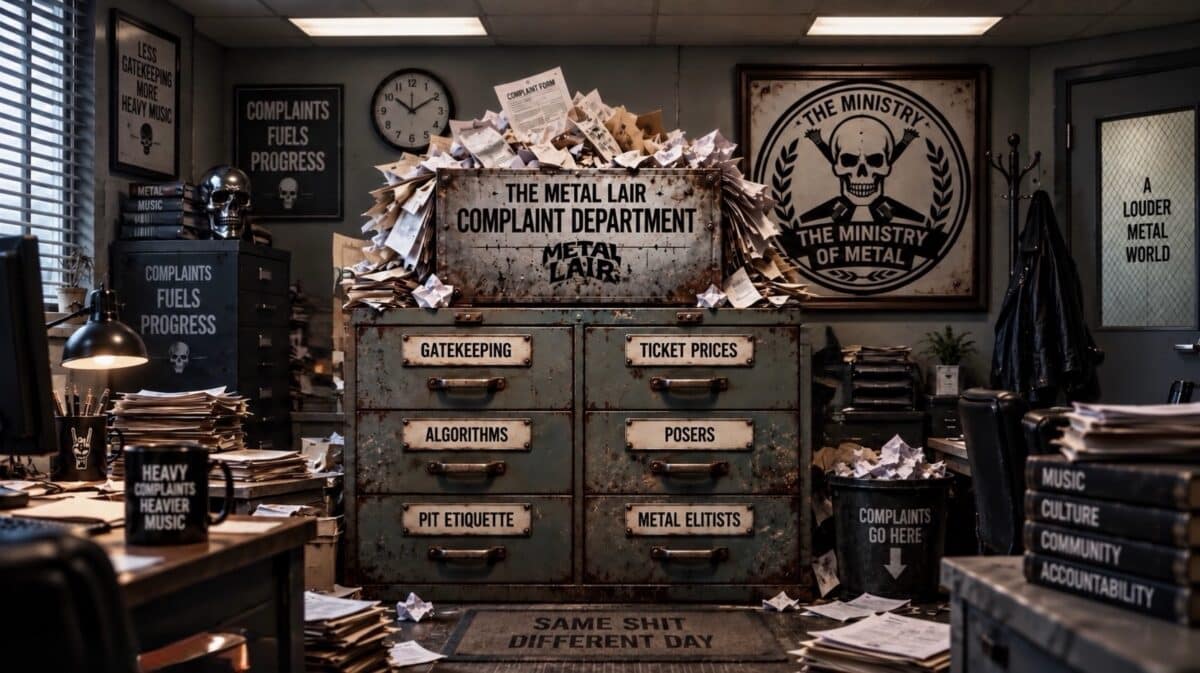
FILE A COMPLAINT WITH THE METAL LAIR COMPLAINT DEPARTMENT
Have a metal-related grievance that needs official investigation?
Bad concert etiquette? Venue bullshit? Festival fuckery? A trend in metal that needs to die? An industry annoyance? Something that’s been pissing you off since 1987? Have a complaint against Metal Lair?
FILE YOUR COMPLAINT
File it with the Complaint Department. Remmy may investigate your grievance in a future installment.
Selected grievances may be investigated, mocked, dissected or otherwise subjected to the questionable judgment of Remmy Chillmister in a future edition of The Metal Lair Complaint Department.
Submission does not guarantee investigation. Remmy has a substantial backlog of things that piss him off.
No algorithms. No fluff. No watered-down corporate metal coverage.
Subscribe to Metal Lair and get weekly underground features, Seven Deadly Songs, Deep Cuts, interviews, and original metal journalism sent directly to your inbox.
Join the patrons of Metal Lair
MetalLair.net is a metal zine muttering to itself about seo and blastbeats at 3 AM powered by caffeine, riffs, a severe lack of sleep, and a dog wondering why the human is still awake.
Sometimes it’s Kevin passing out mid Seven Deadly Songs.
Sometimes it’s digging up forgotten records no one else is talking about.
Always, it’s built for people who actually live this music. If that sounds like you, you’re already one of us.
Supporting Metal Lair means keeping it independent, loud, and real with no corporate filters, no watered-down takes. If you want to help keep it alive…
Become a patron of Metal Lair.
1 thought on “When Metal Became Its Own Establishment: Gatekeeping, Prejudice and the Collapse of Civilized Discourse”
Comments are closed.