Written By Lucien Drake
Behemoth I, Scvlptor Review: Darkness Rebuilt in 2026
Few extreme metal bands have managed to achieve what Behemoth have accomplished across more than three decades.
Emerging from Poland’s underground in the early 1990s, the band evolved from its black metal origins into one of the most internationally recognized and influential forces in extreme music, building a career in which artistic ambition and commercial success have increasingly occupied the same unlikely territory.
That trajectory reached a defining moment with 2014’s The Satanist. Behemoth’s tenth studio album debuted at No. 34 on the Billboard 200, at the time an extraordinary American chart showing for a record rooted in blackened death metal. Nergal himself described the result as “unheard of” and called the album a game changer in the band’s history.
The critical response was even more emphatic. The Satanist received a Metacritic score of 92 and appeared prominently throughout the metal press’s year-end rankings, including No. 6 at Revolver and No. 8 at Kerrang!. It won Album of the Year at Metal Hammer’s Golden Gods Awards and received Poland’s prestigious Fryderyk Award.
Its reputation only grew with time. Five years after its release, Loudwire named The Satanist the Metal Album of the Decade, describing the record as a landmark work born from a period of extraordinary adversity and artistic transformation for Nergal and Behemoth.
In other words, Behemoth have already done it.
They’ve earned the accolades. They’ve invaded the mainstream charts without sanding down the edges of their music. They’ve made the career-defining album. They’ve survived long enough to become elder statesmen of extreme metal without ever particularly behaving like elder statesmen.
That refusal to behave has extended well beyond the music. Behemoth remain frequent targets of religious outrage and censorship, a battle Metal Lair recently explored in “Metal, Censorship, and the Old War That Never Ends.”
So, naturally, I have one question.
What the fuck are Behemoth still trying to prove?
Maybe nothing.
Maybe they’re taking thirty-five years of accumulated musical DNA, throwing it onto the operating table and saying:
This is where we came from. This is what made us. This is what we are now. And here’s where we might be going.
Seriously. Who do these bastards think they are putting out music this magnificent after they’ve already won the awards, conquered the charts and recorded an album routinely discussed as a modern extreme-metal masterpiece?
Gentlemen. You’ve won.
Leave something for everybody else.
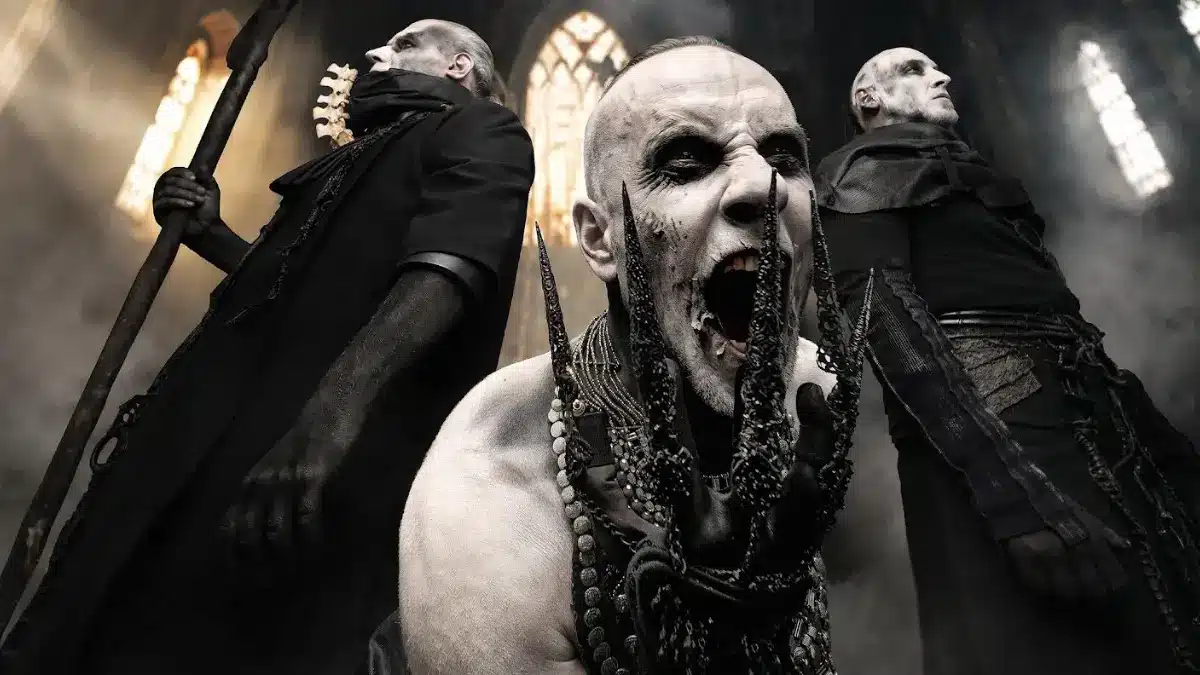
Behemoth I, Scvlptor Track By Track Breakdown
I, Scvlptor
The album opens with its title track, “I, Scvlptor,” and frankly, it sets the bar almost unfairly high. This is my favorite track on the record.
The guitar work is absolutely vicious, with riffs that feel enormous without sacrificing definition, while the drums hit with a precision and physical force that keep the whole thing surging forward.
But Nergal’s voice is what gives the song its infernal center of gravity. His rough vocals are extraordinarily deep and guttural here, less like conventional extreme-metal growls than something that crawled upward after the earth cracked open and Hell discovered an exit.
It is ominous, masculine, commanding and genuinely sinister rather than theatrically evil. When the full band locks together behind him, “I, Scvlptor” becomes one of those tracks where every component feels exactly where it belongs. The guitars in particular are fucking phenomenal.
And then there is the video. Shot entirely in oppressive black and white, the visual world of “I, Scvlptor” looks like the original Mad Max wandered into Silent Hill after the warning sirens sounded and never found its way back out.
Wind tears across a barren landscape while dirt and sand whip through the air. Strange wooden shack-like structures bearing crosses stand in the wasteland.
Figures wrapped head to toe in filthy white cloth drift through the scenery like displaced Silent Hill creatures, while processions of people in long black robes and pointed hoods turn other scenes into some nightmare religious ceremony.
The body horror starts almost immediately. An inverted cross carved and stitched into human flesh begins pulling itself open at the seams.
A young girl appears with no eyebrows or eyelashes and enormous black eyes. A woman’s face crawls with insects. Another figure exposes rotted black teeth while actual bugs move in and out of the mouth, an image made considerably worse by how disturbingly real it looks.
Elsewhere, bodies hang upside down with filth dripping from them while hooded figures gather nearby. Rows of what resemble human faces hang like masks, looking less manufactured than peeled away from the people who once owned them.
And somehow it keeps getting stranger. Gigantic human heads are being carved out of the landscape, an image that beautifully echoes Nergal’s description of the song as an exploration of the endless act of shaping oneself.
A black-cloaked figure holds an enormous black pillar candle as wax melts rapidly down its length and pours over black-gloved hands. There are monumental structures, ritual gatherings and human bodies treated alternately as flesh, sculpture and religious objects.
The entire video feels tactile and diseased. You can practically feel the grit in the wind, the wet wax, the rough cloth and the insects crawling over skin.
Yet among all this human corruption are two oddly serene images: a dove held in someone’s hands and a horse standing quietly against a sheet snapping in the wind. Neither animal is harmed or transformed into something grotesque.
In a world where human beings are mutilated, concealed, suspended, carved and ritualized, the animals simply exist. Whether that contrast was deliberately intended as symbolism or not, it’s difficult not to read something into it: perhaps the only truly innocent creatures inhabiting this hellscape are the ones that didn’t create it.
There are moments when the video feels less like a conventional metal promo than an artifact recovered from somebody else’s apocalypse. Its imagery is grotesque without becoming cheap, surreal without becoming meaningless and deeply disturbing while remaining strangely beautiful.
Most importantly, none of that visual theater compensates for a weak song. The song is every bit as powerful as the nightmare built around it.
“I, Scvlptor” is Behemoth operating at an exceptionally high level: monstrous vocals, outstanding drumming, phenomenal guitars and a video so dark, unhinged and visually arresting that individual frames stick in the brain after it’s over.
If the rest of the album had simply tried to survive its opening track, I wouldn’t have blamed it.
Lord Ov The Horizons
“Lord Ov The Horizons” is one of the prettiest surprises on I, Scvlptor. It opens slowly with melancholy guitars and Nergal singing cleanly, and damn, the man has a genuinely beautiful voice when he gives the gutturals a night off. The restrained opening gives the song an almost mournful quality before everything begins to darken.
When the harsh vocals finally arrive, Nergal doesn’t simply fall back into his familiar growl. He sounds even more ferocious than usual, dropping into a particularly demonic register that recalls those rare moments when a vocalist suddenly goes somewhere deeper and nastier than their signature sound.
The transformation works because the song gives it room to breathe: melancholy and restraint gradually give way to something genuinely menacing.
The chorus brings the weight crashing back in, but the track never loses that strange beauty underneath it. It is slow, atmospheric, heavy and unexpectedly melodic, and easily one of my favorites on the record.
The album closes with a rough studio mix of the same song, and perhaps perversely, I prefer it. The polished version is excellent, but the rough mix has a little more dirt under its fingernails. Sometimes the monster looks better before somebody combs its hair.
Rise of The Blackstorm of Evil
“Rise of the Blackstorm of Evil” reaches deep into Behemoth’s own history, resurrecting a song from the band’s primitive early years and rebuilding it with the considerably heavier machinery of modern Behemoth.
The difference is predictably enormous: sharper guitars, thunderous drums, far greater definition and Nergal sounding considerably more formidable than his younger incarnation.
It’s interesting to hear decades of evolution compressed into one re-recording, but there’s no need to overcomplicate the diagnosis. Yep. Behemoth. Behemothing.
In Thy Pandemaeternum
“In Thy Pandemaeternum” wastes absolutely no time, launching straight into Nergal’s ferocious signature gutturals and a barrage of fast, heavy riffing.
There’s an unmistakable black-metal DNA running through the guitars, crossed with the muscular weight and technical precision of death metal that has long made Behemoth such a formidable hybrid of both worlds.
It’s fast, furious and unapologetically metal: razor-sharp production, tremendous guitar work, punishing drums and Nergal sounding every bit as commanding as expected.
As another re-recording from Behemoth’s early catalog, it demonstrates just how much sheer sonic muscle the band can bring to its older material without stripping away its original character.
At this point, elaborate analysis feels almost unnecessary. The riffs rip, the drums thunder, Nergal summons something unpleasant, and everybody goes home happy.
Begotten
“Begotten” arrives as the genuine deep cut of the collection, a previously unreleased track originating from The Shit Ov God sessions. Why it was ultimately left behind is difficult to discern from the song itself. Perhaps it simply didn’t belong within the architecture of that record.
“Begotten,” excavated from The Shit Ov God sessions, is unmistakably Behemoth and unquestionably well executed. It’s heavy, dark and delivered with the precision expected from this band.
It’s also, dare I say it, a little boring. Nothing is particularly wrong with it, which may actually be the problem.
Surrounded by material with sharper teeth and stranger contours, “Begotten” feels comparatively conventional. Perhaps its absence from The Shit Ov God wasn’t a question of quality at all. Maybe it simply wasn’t interesting enough to demand a place there.
Apparently even Behemoth’s cutting-room floor is annoyingly competent.
In League With Satan
There’s something almost hellbilly about Venom’s original “In League With Satan.” Listening to it now, it feels like it should be blasting through some filthy supernatural scene in a Rob Zombie movie, except Venom got there first.
Decades before Zombie made horror-soaked groove part of his musical DNA, Venom were already stomping around in that graveyard.
Behemoth’s version changes the atmosphere immediately. Venom’s original begins with a spoken incantation before kicking into its wonderfully filthy, almost hellbilly stomp, while Behemoth enters with a sharper, heavier and considerably more polished attack.
Then the voices arrive, and the song starts sounding less like a cover performed by a metal band than some infernal church service. Imagine walking into the Church of Satan during hymn hour: instead of a choir singing from the Bible, an anti-choir of fallen angels and demons is chanting from its profane inverse.
It gives “In League With Satan” a ceremonial grandeur that Venom’s rawer original doesn’t attempt. The DNA is unmistakably Venom, but Behemoth and Shagrath turn the old hymn into a full-blown black mass.
The Return of Darkness and Evil
Bathory’s original “The Return of Darkness and Evil” comes charging forward at a fast pace beneath a thick layer of grit. Quorthon’s rough, growling black-metal vocals cut through a recording that sounds almost like ancient vinyl covered in scratches.
The guitars are buried beneath gravelly distortion, while the drums have a wonderfully primitive pots-and-pans clatter. It is raw as hell, and by modern standards, astonishingly rough.
Behemoth’s live rendition with Sakis Tolis of Rotting Christ remains remarkably faithful to the character of the original, right down to the rough, growling black-metal vocal approach.
Tolis is familiar territory around these parts, having previously sat down with Metal Lair for an in-depth conversation about Rotting Christ, the band’s evolution and his enduring approach to extreme metal.
The enormous difference is clarity. Suddenly every instrument has definition. The guitars cut cleanly through the mix, the drums strike with precision, and the individual components no longer have to claw their way through a wall of sonic gravel.
It is crisp, powerful and extremely well produced without sanding away the primitive black-metal spirit of Bathory’s original. Behemoth haven’t rebuilt the song so much as cleaned several decades of dirt off the window and let us see the monster clearly.
The improved clarity also exposes details that were difficult, if not impossible, to pick out in the Bathory recording I heard. Behemoth’s version includes ominous demonic chanting woven through the track, adding another ritualistic layer to the atmosphere.
Whether those nuances were present but buried beneath the original’s abrasive production or introduced more prominently here, the difference as a listener is enormous. In Behemoth’s rendition, you can actually hear the architecture of the song: individual instruments, vocal textures and small atmospheric details all emerge with sharp definition.
Lord ov the Horizons[Studio Rough Mix]
Curiously, it is the rough studio version of “Lord ov the Horizons” that proves most difficult to shake.
After spending much of I, Scvlptor admiring the precision and depth of its production, hearing the song in a less polished state exposes something underneath all that architecture.
The roughness doesn’t weaken it. If anything, it allows the bones to protrude.
I, Scvlptor feels less like Behemoth trying to prove something than a band taking inventory of its own history. New material sits beside resurrected early work, discarded recordings and tributes to the bands that helped build the foundations beneath them.
Somehow, instead of feeling like a collection of leftovers and curiosities, it holds together as a portrait of Behemoth across eras.
Thirty-five years in, they can still be vicious, beautiful, unsettling and occasionally surprising. They’ve already conquered most of the mountains available to an extreme-metal band. Apparently nobody told them they were allowed to stop climbing. Good.

Metal Lair Rates I, Scvlptor 4 out of 5 Devil Horns
Pre-order I, Scvlptor Here

Tracklist
1. I, Scvlptor
2. Lord ov the Horizons
3. Rise of the Blackstorm of Evil
4. In Thy Pandemaeternum
5. Begotten
6. In League With Satan
7. The Return of Darkness and Evil [Live]
8. Lord ov the Horizons [Alt. Version]
About The Author:
Lucien Drake is a writer and archivist at Metal Lair, contributing across features, essays, cultural commentary, and long-form series including Deep Cuts, Road Riffs and editorial projects exploring music, memory, and resistance.
Known for treating heavy music as living history rather than nostalgia, Drake focuses on influence over canon, context over hype, and the stories that survive outside official timelines.
Read More From Lucien Drake:
The Underground Never Needed Your Approval – Only the Real Ones Survived
Before Algorithms Hunting Metal Was Bloodsport
The Metal Sex Playlist: Bang Your Head… and Each Other
The Crossroads at Midnight: The Devil, the Blues, and the Birth of Metal

No algorithms. No fluff. No watered-down corporate metal coverage.
Subscribe to Metal Lair and get weekly underground features, Seven Deadly Songs, Deep Cuts, interviews, and original metal journalism sent directly to your inbox.

Join the patrons of Metal Lair
MetalLair.net is a metal zine muttering to itself about seo and blastbeats at 3 AM powered by caffeine, riffs, a severe lack of sleep, and a dog wondering why the human is still awake.
Sometimes it’s Kevin passing out mid Seven Deadly Songs.
Sometimes it’s digging up forgotten records no one else is talking about.
Always, it’s built for people who actually live this music.
If that sounds like you, you’re already one of us.
Supporting Metal Lair means keeping it independent, loud, and real with no corporate filters, no watered-down takes. If you want to help keep it alive…
Become a patron of Metal Lair.