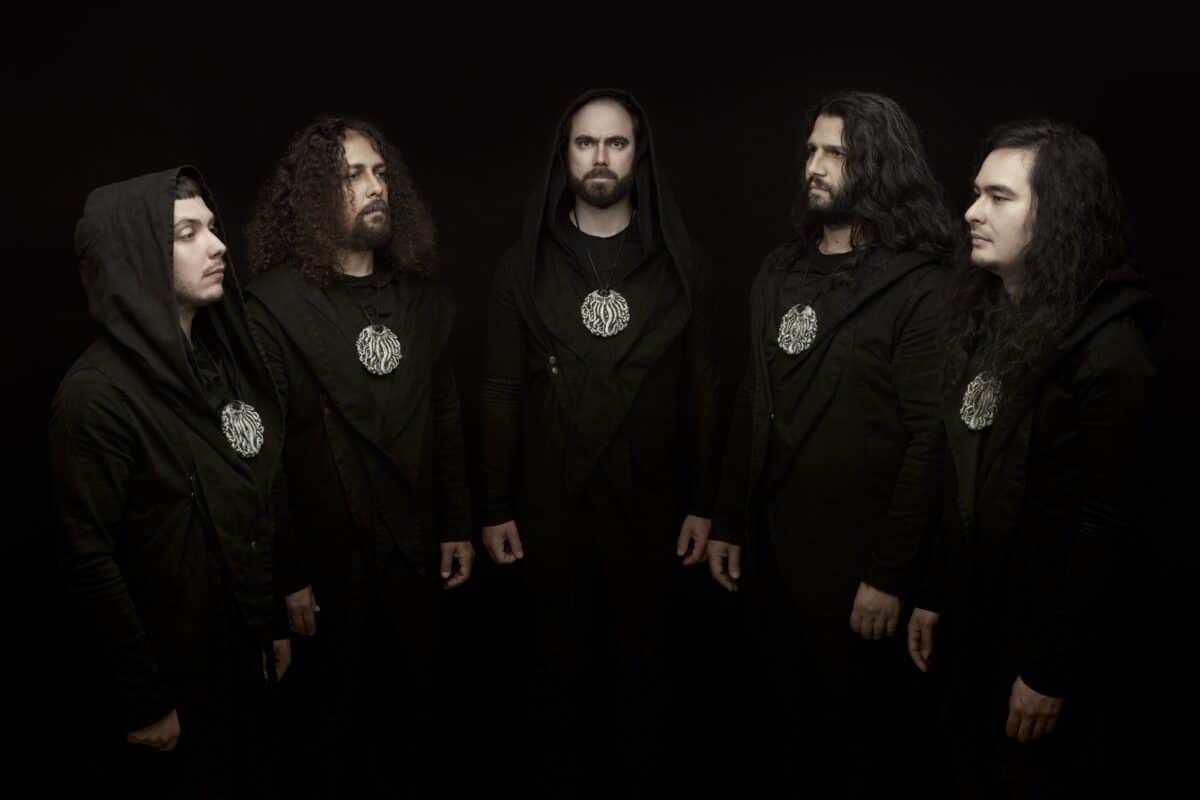
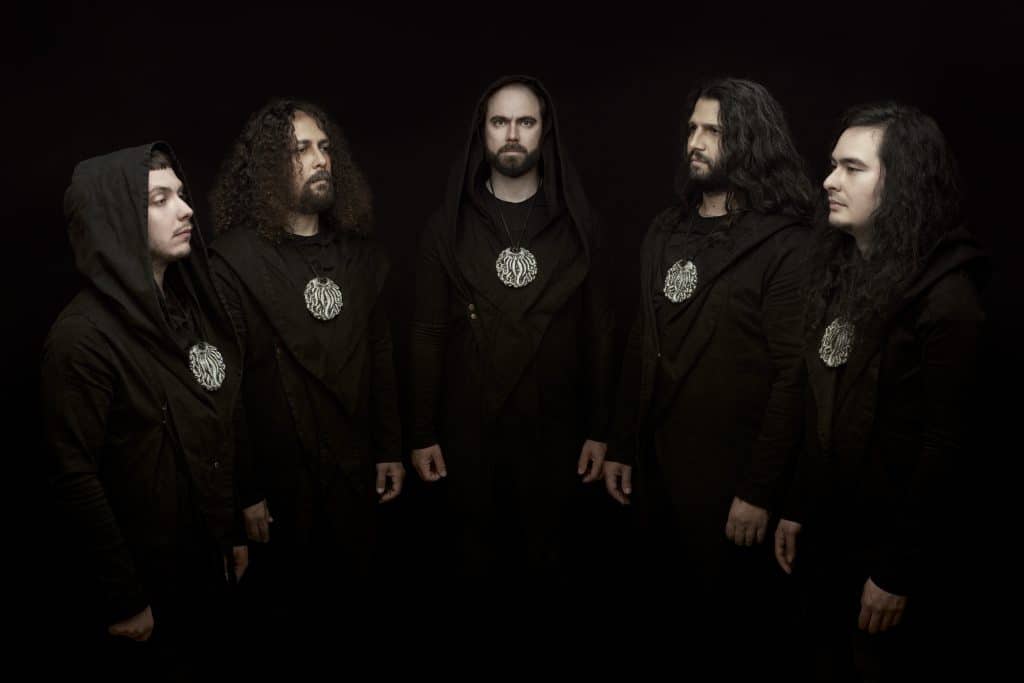
It is a privilege to sit down with Benjamin Guerry of The Great Old Ones. Emerging from the shadowy depths of H.P. Lovecraft’s timeless horrors, this French black metal quintet has carved a path unlike any other. Their music is not merely a collection of songs but a portal into the realms where eldritch deities slumber and forbidden knowledge lurks just beyond mortal comprehension.
Since their inception in 2009, The Great Old Ones have summoned visions of unfathomable terror and beauty by conjuring aural dimensions that blend the chaos of black metal with the spectral allure of ambient textures and doom-laden harmonies. Each note, a scream that feels like a whisper from beyond the veil, calling listeners to explore the vast, uncharted corners of the multiverse.
The stars align once more as they prepare to unleash their latest offering, Kadath, upon an eager world on January 24th, 2025. Named after the mythical city from Lovecraft’s The Dream-Quest of Unknown Kadath, this new chapter promises to plunge us even deeper into the surreal dreamscapes where cosmic entities roam and the line between nightmare and reality dissolves.
Today we delve into the mysteries behind this monumental record. How does one capture the unspeakable vastness of Lovecraft’s cosmos in sound? What drives their obsession with the unknown? And how do they translate their visions into an art form so evocative, it feels as though one is peering into the very abyss?
Prepare yourselves for an exploration of madness, creativity, and dark, twilight themes that continue to guide The Great Old Ones on their transcendent journey. Welcome, Benjamin Guerry. Let us begin our descent into the enchanted lands beyond the waking horizon.
Metal Lair: Kadath marks a departure from the oceanic Cthulhu mythos and plunges into the Dreamlands. What was the catalyst for this shift, and how does the Dreamlands resonate with your musical and philosophical exploration of Lovecraftian horror?
The Great Old Ones (Benjamin Guerry: guitar / vocals): This change happened naturally. I generally always work the same way for each album. I start to compose one or two songs, and the concept comes by itself, and then it’s a mix between the music and the chosen story.
For “Kadath”, I quickly felt that the tone of the album would be a little different. Always violent and immersive, but also more epic and sometimes a little brighter. This reminded me of my readings of the stories of the “Dream Cycle” and therefore of “The Dream-Quest of Unknown Kadath” which is the culmination of this cycle. There is a more marked poetic aspect, and a more intense feeling of travel, which is felt in the songs. I also consider myself a bit of a dreamer, so this story particularly resonated for me.
Metal Lair: In your music, the lines between beauty and terror are often blurred. How do you balance these contrasting elements to create such a haunting atmosphere? Is it more a conscious decision or an organic process that occurs during songwriting?
Benjamin Guerry: Nothing is really calculated in advance. It depends on the emotions of the moment, but also on the passage of the story that a musical part must illustrate. I also think there can be beauty in terror, and vice versa. These two elements are not necessarily in opposition. There are many ways to be transported by music, and we don’t put limits on ourselves. The same song can include the brightest part of the album, as well as the darkest, as long as the emotions are there.
Metal Lair: H.P. Lovecraft’s works are notoriously bleak and abstract, yet they contain an underlying sense of cosmic wonder. How do you navigate this tension between awe and dread when translating these themes into music?
Benjamin Guerry: Fear of the unknown has a very important place in Lovecraft’s work. And this fear can quickly become fascination, in the same way that we can find beauty in macabre images and death, particularly in Gothic literature. TGOO’s music has always been a mix of all of this, to achieve a kind of transcendence.Moreover, even in a story like “The Dream-Quest of Unknown Kadath” which mixes fantasy and horror, this contrast is even more present. Some passages are very bright, made of magnificent sunny landscapes, and others represent despair and the end of a quest. We put this to music by first letting our soul and our emotions speak, and so it happens naturally.
Metal Lair: Kadath is a journey through Randolph Carter’s odyssey. How did you approach the challenge of narrating such a complex, layered story through instrumental and vocal expression? Were there any particular musical techniques or motifs you used to represent Carter’s inner struggles?
Benjamin Guerry: We’ve always told stories adapted from Lovecraft so it’s a process we know well. But it is true that a lot happens during Randolph Carter’s quest. As you said, it’s a layered story, but we also make music with a lot of layers, due to the composition and the presence of three guitars. This allows us to develop more complex atmospheres and multiply the possibilities. And we try not to let ourselves be guided by any musical theories and use our ears and our sensitivity to adapt each part to the emotion of the protagonist. On the other hand, we had to ensure that the album was dynamic, hence its variety, in order to be able to respect all the elements of the story.
Metal Lair: The track Leng is over 15 minutes long. What inspired such an epic, expansive piece? How do you approach composing long-form music that maintains both intensity and depth?
Benjamin Guerry: “Leng” is a 15min instrumental song that we are very proud of. Without vocals (except for a few spoken words in the middle), this song allows listeners to imagine landscapes very different from each other. It is a space of total freedom for the imagination. Even regarding the composition, there is a great freedom because there is always a certain musical logic to keep when there are vocals, which takes a very distinct place. But actually, you have to manage to keep it exciting for 15 minutes. This is why the song is very dynamic, and goes from a sort of cavalcade to something much heavier, dramatic, even melancholic.What’s interesting is that the passage from the story that the song is inspired by is quite short. But precisely, this allowed room for more interpretation. And it will be the same for the listener.
It’s also a sort of homage to the first Metallica albums in which there was always an instrumental song. I am a huge fan of these songs.
Metal Lair: You recorded Kadath at the Studio Sainte-Marthe in Paris, under Francis Caste’s production. How did this studio environment shape the ghostly atmosphere of the album? Were there any unique challenges or breakthroughs during the recording process?
Benjamin Guerry: We arrived at the studio with a fairly clear idea of the sound we wanted, and at the same time we were waiting to see how Francis would interpret our direction. And as usual, Francis was amazing. We had to keep the atmospheres, while having a powerful sound, but above all not modern. And he rose to the challenge perfectly. We of course spent a lot of time on the selection of the amps used, on the drum equipment, in order to find what would create a total symbiosis between all the instruments, and thus best transcribe the compositions, and therefore the atmosphere from the original story.
Metal Lair: The concept of The Gathering (a 1:19 track) is intriguing given its brevity. What role does it play in the larger narrative of Kadath, and how do you approach composing such a short yet impactful piece?
Benjamin Guerry: “The Gathering” allows you to breathe a little before the rest of the journey, and it is an essential moment before resuming the quest. In the story, the song represents the moment when Randolph Carter attends the meeting between the ghouls and the nightgaunts, chaired by Richard Pickman, in order to prepare for the crossing of Leng, a devastated and inhospitable place in the dreamlands.
Metal Lair: The band collaborated with Jakub Rebelka for the cover art. How did you come up with the design? Can you walk us through the creative synergy between the band and Jakub for the album’s aesthetic?
Benjamin Guerry: I discovered Jakub’s work through the comic “The Last Day of Howard Phillips Lovecraft” written by Romuald Giulivo and Jakub Rebelka which I was lucky enough to receive before its release for a conference on Lovecraft that I was hosting. So I was able to meet Jakub when he came to Bordeaux for a signing session, and we talked about the project. He immediately showed great enthusiasm, and started working on the artwork as soon as he returned to Poland. He was truly the ideal artist to illustrate “Kadath”, with his surreal, dark, but also epic and grandiose approach, and had carte blanche to create the artwork as he wanted.
Metal Lair: Given your mastery in blending atmosphere with brutality, what role do you think dynamic moments of stillness versus intense eruptions play in enhancing the listener’s experience of your music?
Benjamin Guerry: Some bands base their artistic vision on continuous violence, and they succeed very well. For our part, to intensify dramatic and violent passages, it’s important to maintain great momentum. In addition, it allows you to put various emotions to music, which is better suited to a literary approach. This makes it easier to bring the listener on the journey, and allow them to experience different aspects of the quest we are illustrating. We are inspired by classical music, and dynamics are very important there.
Metal Lair: Lovecraft’s mythos often emphasizes humanity’s insignificance in the vast, uncaring expanse. How do you personally interpret this sense of cosmic dread? Does it influence the way you approach life and creativity outside of music?
Benjamin Guerry: Indeed, this fascination and this fear of the unknown greatly influenced Lovecraft’s work. This is also what we find in his literary philosophy, Cosmicism, the common thread of our previous album of the same name. We are nothing on the scale of the cosmos. And, like him, when we consider the subject, we feel this immensity of the universe, which is dizzying. However, this should not prevent you from having projects, from being creative, because moving forward helps you avoid making life futile.
In the end, I would say that we are divided. Man is capable of great things, and yet he is only dust compared to the depth of the cosmos.
Metal Lair: In a world where many black metal bands are embracing raw nihilism or existential dread, you’ve chosen to explore the more philosophical elements of cosmic horror. How do you see your music standing apart from other bands in this genre?
Benjamin Guerry: To begin with, we have a more literary approach to human feelings, linked to the concept of the band. Of course, Lovecraft had a form of nihilism, so that is also reflected in our music. But there are more varied elements in his writings, and we have chosen to explore all of these elements. Maybe that’s what differentiates us from some Black Metal bands. However, today, Black Metal has become a very varied music itself. It is also one of the rare styles of metal whose different periods are all fascinating.
Metal Lair: On Kadath, there’s a sense that the listener is not merely an observer, but part of the journey. How do you view the role of the listener in experiencing the “dream” of the album, and what do you hope they take away from it?
Benjamin Guerry: That’s exactly it, and I thank you for noticing that. Indeed, and even though we make music primarily for ourselves, we really want the listener to be able to take the journey himself. We offer immersive music, which, as explained above, aims to express the different emotions of Randolph Carter. Moreover, unlike the original book, the words are written in the first person. This is of course with the aim that the listener puts themselves in the place of the protagonist, and experiences this quest as if it were their own.
Metal Lair: Black metal is often steeped in personal struggle, yet your lyrics delve into a mythic, cosmic scale. How do you balance your own personal experiences with the larger, otherworldly narratives you create?
Benjamin Guerry: There are always personal elements in the lyrics, even though they are directly adapted from Lovecraft’s writings. You have to feel close to the author to succeed in putting yourself into the music and the lyrics. He was a dreamer, with a great fascination for the unknown, a sense of poetry, a certain sensitivity. We find ourselves in these elements, and it allows us to experience Lovecraft’s stories as if they were our own.
Metal Lair: The theme of dreams and nightmares runs deep in Kadath. How do you interpret the concept of “dreams” in relation to the human condition, and what do you think dreams can reveal about our fears and desires?
Benjamin Guerry: Dreams are very good indicators of what we have deep within us, and our unconscious. You have to be able to listen to them, to understand them. The study of dreams is also something fascinating. Often, our brain tries to send us a message, or tries to bring up or push back ideas that we might have buried deeply. The human brain is a complex organ, with complex mechanisms. We have much to learn from our dreams and nightmares. And this is what Randolph Carter realizes at the end of his quest.
Metal Lair: Your music has drawn comparisons to bands like Behemoth and Emperor, but there’s a distinctly atmospheric and narrative-driven quality to your work. How do you view your sound in relation to these bands, and what makes The Great Old Ones stand out in the broader black metal scene?
Benjamin Guerry: Being compared to these great groups is very pleasing. I think the need to develop atmospheres is a common point, even if these atmospheres are different. Obviously, I consider Emperor to be much darker than TGOO, and I will add that we do not claim to have reached their level of transcendence. We must remain humble in the face of such a profound, spontaneous work, which made them touch something that the human cannot understand. It’s hard to say what sets us apart from other Black Metal bands. I believe that we have our identity, that it is recognizable, and I think that is the most important thing.
Metal Lair: You’ve shared the stage with iconic acts like Behemoth and Gaahl’s Wyrd. What’s it like performing alongside such legendary bands, and how do you ensure that The Great Old Ones brings its own unique energy to a live show?
Benjamin Guerry: It was a great honor to be able to play with them, especially since, for both bands, they are very accessible and friendly people. And we did what we know how to do: play our music as intensely as possible. Concerts are very important for everything, and in these moments, TGOO’s music takes a different turn: more powerful, even more immersive. Moreover, each person in the audience lives this experience in their own way. Sometimes one person has their eyes closed, and the one next to them is moving their head in all directions. This is what makes The Great Old Ones strong live. Everyone experiences their journey, and we play the role of vectors of emotion.
Metal Lair: With so many layers to the music, from the relentless drumming to the haunting guitars and vocals, do you approach live performances differently than the studio recordings? How do you translate the dense atmosphere of Kadath into a live setting?
Benjamin Guerry: We have an approach to composition and the studio which, apart from some synth arrangements for example, is to offer live exactly what we offer on album. There is obviously work on the sound which is important, because it’s essential that the melodic aspect of our songs does not disappear. But the music is dynamic enough that we can develop the same atmospheres as in the studio, while maintaining the spontaneity of the live shows. And our main goal is that the audience leaves the venue with the feeling of having gone far away, far from their daily lives, and far away in their own minds.
Metal Lair: The themes in your work often evoke vast and infinite realms. Do you find that your music is influenced by a specific sense of space, whether real (such as the Bordeaux region) or imagined when you compose?
Benjamin Guerry: We are rather in a process of imagination. So the places we know don’t really have an impact on the composition of our music. Obviously, memories of places we have visited must, in some way, influence us. But, as an escape, our music must make us travel further, explore lands that are unknown to us, and it is more exciting to draw on our imagination rather than on real places, except when they have been used by Lovecraft himself.
Metal Lair: You’ve built an impressive discography, each album expanding your mythos. How do you see the next chapter in The Great Old Ones evolving? Is there a particular Lovecraftian theme or story you’re eager to explore next?
Benjamin Guerry: We are still in the “Kadath” period so we have not yet thought about what comes next. It is entirely possible that we return to the side of the Cthulhu Mythos, or that we base ourselves on the life of Lovecraft himself. The possibilities are vast and endless! We are always keen not to offer the same album twice, and to continue to evolve. We are still too much in the present to already think about the future!
Metal Lair: If you had to introduce The Great Old Ones to someone who has never heard your music, what would be the one song or album you’d play for them first, and why?
Benjamin Guerry: This is a very difficult question! On “Kadath”, the first track “Me, The Dreamer” could be a good example of what we offer. Due to its progression in two parts, it sums up well what we are now. It has an epic, dramatic sense, a bright side, but also very dark. I could also think of Antarctica, a song from our second album “Tekeli-li”, which sums up, in its own way, all of this.
Metal Lair: As The Great Old Ones continues to push the boundaries of black metal, what kind of legacy do you hope to leave within both the genre and the broader metal community?
Benjamin Guerry: I think we would like our listeners to remember each of our albums like so many books they would have read. Each of our albums is unique, each telling different stories, with different atmospheres and places. Imagine looking at your travel photo album and remembering everything you saw and felt. I would like our discography to be considered like this: different journeys into unknown lands, meeting entities that we cannot understand.
Metal Lair: “Thank you so much for speaking with us! It’s been a huge privilege interviewing you. Everyone at Metal Lair really enjoys your music! Any final thoughts you’d like to share with your fans?”
Benjamin Guerry: Thank you to the entire Metal Lair team for your interest in our music, and thank you to everyone who has followed us since the beginning, and who joins us along the way. We hope to be able to meet everyone, and take you with us on our cosmic journeys!

Kadath Track Listing
1.Me, the Dreamer
2.Those From Ulthar
3.In the Mouth of Madness
4.Under the Sign of Koth
5.The Gathering
6.Leng
7.Astral Void (End of the Dream)
The Great Old Ones Online: