Written By Chris Norris
Few projects in experimental metal have followed a creative path quite like Thy Catafalque. For more than two decades, Hungarian composer and multi-instrumentalist Tamás Kátai has approached music without conventional boundaries, drawing from black metal, progressive rock, electronic experimentation, folk traditions, and influences that resist easy classification.
With XIII: Sárga erdő, Thy Catafalque enters another chapter, this time embracing a warmer, more organic production. Featuring live drums throughout, contributions from more than thirty musicians, and a twenty-voice male choir, the album expands its instrumental palette while maintaining Kátai’s unmistakable compositional identity.
In this Thy Catafalque Tamás Kátai interview, Metal Lair’s Chris Norris reconnects with the musician to discuss the decisions behind the new album, his connection to his Hungarian roots, the involvement of live musicians, and the personal experiences that found their way into the music.
This conversation follows Metal Lair’s earlier interview with Tamás Kátai, offering another look into the creative world behind Thy Catafalque.
The conversation also explores Kátai’s commitment to keeping his creative process independent of expectations, even as Thy Catafalque has evolved from a largely private studio project into an internationally touring live act.
Thy Catafalque Tamás Kátai Interview Q&A
Tamás, thank you for taking the time to speak with Metal Lair again. It’s a pleasure to welcome you back, and we’re excited to talk with you about Thy Catafalque’s new album, XIII: Sárga erdő, and the ideas, memories and stories behind it.
Metal Lair: XIII: Sárga erdő feels very rooted in memory, place and things that disappear with time. When you began writing this record, was there a particular image, place or feeling that kept pulling you back into it?
TAMÁS KÁTAI: Thank you for having me again. No, I just started writing a new album.
There was no pre-conception or any pre-constructed idea behind the new material as usually is the case. Writing songs, this was the project. Except that I was looking for warmer production.
Metal Lair: This is the first Thy Catafalque album to feature live drums throughout, with Árpád Szenti behind the kit. After years of working differently, what made this the right record to make that change, and did hearing a live drummer alter the way you wrote any of the songs?
TAMÁS KÁTAI: The songs have all been done (with the exception of one) before Árpád got the demos. I made the drum programs as usual and then he received these finished songs.
I asked him to play the drum patterns close to the original but whenever he has any thoughts or better ideas just go and try it and we’ll see if it works. And it happened a couple of times and and it worked very well.
Especially with fills and small details where he knows much better what sounds more natural and right. And this was the driving force to work with real drums this time: I was aiming for a more organic and living production and drums are an essential part of such a concept.
Metal Lair: XIII: Sárga erdő features more than thirty musicians, a twenty-voice male choir, and an extraordinary range of instruments. What inspired you to bring so many different musicians, voices and textures into this particular album?
TAMÁS KÁTAI: As I said, it was the more organic approach to the music. I wanted the production to breathe and wherever it was possible I tried to use a real instrument instead of a virtual one.
It does not mean the album is crowded with all kinds of sounds in every second. Just when it was neccessary and felt natural. I needed to be disciplined and I hope I was.
Metal Lair: Cseremisz draws on the cultural world of the Mari people, historically known as the Cheremis, whose Finno-Ugric language has distant linguistic ties to Hungarian. What drew you toward that connection, and how did it find its way into the song?
TAMÁS KÁTAI: Cheremis people are now called Mari and they are not vanished. They still have an ethnic republic in Russia, Mari El Republic with around 150.000 ethnic Mari people living there.
They are a Finno-Ugric people with a language relativity to Hungarian language. Hence we know about them in Hungary.
I have always been interested in our distant relatives and that’s where the songs was coming from.
This is not a folk song, I wrote it but the lyrical content and the music itself felt close to that region even though I have never been anywhere near the Volga.
Metal Lair: You returned to the woods near Makó to film “Búcsú a piros madártól,” close to where one of Thy Catafalque’s earliest videos was made twenty-five years ago. What was it like standing in that landscape again with so much history between those two moments?
TAMÁS KÁTAI: There is not much mysticism behind this. Even though I live in Budapest, my family stays in Makó and I regularly visit the town, so I still know the place and walk up and down and it just feels natural to shoot videos there because this is my home.
It’s easy and cosy and I think it adds to the authenticity of the music. Anyway there had been another video for the song, a more professional one, shot somewhere else but at the end I didn’t like the result, it did not connect to the vibe of the song or the band so I decided to make another one by myself and I didn’t have much time to do that but I’m more happy with this one with the DIY way.
Metal Lair: There is a strong sense of leaving, distance and disappearance running through Sárga erdő. Do those themes come more from looking backward at your own life now, or are they simply ideas that happened to gather around these songs?
TAMÁS KÁTAI: This album is more personal than the previous ones due to things happening in my personal life.
Composing music and lyrics is one way to deal with heavy topics in real life and that’s what I could do. So this record is a bit sad, I reckon. I didn’t intend to end up like this but well, that’s how it is.
Metal Lair: “87 tavasz, 87 ősz” translates as “87 Springs, 87 Autumns.” The number feels very specific, and describing time through seasons gives the title an unusually human quality. What does 87 represent, and what story lies behind that closing track?
TAMÁS KÁTAI: My grandmother passed away during the composing period at the age of 87 years.
Metal Lair: Thy Catafalque began as something almost entirely private and studio-based, but it has gradually evolved into a band that travels, tours and exists in front of people around the world. Has seeing these songs become physical in a live setting changed your relationship with the project at all?
TAMÁS KÁTAI: I do hope it did not. I keep the studio project and the live band separated in terms of composing. I don’t want the concerts to affect the music because I believe they limit the creative space.
I need all the freedom in writing and when it comes to perform the songs we will figure out what and how to do but this is secondary.
However everyone from the live band got involved in the album one way or another but after all it is me composing everything and I have to make the creative decisions because that’s the cleanest way.
Metal Lair: You have said before that you do not like placing stylistic rules around your writing. At this point, after so many records, is there anything you have not yet tried with Thy Catafalque that still genuinely excites or frightens you a little?
TAMÁS KÁTAI: I still find music to be exciting and a vast land waiting to be explored. I have no idea what to do next but I’m looking forward to it. There’s nothing to be afraid of here.
Metal Lair: If Sárga erdő were not an album at all, but a physical place someone could walk into for one night, what would they see, hear and find waiting for them there?
TAMÁS KÁTAI: Easy. That’s a yellow forest in the middle of the autumn.
Thy Catafalque: Creative Freedom Without Compromise
More than two decades into Thy Catafalque’s evolution, Tamás Kátai remains committed to the freedom that has defined the project from its beginning.
XIII: Sárga erdő introduces a more organic recording approach, but the fundamental philosophy remains unchanged. The music comes first, unrestricted by genre expectations, live performance considerations, or predetermined concepts.
Throughout this conversation, Kátai makes clear that experimentation remains central to his work. Although he has no specific direction planned for what comes next, his curiosity about music remains undiminished.
For an artist whose catalog has consistently resisted categorization, perhaps that openness is the most enduring characteristic of Thy Catafalque.
Metal Lair thanks Tamás Kátai for speaking with Chris Norris about XIII: Sárga erdő and sharing his perspective on the album’s creation.
Explore more conversations with artists from around the world in Metal Lair’s Interview Archive.
XIII: Sárga erdő comes out November 20, 2026 on Season of Mist.
Pre-order
Pre-save on Spotify

Tamás Kátai
Tracklist:
1. Búcsú a piros madártól
2. Ég-anyám, föld-apám
3. Dunnák alatt kék mező
4. Szitakötő
5. Suhamló éji fák
6. Puszta
7. Sirató
8. Cseremisz
9. Sárga erdő
10. Tömbök
11. Kút vizén nap forog
12. 87 tavasz, 87 ősz

Line-up:
Tamás Kátai — Guitar, Bass, Keyboards & Vocals
Guest Musicians:
Martina Veronika Horváth — Vocals (9, 12)
Ivett Dudás — Vocals (3, 10, 11)
Gábor Dudás — Vocals (2, 5, 11, 12)
Bálint Bokodi — Vocals (1, 8, 9)
Annamari Oláh — Vocals (6)
Lambert Lédeczy — Vocals (6)
Gergely Balla — Vocals (7)
Gábor Veres — Vocals (10)
Antal Cseh — Bass/Baritone Vocals (12)
The Male Choir of Tiszaföldvár — choir (8)
Anikó Für — Prose (5)
Árpád Szenti — Drums & Percussion
Krisztián Varga — Lead Guitar (1, 5, 6, 9, 10)
Zoltán Vigh — Lead Guitar (10)
Breno Machado — Lead Guitar (12)
Daniele Belli — Classical Guitar (12)
Anikó Barna — Citera & Koboz (8)
Chithrinie Nirupama — Sitar (4)
Peter Voronov — Violin (5)
Maria Grigoryeva — Violin (5)
Victor Morales — Violin & Piano (9)
Oleg Bezuglov — Violin (12)
Michaela Lilla Bos — Cello (9)
Francesco Pisciotta — String Arrangement (11)
Noam Dayan — Kamancheh (1)
Dmitry Karev — Accordion (8)
Dario Cei — Flute (8, 10)
Brandon Wilkins — Bassoon & Alto Flute (2)
Dan Rowland — Oboe d’Amore (7)
Kelly O’Donohue — Trumpet, Trombone & Flugelhorn (9, 11, 12)
Michele Fortunato — Trombone (12)
Patricio Böttcher — Alto Saxophone (3)
Efim Braylovskiy — Alto Saxophone (9)
Ibrahim Danbaba — Saxophone (11)
Follow Thy Catafalque
Website: https://www.thy-catafalque.hu/
Bandcamp: https://thycatafalque.bandcamp.com/
Facebook: https://www.facebook.com/thycatafalque/
Instagram: https://www.instagram.com/thy_catafalque/
X/Twitter: https://x.com/thycatafalque
Threads: https://www.threads.net/@thy_catafalque
TikTok: https://www.tiktok.com/@thycatafalque
Spotify: https://open.spotify.com/artist/4sgTqbA7htxYkRRJBPZIom
Apple Music: https://music.apple.com/artist/thy-catafalque/372164196
Deezer: https://www.deezer.com/artist/1441022
Tidal: https://tidal.com/browse/artist/4026939
About the Author
Chris Norris is the voice behind Metal Lair’s global metal coverage, World Metal Weekly. From funeral doom in the north to thrash born in the streets. Known for spotlighting bands before algorithms notice them and for writing with the precision of a scalpel… or a well-sharpened guitar pick. Vinyl collector. Night-shift journalist. Believes heavy music has no borders.
Read More From This Author:
The Konsent Album Review: A Dystopian Progressive Metal Masterpiece
GÅTE Sigil Interview: Folklore, Magic, Eurovision and a New Chapter
Stoned Jesus Songs to Moon Interview: Igor Sydorenko on Darkness, Descent and the Trilogy
Rotting Christ Interview: Sakis Tolis on 35 Years of Greek Metal, History and Legacy
No algorithms. No fluff. No watered-down corporate metal coverage.
Subscribe to Metal Lair and get weekly underground features, Seven Deadly Songs, Deep Cuts, interviews, and original metal journalism sent directly to your inbox.
Join the patrons of Metal Lair
MetalLair.net is a metal zine muttering to itself about seo and blastbeats at 3 AM powered by caffeine, riffs, a severe lack of sleep, and a dog wondering why the human is still awake.
Sometimes it’s Kevin passing out mid Seven Deadly Songs.
Sometimes it’s digging up forgotten records no one else is talking about.
Always, it’s built for people who actually live this music.
If that sounds like you, you’re already one of us.
Supporting Metal Lair means keeping it independent, loud, and real with no corporate filters, no watered-down takes. If you want to help keep it alive…
Become a patron of Metal Lair.
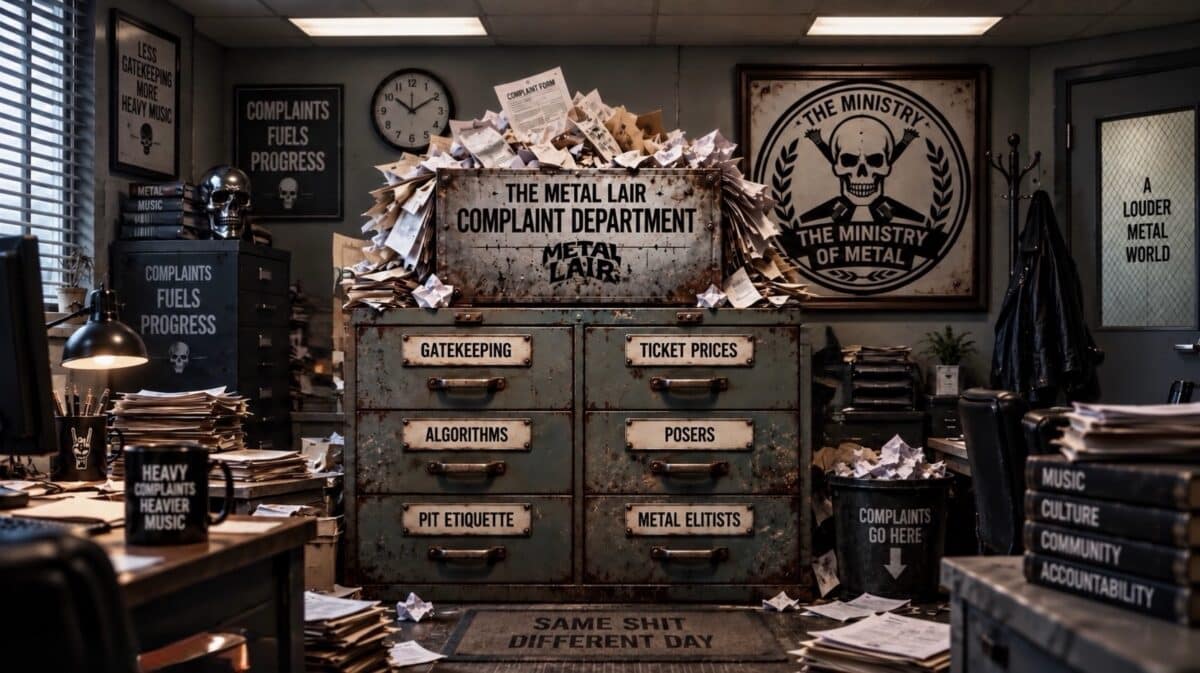
FILE A COMPLAINT WITH THE METAL LAIR COMPLAINT DEPARTMENT
Have a metal-related grievance that needs official investigation?
Bad concert etiquette? Venue bullshit? Festival fuckery? A trend in metal that needs to die? An industry annoyance? Something that’s been pissing you off since 1987? Have a complaint against Metal Lair?
FILE YOUR COMPLAINT
File it with the Complaint Department. Remmy may investigate your grievance in a future installment.
Selected grievances may be investigated, mocked, dissected or otherwise subjected to the questionable judgment of Remmy Chillmister in a future edition of The Metal Lair Complaint Department.
Submission does not guarantee investigation. Remmy has a substantial backlog of things that piss him off.