Written By Sabbatha Ashvale
In an era where most artists livestream their breakfast and document every studio session, Sydney, Australia’s Cenobia has taken the opposite approach.
Three songs with cinematic music videos. No interviews. Almost no biography. And yet the numbers are already impossible to ignore.
For an artist who hasn’t played a single live show yet, Cenobia’s arrival in the metal world has been unusually swift. Her videos have already crossed the million-view mark on YouTube, while her early singles are quietly building momentum across streaming platforms.
For a project this new and this quiet, that kind of traction raises eyebrows. But numbers only tell part of the story. What’s far more interesting is the music itself.
The Sound of Cenobia
From the moment the opening notes of Cenobia – Devour Me begin to unfold, it’s clear that Cenobia isn’t chasing trends. The song moves with a dark cinematic weight, balancing dense guitars with a vocal performance that shifts between feral intensity and haunting clean passages.
Early listeners quickly noticed the contrast: moments of harsh aggression giving way to unexpectedly clean passages that carry a haunting melodic edge.
That balance becomes even clearer on Cenobia – Throne of Want. The track leans deeper into atmosphere, building tension before releasing it in waves of distortion and layered vocals.
It’s the kind of songwriting that feels deliberate rather than rushed – less like a demo from an unknown artist and more like the work of someone who understands how heavy music breathes.
The newest single, Cenobia – Make Us Whole Again, pushes that evolution further. Where the earlier songs flirted with brutality, this one leans into emotional weight.
Cenobia has hinted that the song was written for someone who will never hear it – a quiet confession buried beneath the music.
The lyrics suggest a deep sense of loss, possibly grief, unrequited love, or someone who simply drifted away.
The clean vocals sit higher in the mix, revealing a voice that carries both control and vulnerability, something that’s becoming increasingly rare in a genre that often rewards sheer aggression over nuance.
That voice may ultimately be Cenobia’s greatest strength.
Metal has always been full of powerful vocalists, but what sets Cenobia apart is the sense of precision in her delivery. Instead of overwhelming the listener with constant intensity, the songs allow space for tension to build. When the heavier moments arrive, they feel earned.
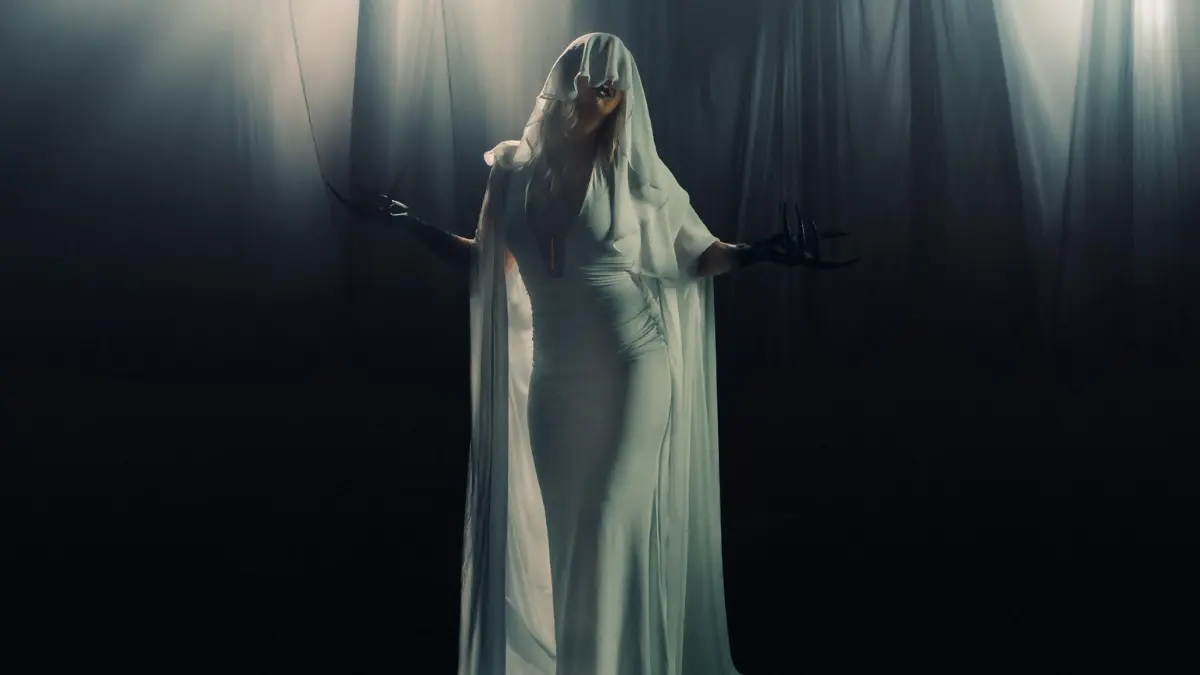
And then there’s the visual world surrounding the music. Each of Cenobia’s videos arrives with the polish of a short film rather than a quick promotional clip.
Dark lighting, slow-moving symbolism, and a carefully controlled aesthetic give the impression that the songs are chapters in a larger narrative still unfolding.
Whether intentional or not, the effect creates a sense that listeners are stepping into a world rather than simply pressing play on a track.
It’s a striking contrast to the hyper-exposed culture surrounding most modern releases.
Cenobia, by comparison, remains largely silent.
Requests for interviews have been politely declined. Background details are scarce.
Beyond the fact that the project appears to be emerging from Sydney, Australia’s metal scene, very little is known about the artist beyond her music and the imagery surrounding it. In a strange way, that absence has become part of the appeal.
In an industry that usually reveals everything immediately, that restraint feels almost old-fashioned. Metal has always had room for mythology, from anonymous black metal projects to artists who let the music speak before the personality, something bands like Ghost and Sleep Token have turned into an art form.
Cenobia seems to be leaning into that tradition. With so little information available, listeners are left to focus on the songs themselves and perhaps wonder who exactly is behind them.
Fans are left to interpret the work on its own terms rather than filtering it through the personality of the person behind it.
In a genre that often thrives on mythology, that silence can be powerful.
It’s impossible to know exactly where Cenobia’s story will go next. With only three songs released so far, the project still feels like the opening chapter of something larger. Whether the mystery continues or eventually gives way to a more traditional artist presence remains to be seen.
For now, the music is doing exactly what it needs to do. And sometimes, that’s enough.
A note from Sabbatha Ashvale
Cenobia, if you ever feel like talking about the music instead of letting the internet speculate itself into a frenzy, Women in Metal at Metal Lair would happily make space for you.
No lore-breaking required. Just the music.
Like what you just read? Check out our Women in Metal series where we spotlight the voices, pioneers, and rule-breakers redefining heavy music.
Update – March 22, 2026
Cenobia has broken her silence, if only slightly.
A new visual teaser surfaced this week across her social platforms, bearing the words “She Is Coming” alongside what appears to be a looming announcement tied to Sydney, Australia.
No dates have been officially confirmed yet, but the imagery strongly suggests that Cenobia’s first live appearances may be imminent.
If that holds true, it marks a turning point for a project that has, until now, existed almost under a self-imposed veil of anonymity built on three songs, three videos, and a carefully maintained absence.
The question is no longer just who Cenobia is. It’s what happens when she steps out from behind the veil and into something real and onstage.

Support Metal Lair
MetalLair.net is a metal zine muttering to itself about seo and blastbeats at 3 AM while scheduling posts – powered by caffeine, riffs, and a severe lack of sleep and a dog wondering why the human is awake again.
And occasionally, Kevin falling asleep on his keyboard while writing album reviews and Seven Deadly Songs.
If you enjoy the interviews, reviews, features and recurring series, you can support the site here: