Written By Sabbatha Ashvale
Women in Metal: The Dangerous Ones
A Rip In Time: Women In Metal A Metal Lair Original Series
Welcome to Women in Metal. This isn’t your background playlist or some algorithm-friendly soundbite. These are the women who threatened the status quo. They didn’t just enter the boys’ club, they used it for bloodsport.
Metal didn’t just get infiltrated, it got breached. These weren’t scene darlings or hype cycles. They were walking detonators. They were proof that metal should never be safe.
Some self-destructed. some weaponized their bodies and some simply refused the leash. This isn’t about representation. This is about women who made the scene flinch.
“Not groupies. Not guests. Architects of the sound.”
The Underground Never Needed Your Approval
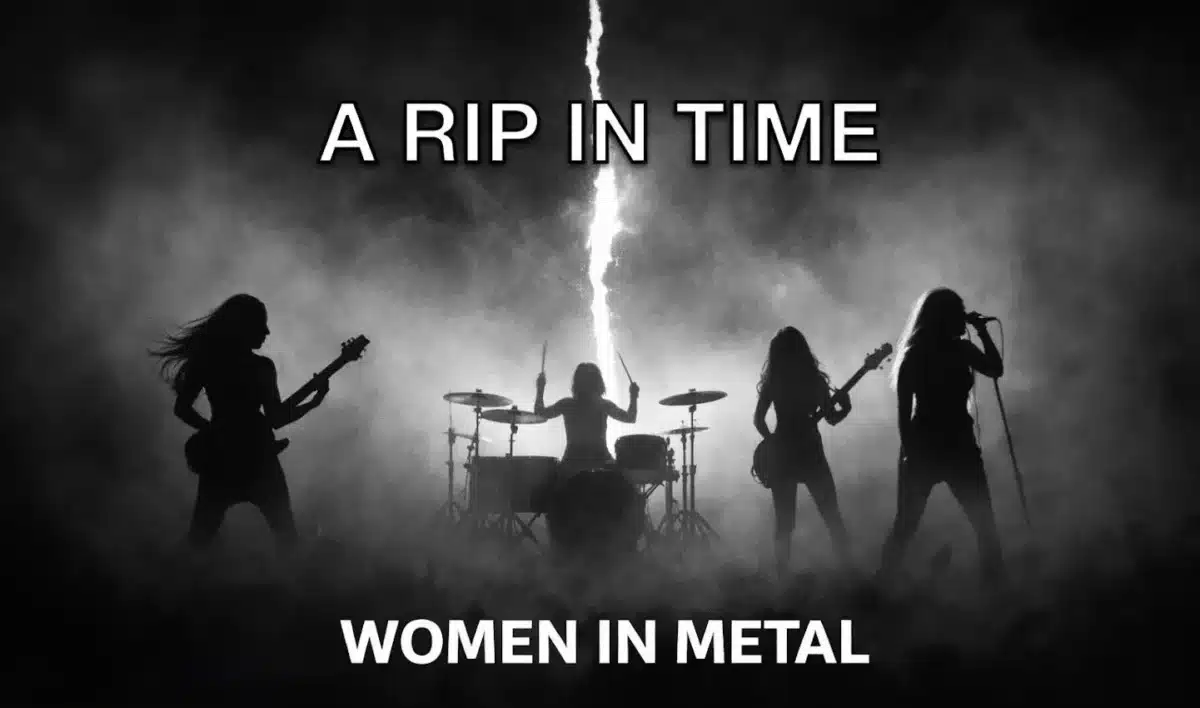
A Rip in Time: Women in Metal. A Metal Lair Original Series
A Rip in Time: Kim McAuliffe (Girlschool)
Girlschool were the first all-female NWOBHM band to break through on equal footing with men and the first to collaborate with Motörhead, with Lemmy treating them as peers, not novelty.
Girlschool came out of late-70s London, same smoke, same pubs, same NWOBHM pressure-cooker as Motörhead and Saxon.
Kim McAuliffe drove rhythm guitar and vocals like she had zero interest in proving anything, she was already equal.
When Motörhead merged with them under the hybrid name Headgirl and cut “Please Don’t Touch,” that wasn’t a novelty collab. That was Lemmy making it public record. They weren’t a cute exception. They could out groove half the guys in the room.
Moment: Take It All Away – Demolition (1980)
This was their independent, raw debut single released on the tiny City Records label. It didn’t make a dent in the commercial charts, but it did something much more important: it landed on the turntable of Lemmy Kilmister.
Lemmy thought the track was incredible, later remarking that they could actually play their instruments, unlike many of the punk bands of the era. Because of this single, he invited them to open for Motörhead on the massive 1979 Overkill tour and hooked them up with their manager, Doug Smith. That connection secured their major deal with Bronze Records.
When Lemmy co-signed them as equals on wax, not as an opener. It wasn’t “Motörhead featuring a girl band.” It was collaboration. That was the breach point.
Once signed to Bronze, they dropped Emergency – Demolition (1980) as the lead single for their debut album Demolition. This is the track that officially put them on the map for the general public.
Deep Cut: Girlschool / Motörhead – “Please Don’t Touch” (Headgirl)
Because this is the tape where the lie breaks. Lemmy didn’t stamp them as a novelty act, he stamped them as peers. After this track existed, the scene could never again pretend women were “exceptions.”
Why This One:
Girlschool didn’t just nudge the door open for women in heavy metal, they blew it off its hinges with a crowbar.
Before they arrived, women in rock were largely relegated to frontwomen backed by male musicians, or heavily manufactured acts packaged for the male gaze. Girlschool shattered that blueprint by proving an all-female band could be entirely self-determined, completely devoid of corporate gimmicks, and musically heavy enough to run the boys off the stage.
Unlike their structural predecessors, The Runaways who were put together, managed, and famously exploited by producer Kim Fowley, Girlschool had no male mastermind behind the curtain.
They formed autonomously in South London as Painted Lady before evolving into Girlschool. They bought their own gear, booked their own pub gigs, and wrote their own songs.
This level of raw independence was revolutionary at the time; it proved women didn’t need a male industry architect to find a heavy sound or an audience.
In the late 1970s and early 1980s, the music industry’s default setting for marketing female rock artists was hyper-sexualization. Girlschool completely opted out. They wore the exact same uniform as their male NWOBHM peers: battered leather jackets, heavy boots, denim, and band t-shirts.
By presenting themselves as street-level rockers rather than pin-ups, they forced the industry and the fans to judge them solely on their riffs, their speed, and their live performance. They made it acceptable for female metal musicians to just be one of the musicians, rather than a visual novelty.
They won over these notoriously tough crowds because their music was genuinely fast, aggressive, and dirty. When Lemmy Kilmister and Motörhead publicly championed them, it wasn’t out of charity it was because Girlschool matched their sonic ferocity.
Perhaps their greatest historical victory is that they became the longest-running all-female rock band in history, still active today. They showed that an all-female lineup wasn’t a short-lived marketing stunt or a fleeting trend.
They laid down a permanent infrastructure that inspired everything from the 1990s Riot Grrrl movement to modern extreme metal bands, proving that gender had absolutely zero bearing on a band’s ability to deliver a crushing live set.
A Rip in Time – Kathleen Hanna (Bikini Kill / Riot Grrrl)
Before metal ever learned to fear a woman with a mic, punk already had one who treated the stage like an execution platform.
Kathleen Hanna didn’t arrive to “represent” anything, she arrived to destroy the conditions that made representation necessary in the first place.
Riot grrrl was wasn’t branding, or style, or aesthetics, it was a jailbreak. She didn’t decorate the attic of punk, she burned the entire structural blueprint that kept women ornamental.
Kathleen is the pivot where fury stopped being a personality trait and became infrastructure. The industry wasn’t threatened by her volume, it was threatened by her refusal to be charming.
Every scream was a policy decision. Every lyric was a radical reframing of who gets to define reality in a scene built by men. Before her, female rage was a spectacle. After her, it was a doctrine.
Kathleen didn’t just scream, she engineered a cultural permission slip. Riot grrrl wasn’t a subgenre, it was a direct action. Female rage stopped being “attitude” and became a political instrument.
She didn’t ask for space, she stole the mic and dared the room to eject her. And the room blinked first. After Kathleen, “loud women” weren’t a spectacle, they were a threat.
Moment: Rebel Girl Revolution Girl Style Now! demo cassette (1991)
Before “Rebel Girl,” a lot of underground punk was still heavily male-dominated and aggressive in a exclusionary way. Kathleen Hanna’s fierce, unapologetic delivery flipped the script.
Instead of treating other women as competition, the song was a radical celebration of female friendship, solidarity, and empowerment (“In her kiss, I taste the revolution”). Between Tobi Vail’s driving beat, Kathi Wilcox’s steady bass, and Billy Karren’s jagged guitar riffs, it was an undeniable, infectious hook that radioactive-shattered the underground glass ceiling and still tops lists of the greatest punk songs ever recorded.
Deep Cut: The Heavy Dirge: “Sugar” (Pussy Whipped, 1993)
While most people associate Bikini Kill with fast, up-tempo garage punk, “Sugar” is a slow, suffocating, borderline sludge-metal/noise-rock crawl.
Driven by a massive, repeating, down-tuned bassline from Kathi Wilcox and a dragging, heavy drum beat from Tobi Vail, the track strips away all punk pop sensibilities. Billy Karren’s guitar is pure feedback and serrated noise.
Kathleen Hanna delivers one of the most agonizing, throat-shredding vocal performances of her career here. She drops the melodic sneer entirely, moving from a low, threatening hiss into unhinged, multi-tracked shrieks that sound like genuine catharsis. It’s an incredibly intense, atmospheric track that completely changes the pacing of Pussy Whipped and gets criminally overlooked.
Why This One:
While Bikini Kill didn’t play traditional heavy metal, their sonic weapon of choice was raw, abrasive, three-chord garage punk, their historical importance to women in metal and extreme music is foundational.
Before the late-90s and early-2000s breakout of bands like Kittie, Otep, or Walls of Jericho, Bikini Kill systematically dismantled the structural, physical, and psychological barriers that kept women excluded from aggressive underground music. They didn’t just write songs; they built the infrastructure that allowed women to be loud, angry, and extreme on a public stage.
In the early 1990s, the underground heavy music scene (punk, hardcore, and the burgeoning extreme metal scenes) was overwhelmingly a male monolith. Women in the crowd were frequently relegated to the back of the room, treated as visual accessories, or subjected to physical hazards in violent mosh pits where they had no agency.
Bikini Kill formed in Olympia, Washington, in 1990 with a singular, radical purpose: to scream back. They existed to force a space for female expression in a subculture that claimed to be counter-cultural but still mirrored the patriarchal dynamics of the mainstream. They wanted to prove that a woman’s anger was a legitimate, powerful artistic force.
Bikini Kill became the vanguard of the Riot Grrrl movement, an underground feminist network that linked music, political activism, and DIY zine culture.
Their most revolutionary barrier-breaking tactic was physical and spatial: the “Girls to the Front” policy.
During their live sets, Kathleen Hanna would stop the music and demand that men move to the back and sides of the venue, bringing women physically to the barricade and the center of the floor.
It created a literal safe space where women could experience aggressive music without the threat of harassment or physical intimidation.
It allowed young women to see themselves represented right at the edge of the stage, transforming them from passive observers into active participants. This layout directly inspired the next generation to pick up instruments and form their own extreme bands.
Bikini Kill’s lyrics completely rejected the sanitized pop-culture tropes of female submissiveness. Instead, they weaponized uncomfortable, visceral realities with a raw intensity that rivaled the thematic weight of extreme metal. They focused on heavy, systemic themes:
Dismantling the Male Gaze: In tracks like “White Boy,” Hanna tackles the entitlement of the male-dominated scene head-on (“I’m so sorry if I’m alienating some brilliant boy”), dripping with sarcasm and fury.
Exposing Systemic Trauma: Songs like “Suck My Left One” and “Daddy’s Li’l Girl” ripped open the silence surrounding domestic abuse and incest. They didn’t use metaphor; they dragged horrific real-world horrors into the light, using punk rock as a collective exorcism.
Radical Autonomy: They sang about bodily independence and female solidarity, demanding that women define their identities completely outside of male validation.
Bikini Kill “broke the barrier” by changing the definition of what a frontwoman was allowed to look and sound like.
Before them, women in rock were often expected to remain melodic, polished, or sensual. Hanna and her bandmates traded perfection for pure, unadulterated catharsis. Hanna would yell until her voice cracked, throw herself across the stage, and perform with words like “SLUT” or “INCEST” sharpie-drawn onto her bare skin turning the weapons used to shame women into symbols of defiance.
By mastering the DIY ethos, pressing their own records, booking their own independent tours, and bypassing mainstream corporate gatekeepers they laid down the ultimate blueprint. They proved that women did not need permission from a male-dominated industry to create aggressive art.
Without Bikini Kill shifting the cultural gravity of underground venues in the early 90s, the landscape that allowed extreme metal frontwomen to command the stage on their own terms a decade later would have looked completely different. They proved that extreme anger belongs to everyone.
A Rip in Time – Otep Shamaya (Otep)
Otep Shamaya wasn’t let in, she barged in. When the business suits and scene dudes were still parroting “women can’t headline / can’t anchor a festival slot / can’t hold a pit,” she didn’t debate them, she sold out shows and kicked doors off hinges with her own name on the marquee.
She didn’t enter metal through networked favors or pedigree. She was a slam poet who turned her voice into a weapon and proved sheer force of presence can be its own infrastructure.
The industry didn’t know what to do with that kind of undeniability. So instead of bending her to fit the lane, she paved a new one by being infuriatingly unignorable.
The boys-club didn’t grant permission and she didn’t seek it. She simply made herself too powerful to exclude. she broke the “you don’t get to headline” ceiling by acting like that ceiling was beneath her.
When she stood up there alone under the lights, the stage finally had to admit she belonged because the crowd already knew.
Moment: The Underground Buzz: “T.R.I.C.” (2001)
Before they even had a full-length album out, “T.R.I.C.” (which stood for The Right in Capital) was the track that ignited the band’s rapid rise. It originally anchored their 2001 Jihad EP.
The track perfectly encapsulated early-2000s nu-metal aggression but with a distinct twist: Otep Shamaya’s vocals aggressively careened between hip-hop-influenced cadence, eerie spoken word, and deep, death-metal-style gutturals.
That track and the underground hype surrounding it caught the attention of Sharon Osbourne, who famously invited the band to play Ozzfest 2001 before they were even signed to a major label.
Deep Cut: Battle Ready – Sevas Trac (2002)
Why This One:
“Battle Ready” is its undeniable call to arms. It’s a sonic sledgehammer that bridges the gap between raw, street-level frustration and intellectual mutiny.
Because this is the track where she’s not performing anger, she’s weaponizing it. Every cadence is a middle finger to the boys club bookers who swore women couldn’t anchor a bill.
While songs like “Jonestown Tea” dealt with deeply personal, harrowing trauma, “Battle Ready” turns its fury outward. Along with tracks like “Sacrilege,” it is a direct, ferocious assault on organized religion, spiritual manipulation, and societal conformity.
Otep Shamaya, heavily influenced by the Beat poets (like Jack Kerouac and Allen Ginsberg) and classic literature wrote the lyrics to weaponize language against oppressive institutions. The track positions the listener not as a passive victim of an unfair system, but as an insurgent.
“We are the mutiny, we are the oddity / We are the children of the anomaly… BATTLE READY!”
Instead of wallowing in the pain of religious persecution or poverty, the track demands that you stand up, embrace your “strangeness,” and fight back against anyone trying to dictate your identity.
A Rip in Time – Karyn Crisis (Crisis)
Karyn Crisis didn’t show up to compete with the boys.
she showed up like a message from a place the boys didn’t have access to. she wasn’t trying to be “metal’s toughest woman.” that’s a pedestrian category. she was operating in a different plane, she made extreme vocals feel like a transmission, not a gimmick. her power wasn’t volume, it was frequency. the room didn’t react like “wow she screams like a dude.” the room reacted like “this is not the same species.”
most women in metal were dismissed as novelties.
she wasn’t.
she was the thing the scene didn’t have language for yet. Crisis didn’t ask for space, she altered the environment until it bent around her. other women in the genre kicked doors. she made the walls breathe.
Moment: The Underground Blueprint: “Drilling Me” (1994)
Before Karyn joined, the band was a trio looking for a singer. They handed her a rehearsal tape with an instrumental version of this track. She wrote the lyrics that night, auditioned the next day, and completely transformed the band’s dynamic.
Deep Cut: Sweething – Convulsions (1994)
This is the track where her voice stops being “harsh vocals” and turns into a channel. It’s not performance, it’s possession. the chaos has structure but no safety rails, and it proves she wasn’t trying to sound like a male frontman, she was transmitting something that metal didn’t have a name for yet.
Why This One:
When Crisis headlined CBGB in the late 90s and men in the pit stopped trash-talking and started shutting up, not out of politeness but because they had no file in their head for what she was doing on that mic.
A Rip In Time – Wendy O. Williams (Plasmatics)
Wendy O. Williams wasn’t a frontwoman, she was a controlled detonation in human form. while other artists talked about rebellion, she treated stages like crash sites with explosives, chainsaws, sledgehammers and cars demolished in real time.
She didn’t symbolize danger, she performed it. She wasn’t courting shock, She was documenting where reality failed to contain her.
The industry never decided if she was an icon or a felony waiting for a court date. You didn’t watch her to be entertained, you watched her because part of you didn’t believe a human could survive the things she did on stage.
She didn’t “push boundaries,” she pulverized them and then asked why they were ever considered unbreakable in the first place.
Wendy’s recklessness wasn’t apathy, it was over-voltage. She was wired too hot for ordinary life. Those stunts weren’t “look at me,” they read like someone who refused the cage.
She lived like a person who’d already decided she wasn’t going to make it to old age so she wasn’t going to dilute herself to fit inside in the meantime.
From the outside it looked like “she didn’t care,” but from the inside it was closer to, this world isn’t big enough to contain the thing I actually am.
Wendy wasn’t reckless because she didn’t care. She cared so much it scorched her. She cared about autonomy, anti-corporate and anti-plastic America.
She cared about ripping open the hypocrisy in puritan culture, about women not being props and she cared about America’s weird double standard: “sex is evil” but “violence is patriotic.”
So she weaponized the very things the culture policed, her body plus destruction. Her entire aesthetic was performance art more than metal frontwoman”
She wasn’t self-destructive for the thrill. She was trying to show how disposable we make women who don’t obey.
That’s a different animal and there’s tragedy in it. But there’s also a sort of brutal honesty. She didn’t perform danger, she was danger.
She never pretended life had guardrails…that level of intensity almost always ends badly.
Wendy wasn’t “just a wild frontwoman who got naked and blew up cars.”
She belonged to a family of women who took the female body, the thing society tries hardest to regulate and turned it into a broadcast tower of resistance.
Valie Export did it in galleries, Lydia Lunch did it in downtown NY noise art. Wendy did it in metal and punk clubs with a shotgun and a sneer. Different mediums, same war.
Moment: Butcher Baby
The televised Plasmatics car explosion and chainsaw performance where she turned a TV studio into a blast zone and made the entire music business look timid by comparison.
As far as songs go Butcher Baby is the song that put them on the preverbial map. “Butcher Baby” didn’t just put the Plasmatics on the map, it served as a full-scale declaration of war on the music industry. Released independently in 1978 and later pushed globally by UK’s Stiff Records in 1980, it became their signature calling card for a few very specific, highly volatile reasons.
In 1978, punk was already fast and aggressive, but no one had done what guitarist Richie Stotts and Wendy O. Williams pulled off in the middle of this track. Instead of a traditional guitar solo, the music drops out to reveal the roaring sound of a live, amplified chainsaw chewing through a guitar.
Replicating this stunt on stage became their defining live spectacle. Wendy would saw a plugged-in, screaming electric guitar completely in half, showering the front rows in sparks. It was a brilliant, completely unprecedented piece of anti-art theater that the rock press couldn’t ignore.
Before “Butcher Baby,” women in rock and punk even icons like Debbie Harry or Patti Smith were expected to maintain some degree of conventionality or properness on stage. Wendy blew that to pieces.
With her gravity-defying mohawk, intense physical power, and her trademark black electrical tape, she weaponized her performance. She was completely in control of her image, using shock tactics to strike back against the repression of women in media. The sheer visual force behind the song’s promotion immediately separated them from the rest of the Bowery punk scene.
Deep Cut: Stop – Coup d’Etat (1982)
By 1982, Wendy O. Williams and her crew had evolved from a chaotic New York shock-punk act into a razor-sharp, blistering heavy metal machine. “Stop” is a masterclass in early crossover thrash that frequently gets completely overshadowed by the band’s legendary live stunts.
This album was produced by Dieter Dierks, the mastermind behind the Scorpions’ classic catalog. He took the raw, thin energy of the band’s early independent singles and forged it into a colossal, metallic wall of sound. The guitars on “Stop” hit with massive, bone-crushing weight.
Guitarists Richie Stotts and Wes Beech deliver a relentless, mechanical down-picked main riff. It serves as a direct bridge between the British NWOBHM speed and the early American thrash scene brewing at the exact same time.
Wendy didn’t just sing; she weaponized her vocal cords. On this track, her delivery consists of pure, shredded rasps, aggressive enough to match anything coming out of extreme metal bands of that era, yet completely locked into a driving groove.
Why This One:
Because it isn’t metaphor and it’s a threat. this isn’t shock rock for attention, this is a woman turning destruction into a language. There’s no “female fronted novelty” here, there’s only combustion.
Missed last weeks A Rip in Time: Women in Metal? We’ve got you covered.
Prologue
Here’s the crime scene, the damage, the breach point and here’s who actually detonated the genre.
Metal didn’t bloom in a single lineage; it ruptured in multiple directions. Women were the rupture, not the footnote.
This isn’t anti-establishment. It’s anti-revisionism. And when the timeline gets corrected, when the evidence sits there in black ink, static-free and undeniable, those secure in their legacy won’t feel threatened. Lemmy sure as hell wasn’t. He co-signed Girlschool, recognized Wendy O. as a peer, and didn’t need the throne to feel like a king.
What we’re doing isn’t a hit piece; it’s historical correction.
Metal didn’t ask for permission and neither did the women who helped rewired it.
FAQ: A RIP IN TIME – WOMEN IN METAL
Q: What is A Rip in Time: Women in Metal?
A Rip in Time is Metal Lair’s ongoing tribute to the women who’ve reshaped heavy music. Each installment spotlights a groundbreaking artist who challenged the genre’s boundaries from vocal ferocity to creative evolution, showing that metal’s history isn’t just told through distortion, but through defiance.
Q: What makes this series different?
It’s not a checklist of “women in metal.” It’s a time-ripping journey through eras, sounds, and revolutions. Each feature dives into how these artists rewrote their own rules, their riffs, their philosophies, their fire.
Q: Who’s been featured so far?
Each chapter covers a distinct voice in metal’s lineage. Figures like Doro Pesch, Floor Jansen, Angela Gossow, Sabina Classen, and Tatiana Shmailyuk, with more icons and unsung heroes to come.
Q: How often does the series update?
A Rip in Time appears periodically throughout the year as new chapters are researched and written. It’s designed to evolve, not just repeat.
Q: Does Metal Lair have other series like this?
Yes! Metal Lair runs several signature series that explore every corner of heavy music:
- Seven Deadly Songs – A weekly roundup of the most unholy new releases.
- Deep Cuts – Hidden gems and lost recordings from rock and metal history.
- Metalhead Horoscopes – Weekly forecasts laced with riffs, attitude, and a lucky song for every sign.
- World Metal Weekly – A global passport through the underground, one country at a time.
Explore more from the series:
A Rip in Time: Women in Metal
ABOUT THE AUTHOR
Sabbatha Ashvale is Metal Lair’s resident wildfire in eyeliner. A music journalist and storyteller who writes like she’s swinging a torch through the catacombs of heavy music. She’s equal parts historian and shit-stirrer. Her work focuses on artistry, history, and the often overlooked creators who define metal’s evolving future. She brings depth, grit, and a razor sharp perspective to every piece she writes.
Support Metal Lair
Metal Lair runs on passion, riffs, and far too much coffee. If you enjoy the interviews, reviews, and recurring series, you can support the site here: