
Written By Lucien Drake
Music literacy is in trouble. Or so the familiar argument goes: the singers use pitch correction, the producers use laptops, the kids have short attention spans, and somewhere a guitarist is weeping into a stack of unsold instructional DVDs. It’s a satisfying complaint. It’s also a spectacularly lazy diagnosis.
The real concern is more interesting. With nearly every song ever recorded available at a tap, are we becoming more curious listeners or merely better consumers? Do we understand the craft behind the sounds we love? And can an industry built around instant attention still nurture musicianship, discovery, and the patience required to appreciate an album that refuses to reveal itself in fifteen seconds?
What Does Music Literacy Actually Mean?
Music literacy is not simply the ability to read notation. That is one important skill, particularly in formal music education, but listening, interpreting, recognizing musical structures, understanding context, and thinking critically about what we hear also matter. Music education researchers have argued for broader definitions of literacy rather than reducing it to marks on a staff. A 2021 discussion in Music Educators Journal makes that case explicitly.
A musician who learns riffs by ear can possess remarkable musical knowledge without reading sheet music. A producer building electronic arrangements may understand harmony, rhythm, texture, and composition in ways a conventionally trained instrumentalist does not. And a listener who can tell you why a song works, where its ideas came from, and what it borrows or transforms is doing more than mindlessly consuming content.
That is the standard worth defending: curiosity informed by attention. Not a purity test administered by someone who thinks a laptop is a moral failing.
The Auto-Tune Argument Is Missing the Point
Let’s retire the idea that technology automatically cancels talent. Pitch correction can conceal a weak performance, but it can also be used transparently or as a deliberate artistic effect. Recording studios have manipulated sound for generations. The question is not whether a tool exists. It’s whether the artist uses it to express something worthwhile.
The same applies to electronic music. A synthesizer doesn’t write an arrangement by itself, and a computer doesn’t supply imagination. Plenty of hollow music is made with real guitars; plenty of inventive music is made without them. Metal itself is a sprawling laboratory of studio experimentation, from elaborate layering and precision editing to sounds that wouldn’t exist without technology.
None of this makes criticism forbidden. If a recording feels sterile, say why. If every vocal is polished until the human character disappears, make that argument. But ‘they used software’ tells us almost nothing about the resulting music.
The Attention Economy Doesn’t Reward Patient Listening
Here is where the argument about musical literacy begins to bite. Discovery increasingly happens inside systems designed to keep us scrolling. A song may compete with jokes, advertisements, video clips, and a dozen other distractions before a listener ever reaches its second verse. The challenge is not that younger people are incapable of appreciating complexity. It’s that attentive listening must fight for space in an environment engineered around interruption.
Yet the disappearance of deep listening is not a settled fact. The IFPI’s 2022 global engagement report found that music fans used more than six ways of engaging with music on average, and that more than 500 genres were mentioned by respondents. Listening habits are changing, but that is not the same as proof that musical curiosity is dying.
A thirty-second clip can introduce a listener to an extraordinary band. It can also reduce an extraordinary band to thirty seconds. The difference lies in what happens after the clip ends.
Gatekeepers, Algorithms, and the Myth of a Golden Age
Older generations often remember the great records and forget the mountains of disposable rubbish released alongside them. Nostalgia is an excellent editor. It quietly deletes the terrible singles, the cynical cash-ins, and the bands that sounded suspiciously like everyone else in the record shop.
Commercial pressures are nothing new. Radio programmers, labels, retailers, magazines, and promoters have always influenced what received attention. Streaming recommendations and social feeds have changed the machinery, not invented the concept of gatekeeping. The danger comes when popularity becomes the substitute for judgment, and repetition becomes easier to fund than risk.
That doesn’t mean every hit is worthless or every underground release is genius. Metal fans can be especially guilty of romanticizing obscurity. A record isn’t profound because forty-seven people have heard it. It has to earn the praise, too.
We’ve explored the darker side of gatekeeping in Metal’s Paradox: Gatekeeping and the Perils of Success, and the shifting discovery culture in Before Algorithms, Hunting Metal Was Bloodsport.
Lyrics, Craft, and the Art of Listening Beyond Your Own Genre
It’s tempting to declare modern songwriting intellectually bankrupt after hearing a few vapid chart hits. But bad lyrics existed long before streaming, and sharp writing exists far beyond rock and metal. Dismissing entire genres, especially hip-hop, as though they contain no storytellers or musicianship is not musical discernment. It’s refusing to listen.
A more useful question is whether we can explain what makes a lyric effective. Maybe it’s the precision of a line, an unexpected image, the rhythm of language, or the courage to leave something unresolved. Complexity isn’t the only virtue. A simple refrain can hit harder than a labyrinth of clever words if it says the right thing at the right moment.
Musical literacy means having enough vocabulary and humility to recognize quality even when it arrives dressed in a style you wouldn’t normally choose.
What Heavy Metal Can Teach Us About Musical Literacy
Metal has an extraordinary built-in education system: the lifelong obsession of its fans. Follow the lineage of one riff and you may end up exploring blues phrasing, classical composition, punk urgency, jazz rhythms, extreme vocal technique, regional scenes, and the engineering decisions that make a recording sound unmistakable.
But none of that knowledge is absorbed automatically by owning a black T-shirt. It comes from listening deliberately, discussing music without treating every disagreement as treason, attending local shows, reading credible journalism, and giving unfamiliar artists a genuine chance.
Projects such as Metal Lair’s Deep Cuts: Metal’s Hidden Gems and Seven Deadly Songs matter. Discovery should lead somewhere beyond the algorithm’s next suggestion.
The Tragedy Isn’t New Music. It’s Listening Without Curiosity.
Maybe the title of this essay is deliberately provocative. It should be. Because the tragic decline of music literacy isn’t something we can prove by pointing at a laptop, a pop singer, or a teenager’s playlist. What we can challenge is the habit of allowing convenience, prejudice, and instant gratification to do our listening for us.
Learn how a favorite song is built. Read about the people who shaped its sound. Seek out a local band before the rest of the world discovers it. Sit with an album long enough to disagree with your first impression. And when a new generation makes music differently, listen before declaring civilization dead.
A culture doesn’t become musically literate by worshipping its past. It becomes literate by understanding that past, hearing its present clearly, and remaining curious about what comes next.
ABOUT THE AUTHOR
Lucien Drake writes cultural commentary, criticism, and opinion for Metal Lair, examining the music, the business, and the attitudes that shape heavy metal. He’s particularly interested in the difference between defending a scene and refusing to let it evolve.
READ MORE FROM THIS AUTHOR
Keep digging into Metal Lair’s commentary and original features with Road Riffs: Metal on the Map and the Metal Lair Master Archive.
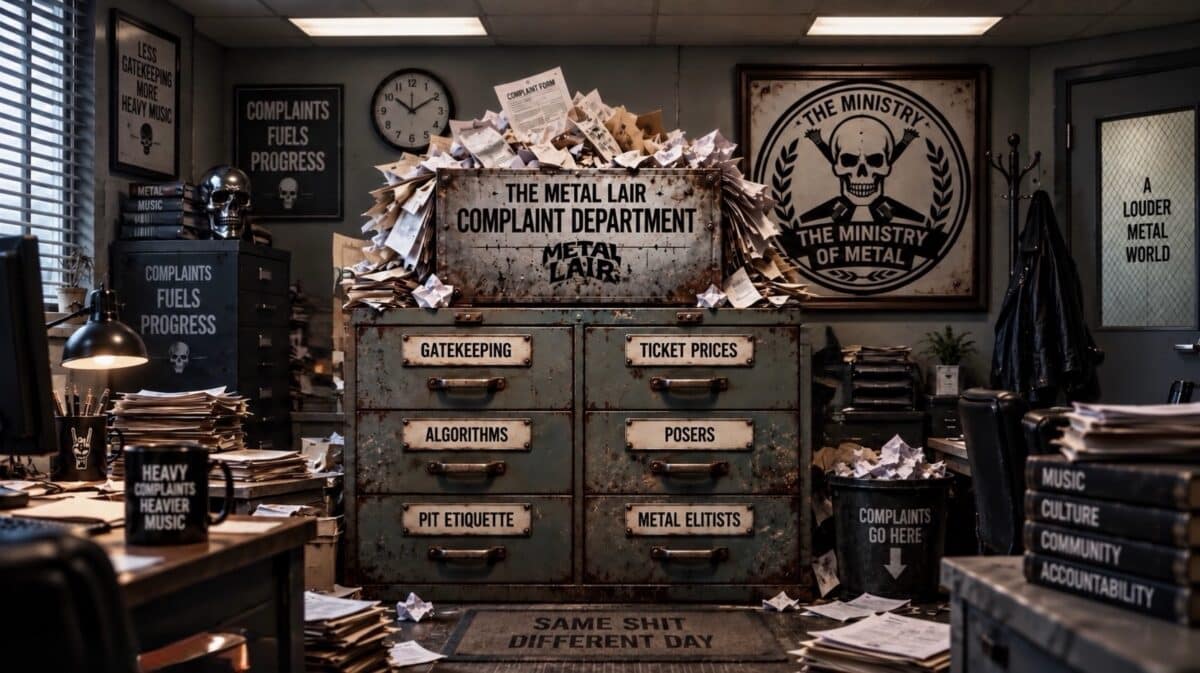
FILE A COMPLAINT WITH THE METAL LAIR COMPLAINT DEPARTMENT
Have a metal-related grievance that needs official investigation?
Bad concert etiquette? Venue bullshit? Festival fuckery? A trend in metal that needs to die? An industry annoyance? Something that’s been pissing you off since 1987? Have a complaint against Metal Lair?
FILE YOUR COMPLAINT
File it with the Complaint Department. Remmy may investigate your grievance in a future installment.
Selected grievances may be investigated, mocked, dissected or otherwise subjected to the questionable judgment of Remmy Chillmister in a future edition of The Metal Lair Complaint Department.
Submission does not guarantee investigation. Remmy has a substantial backlog of things that piss him off.

Join the patrons of Metal Lair
MetalLair.net is a metal zine muttering to itself about SEO and blastbeats at 3 AM, powered by caffeine, riffs, a severe lack of sleep, and a dog wondering why the human is still awake.
Sometimes it’s Kevin passing out mid Seven Deadly Songs.
Sometimes it’s digging up forgotten records no one else is talking about. Always, it’s built for people who actually live this music.
If that sounds like you, you’re already one of us.
Supporting Metal Lair means keeping it independent, loud, and real with no corporate filters, no watered-down takes. If you want to help keep it alive…
Become a patron of Metal Lair.

JOIN THE METAL LAIR NEWSLETTER
No algorithms. No fluff. No watered-down corporate metal coverage.
Subscribe to Metal Lair and get weekly underground features, Seven Deadly Songs, Deep Cuts, interviews, and original metal journalism sent directly to your inbox.