Written By Chris Norris
Songs to Moon often feels less like an album telling you what to feel and more like a psychological test quietly asking what you see.
This is not a heavy album because it keeps feeding you riffs until your fillings vibrate. It is heavy because it gradually removes the armor.
The distortion recedes. The arrangements thin. The safety net disappears. By the time Stoned Jesus reaches the end, what remains feels painfully exposed, like a person standing in the dark with nowhere left to hide.
The mistake is judging Songs to Moon by how heavy it sounds instead of how much weight it carries.
For this Stoned Jesus Songs to Moon review, the real question is not how heavy the album sounds, but how much emotional weight it is willing to carry.
This record does not simply get softer as it progresses. It becomes more vulnerable, more psychologically claustrophobic, and increasingly difficult to escape. The music does not merely decorate the emotional content of the lyrics. It behaves like it.
Claustrophobia becomes repetition, anxiety becomes dissonance, isolation becomes space and resignation becomes silence.
Songs to Moon also lands differently when placed beside the other half of this chapter.
Metal Lair previously spoke with Igor Sydorenko about Songs to Sun and reviewed that album when it arrived, and our more recent Songs to Moon interview digs further into the ideas behind this darker companion piece.
Taken together, the two records feel less like separate releases than opposing emotional poles: one facing the light, the other staring into what remains when it disappears.
STONED JESUS: SONGS TO MOON REVIEW
Under The Skin
That begins immediately with “Under the Skin.” Before the guitars arrive, there is breathing. Deep, heavy, uncomfortable breathing. It places the listener inside a body before the song has even properly begun.
We are not observing anxiety from a distance. We are already trapped inside the physical sensation of it. Then the song hits.
Igor Sydorenko sounds furious. His vocals come out raw and forceful as the music turns heavy, but beneath his lead voice sits something stranger: a second vocal presence that seems to shadow him from underneath. It is not harmony in the comfortable sense. It feels more like intrusion.
A duplicate self. A thought underneath the thought. Something unwanted tracking every movement.
That makes the lyrics about something creeping in and crawling under the skin feel almost literal. The song itself has something living underneath it.
“Under the Skin” becomes the perfect introduction to Songs to Moon because the entire record operates on that principle. The obvious surface is rarely the complete picture.
The aggression hides fear and screaming hides panic. The breathing tells us something is already wrong.
Velvet
“Velvet,” tightens the walls. The opening is sparse, almost suspended in empty air. A solitary drum pulse and a slow guitar figure create a strange sense of stillness, but it is not peaceful.
There is something stalking in the rhythm, a deliberate pulse that briefly recalls the opening tension of Arctic Monkeys’ “Do I Wanna Know?” without sounding anything like it stylistically.
“Velvet” feels trapped. The central riff circles instead of progressing, locking the listener into the same uncomfortable space again and again.
Igor sings about falling from high above, but the song never gives us the relief of impact. There is no bottom. The fall continues, the riff continues. The anxiety continues.
Occasionally the guitar lands on notes that feel deliberately ugly, almost wrong, disrupting whatever balance might have started to form. Then the chorus arrives and does something perversely clever: it becomes catchy.
Existential dread suddenly becomes singable. For a moment, the melody opens up enough to suggest release. Then the song throws you straight back into the same claustrophobic riff. No escape.
“Velvet” becomes suffocating because the repetition is not an accident. It is the mechanism. The music recreates the experience of being trapped inside a thought loop you cannot shut off.
ZYX
Then comes “ZYX,” and even the title is moving backward.
The alphabet has been reversed, which mirrors one of the song’s most important ideas: walking backward from the end.
Musically, it is the first moment on Songs to Moon that feels as though someone might be trying to climb rather than fall.
A warm acoustic guitar opens the track and suddenly there is air in the room again. After the compression of “Velvet,” the effect is startling. There also appears to be a subtle keyboard texture sitting somewhere behind the guitar, less like a separate instrument than an atmosphere hovering around it.
“ZYX” is introspective rather than helpless. The narrator is still hurt. Still uncertain. Still trying to find reasons to continue. But something important has shifted. He is no longer simply being acted upon by the darkness.
He is examining it. He is beginning to recognize it. And recognition creates the first flicker of agency on the album.
The song never turns triumphant. That would feel dishonest. Instead, its beauty feels tentative, like recovery that has barely learned how to stand. He is no longer only the victim.
Syzygy
At the center of the record sits “Syzygy,” the instrumental track, and here Songs to Moon becomes genuinely uncanny.
It begins with an industrial atmosphere that feels less like machinery than weather trapped inside an abandoned building. Wind, static, synthesizer, whatever combination creates it, the result is environmental but wrong.
Then come those strange keyboard notes. They resemble the sound of an old toy piano, the kind of innocent object horror films know exactly how to corrupt.
Suddenly the track feels like an abandoned child’s room in a haunted house, broken glass rattling somewhere down the hall while a toy plays itself.
The imagery is immediate:
Broken childhood, memory and abandonment. Something harmless that has become haunted.
An off-key guitar figure enters over the top, keeping the floor tilted beneath the listener. Then the track transforms.
The lead guitar becomes unexpectedly beautiful. Not merely pretty, but genuinely moving.
Yet beneath it sits another guitar, shadowing the lead in a different register, almost like a ghost track following the melody.
And now the album has done this twice.“Under the Skin” contains the ghost vocal. “Syzygy” contains the ghost guitar. Again, there is something beneath the surface and the primary voice is not alone.
The track moves from eerie to gorgeous without ever completely shedding its unease. Beauty grows out of the nightmare instead of replacing it.
Then, just when the guitar seems capable of carrying the song somewhere transcendent, the music falls away and those strange little keyboard notes return, repeating in the dark. “Syzygy” does not really end. It leaves the door open.
Jackal
Then comes “Jackal.” Sinister and completely unhinged.
The opening is ambient and restrained, built around slow guitar and cymbal shimmer with very little rhythmic weight. Igor enters almost as a narrator rather than a singer, delivering the song like someone recounting a nightmare they have already survived.
“In the darkness…”
From there, the track begins to mutate. At first, the repeated command to “go to sleep” sounds almost soothing. Then it becomes coercive. Then threatening. By the time Igor is growling it, the lullaby has turned into an order.
The song itself is waking up while the voice keeps telling everyone else to sleep. That contradiction gives “Jackal” its deranged power.
The arrangement grows heavier. His delivery becomes more furious. The narration becomes increasingly feverish as the lyrics move through social collapse, poisoned water, depression, hopelessness, numbing content, and a population sleepwalking toward its own destruction.
The nightmare expands from the individual to civilization itself.
There is something in Igor’s delivery here that recalls the theatrical unease of the Marilyn Manson and Trent Reznor era of Antichrist Superstar, not because the music sounds similar, but because of the atmosphere. The voice feels less like conventional singing and more like a damaged narrator guiding us through a grotesque vision.
“Jackal” begins almost softly and becomes increasingly coercive, until “go to sleep” no longer sounds comforting at all. It sounds like something being barked from inside a collapsing world.
Window in My Room
And then Songs to Moon reaches “Window in My Room.”
Depressing as fuck. The lyrics are almost deceptively simple.
Two trees.
A house.
Blue sky.
Rain.
Flowers.
Sunset.
The vocabulary has become nearly childlike, stripped of ornament and metaphor, and that simplicity makes the song more disturbing rather than less.
These are harmless images. Ordinary images. The kinds of things someone might point to in a picture and ask, “What do you see?”
Yet the emotional reality underneath them is confinement.
“My room is my whole world.”
The outside exists, but only through glass.
The narrator can smell the trees, watch the rain, observe the sunset, but participation has been replaced by observation. The world has narrowed to the dimensions of a room, and eventually even the idea of leaving no longer feels desirable.
That is what makes the song so bleak. It is not panic. It is adaptation to isolation.
Musically, “Window in My Room” created one of the strongest images of the entire album for me. Listening to it feels like standing inside an endless cemetery on a dark, overcast day. Mist hangs low over everything. The world appears drained into black and white. There is no sun, no warmth, no break in the clouds.
The lyrics are not about a cemetery. The music simply makes the world feel dead enough to become one.
One More Empty Day
By the time “One More Empty Day” begins, the album finally places the listener back outside. Someone is walking through the world again.
The opening contains street noise and city atmosphere beneath plucked strings, as though we have stepped out of the room and into public life. Cars move. People exist. The world continues normally but the narrator does not.
“One More Empty Day” has a bluesy quality, and blues has always carried that strange alchemy where suffering becomes rhythm. You can tap your foot to misery.
This song weaponizes that contradiction. It is catchy, cinematic and still profoundly bleak.
The track feels made for a film scene in which someone walks through a crowded city on autopilot while flashes of everything that brought them here appear around them: arguments, sleepless nights, tears, loneliness, silence.
The person keeps moving through the city as life goes on around them. But emotionally, they remain disconnected.
That is perhaps the cruelest place Songs to Moon could have ended.
Not with a dramatic collapse or primal scream. But with routine, another morning. Another performance of normality. Another attempt to find enough strength to survive one more empty day.
The entire record feels as though the forecast is dark and overcast with a 100% chance of thunderstorms. The pressure never fully lifts. By the end, it feels like someone is sitting on your chest and you cannot quite draw a full breath.
This is a heavy album not in the obvious way. Its weight comes from dread, isolation, fractured perception, resignation and the slow erosion of hope. It does not merely describe those states. It makes you inhabit them.
By the end of this Stoned Jesus Songs to Moon review, heaviness has almost stopped meaning distortion at all. It has become pressure, isolation, dread and the exhausting work of surviving another day.
Songs to Moon is a funeral procession for the will to live, scored in minor keys and static. An elegy written in the dark by someone who stopped expecting dawn.
It does not sound like sorrow so much as the aftermath of it, grief that has outlived the one it mourned and learned to breathe on its own.
Each track descends another stair into a cellar where the light was never installed.
Songs to Moon feels less listened to than survived, like a fever dream you wake from still carrying the cold.
The music does not simply accompany the lyrics. It translates them. Claustrophobia becomes repetition. Anxiety becomes dissonance. Isolation becomes space. Resignation becomes silence.
There is real courage in making something this exposed and refusing to soften it for the listener.

Metal Lair Awards Songs To Moon 4/5 Metal Horns
Preorder Songs To Moon Here

Tracklist:
1. Under the Skin
2. Velvet
3. ZYX
4. Syzgy
5. Jackal
6. Window in My Room
7. One More Empty Day

Live Lineup:
Igor Sydorenko — Vocals, Guitar
Andrew Rodin — Bass, Backing Vocals
Ihor Biriuchenko — Drums, Percussion
Stoned Jesus Online:
About the Author
Chris Norris is the voice behind Metal Lair’s global metal coverage, World Metal Weekly. From funeral doom in the north to thrash born in the streets. Known for spotlighting bands before algorithms notice them and for writing with the precision of a scalpel… or a well-sharpened guitar pick. Vinyl collector. Night-shift journalist. Believes heavy music has no borders.
Read More From This Author:
GÅTE Sigil Interview: Folklore, Magic, Eurovision and a New Chapter
Stoned Jesus Songs to Moon Interview: Igor Sydorenko on Darkness, Descent and the Trilogy
Rotting Christ Interview: Sakis Tolis on 35 Years of Greek Metal, History and Legacy
Green Carnation Part III: The Messiah Complex Interview

No algorithms. No fluff. No watered-down corporate metal coverage.
Subscribe to Metal Lair and get weekly underground features, Seven Deadly Songs, Deep Cuts, interviews, and original metal journalism sent directly to your inbox.

Join the patrons of Metal Lair
MetalLair.net is a metal zine muttering to itself about seo and blastbeats at 3 AM powered by caffeine, riffs, a severe lack of sleep, and a dog wondering why the human is still awake.
Sometimes it’s Kevin passing out mid Seven Deadly Songs.
Sometimes it’s digging up forgotten records no one else is talking about.
Always, it’s built for people who actually live this music.
If that sounds like you, you’re already one of us.
Supporting Metal Lair means keeping it independent, loud, and real with no corporate filters, no watered-down takes. If you want to help keep it alive…
Become a patron of Metal Lair.
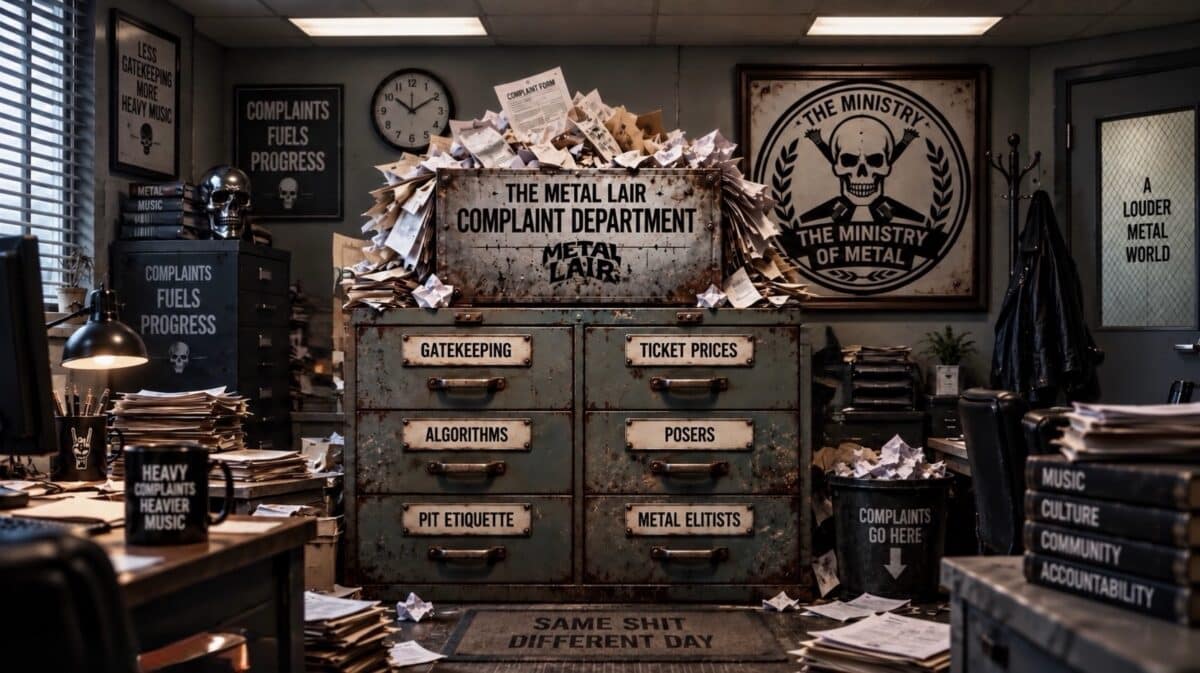
FILE A COMPLAINT WITH THE METAL LAIR COMPLAINT DEPARTMENT
Have a metal-related grievance that needs official investigation?
Bad concert etiquette? Venue bullshit? Festival fuckery? A trend in metal that needs to die? An industry annoyance? Something that’s been pissing you off since 1987? Have a complaint against Metal Lair?
FILE YOUR COMPLAINT
File it with the Complaint Department. Remmy may investigate your grievance in a future installment.
Selected grievances may be investigated, mocked, dissected or otherwise subjected to the questionable judgment of Remmy Chillmister in a future edition of The Metal Lair Complaint Department.
Submission does not guarantee investigation. Remmy has a substantial backlog of things that piss him off.