Written by Lucien Drake
The Judas Priest Ian Hill retirement marks the end of an extraordinary chapter in heavy metal history. On October 9, 2026, founding-era bassist and longest-serving member Ian Hill announced his departure from the legendary British band after 56 years, citing worsening arthritis, a serious shoulder injury, and the physical demands of performing.
At 74, Hill leaves behind a legacy that stretches from the earliest days of Judas Priest to their emergence as one of heavy metal’s most influential institutions.
His departure also brings a significant lineup change, with Davey Rimmer of Uriah Heep and Elegant Weapons stepping in as the band’s new bassist.
But the story behind Hill’s retirement is considerably more personal than a change in personnel.
Judas Priest Ian Hill Retirement Comes After Years of Physical Struggles
In his official statement, Hill explained that he had always approached questions about retirement with a simple principle: he would continue performing as long as he could deliver the standard audiences deserved.
Unfortunately, years of worsening arthritis have made that increasingly difficult.
The condition has affected his shoulders, right hand, and knees, requiring medication, topical treatments, and cortisone injections to manage the pain.
During Judas Priest’s recent European performances, those difficulties were compounded by a damaged tendon in his left shoulder.
The injury occurred shortly before the encores at the band’s Brussels performance and ultimately prevented Hill from completing the subsequent London show.
Rimmer, who had already been preparing as a potential substitute, stepped in.
For Hill, the incident underscored a difficult reality. Continuing to tour could no longer be taken for granted, even with medical treatment.
He also acknowledged that more than five decades on the road had come at a cost to his family life.
His decision to retire reflects not a loss of commitment to Judas Priest, but a recognition that his health and time with loved ones now deserve priority.
The Bassist Who Helped Build Judas Priest’s Heavy Metal Legacy
Ian Hill joined Judas Priest in 1970, long before the band became synonymous with leather, studs, twin-guitar harmonies, and the unmistakable voice of Rob Halford.
While other musicians entered and departed the lineup over the decades, Hill remained a constant presence.
His bass playing formed an essential foundation beneath some of heavy metal’s most recognizable recordings.
From the early experimentation of Rocka Rolla and Sad Wings of Destiny to the steel-plated assault of British Steel, Screaming for Vengeance, and Painkiller, Hill helped anchor a catalog that shaped generations of musicians.
His playing rarely demanded the spotlight. Instead, he provided the muscular rhythmic support that allowed Judas Priest’s guitars and vocals to dominate without sacrificing the music’s underlying momentum.
There is something fitting about that consistency. Heavy metal history often celebrates the flamboyant frontman, the heroic guitarist, and the drummer whose double-kick assault rearranges your internal organs.
But the bassist standing beneath that sonic architecture is just as essential. For more than half a century, Ian Hill was that foundation.
Davey Rimmer Takes Over Following Ian Hill’s Departure
Judas Priest have confirmed that Davey Rimmer will replace Hill.
Rimmer brings substantial experience through his work with Uriah Heep and Elegant Weapons, the latter featuring Judas Priest guitarist Richie Faulkner.
The transition was already underway before the retirement announcement, as Rimmer had learned the band’s live material in preparation for a possible emergency substitution.
His performance during the London concert demonstrated that he could step into the role under demanding circumstances.
Nevertheless, replacing Hill is about considerably more than mastering the bass lines.
He wasn’t simply another member of Judas Priest. He was the group’s longest-standing musical constant, connected to virtually every stage of its evolution.
Rimmer now inherits a position embedded in the band’s identity.
Hill himself endorsed the appointment and expressed confidence in his successor.
Ian Hill Contributed to Judas Priest’s Next Album Before Retiring
One particularly encouraging detail emerged from Hill’s farewell statement.
Despite his physical difficulties, he confirmed that he had recorded bass lines for material intended for Judas Priest’s next album.
That means his musical contributions may continue to be heard even after his retirement from the band.
The forthcoming project represents another chapter in Judas Priest’s remarkable longevity following the release of Invincible Shield in 2024.
No confirmed release date for the next album was provided in Hill’s retirement announcement.
For longtime fans, the possibility of hearing his playing on another Judas Priest record offers a meaningful connection between the band’s past and its future.
Judas Priest Moves Forward, But an Era Has Ended
The Judas Priest Ian Hill retirement carries a particular emotional weight because his presence was so deeply woven into the band’s identity.
Heavy metal has never been especially comfortable with endings.
Its heroes are expected to remain immortal, delivering blistering performances well into the decades when most people have happily abandoned any obligation to stand beneath blinding lights and deafening amplifiers.
But musicians are human beings, and no amount of devotion can suspend the physical consequences of time.
Hill spent 56 years helping build something that will outlive every musician who contributed to it. That is an extraordinary achievement.
Judas Priest will continue, and Davey Rimmer deserves the opportunity to establish his own place in the band’s ongoing history. Yet Hill’s departure remains a landmark moment.
The man who stood at the foundation of Judas Priest for more than half a century has finally put down his bass.
And the music he helped create will continue shaking the walls long after the stage lights go dark.
Read Ian Hill’s complete farewell statement on the official Judas Priest website

About The Author:
Lucien Drake is a writer and archivist at Metal Lair, contributing across features, essays, cultural commentary, and long-form series including Deep Cuts, Road Riffs and editorial projects exploring music, memory, and resistance.
Known for treating heavy music as living history rather than nostalgia, Drake focuses on influence over canon, context over hype, and the stories that survive outside official timelines.
Read More From Lucien Drake:
AMON AMARTH – THE ALLFATHER AWAKENS REVIEW: THE OLD GODS STILL HAVE TEETH
Metal, Censorship , and The Old War That Never Ends
The Underground Never Needed Your Approval – Only the Real Ones Survived
Before Algorithms Hunting Metal Was Bloodsport
The Metal Sex Playlist: Bang Your Head… and Each Other

No algorithms. No fluff. No watered-down corporate metal coverage.
Subscribe to Metal Lair and get weekly underground features, Seven Deadly Songs, Deep Cuts, interviews, and original metal journalism sent directly to your inbox.

Join the patrons of Metal Lair
MetalLair.net is a metal zine muttering to itself about seo and blastbeats at 3 AM powered by caffeine, riffs, a severe lack of sleep, and a dog wondering why the human is still awake.
Sometimes it’s Kevin passing out mid Seven Deadly Songs.
Sometimes it’s digging up forgotten records no one else is talking about.
Always, it’s built for people who actually live this music.
If that sounds like you, you’re already one of us.
Supporting Metal Lair means keeping it independent, loud, and real with no corporate filters, no watered-down takes. If you want to help keep it alive…
Become a patron of Metal Lair.
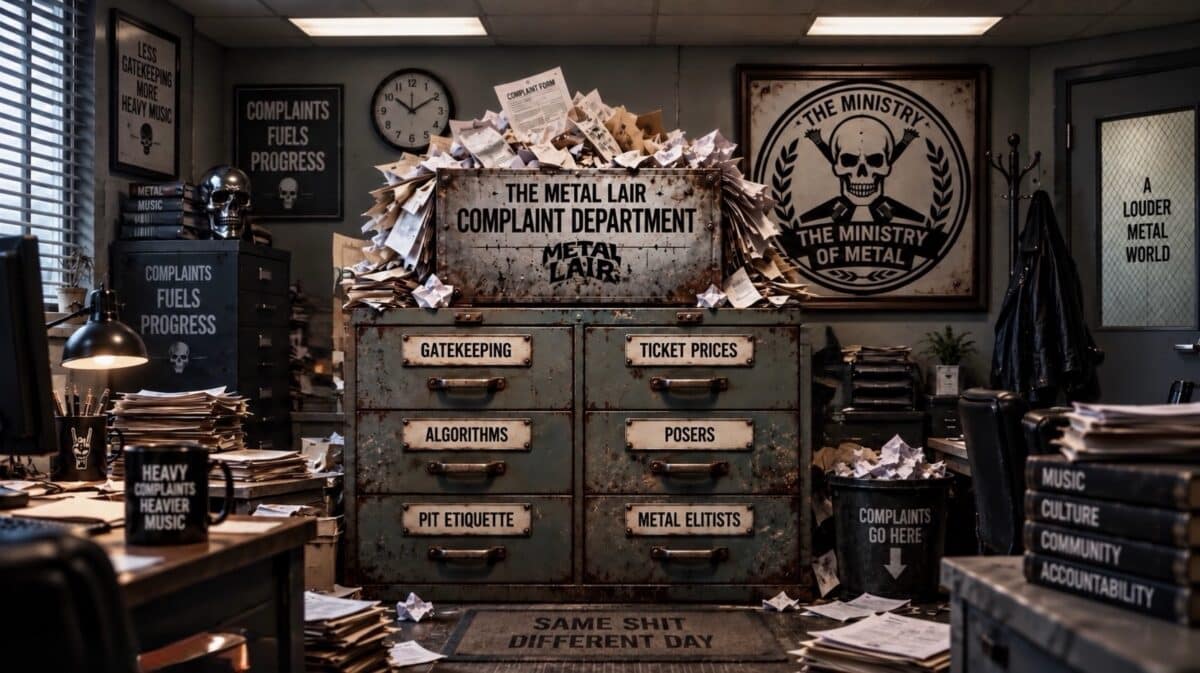
HAVE A METALHEAD COMPLAINT?
“People roundhouse-kicking” in the pit grinding your gears? Gatekeepers questioning whether you’re “metal enough”? Frustrated with getting hit in the head by peoples smelly shoes at a concert?
Whatever’s poisoning your particular corner of the metal community, file an unofficial complaint with The Metal Lair Complaint Department.
Vent your venom. Name the offense. Make your case.
Your complaint could be featured in next week’s issue of The Metal Lair Complaint Department.