Written By Sabbatha Ashvale
Women in Metal: The Shatterers
Five Voices That Crossed the Line and Burned It Behind Them
Metal history loves to pretend it’s neutral. It isn’t.
It’s loud about who gets canonized, who gets footnotes, and who gets erased once the dust settles. Women didn’t “enter” metal politely over time – they ruptured it, ripped it open, and forced the genre to evolve around their presence whether it wanted to or not.
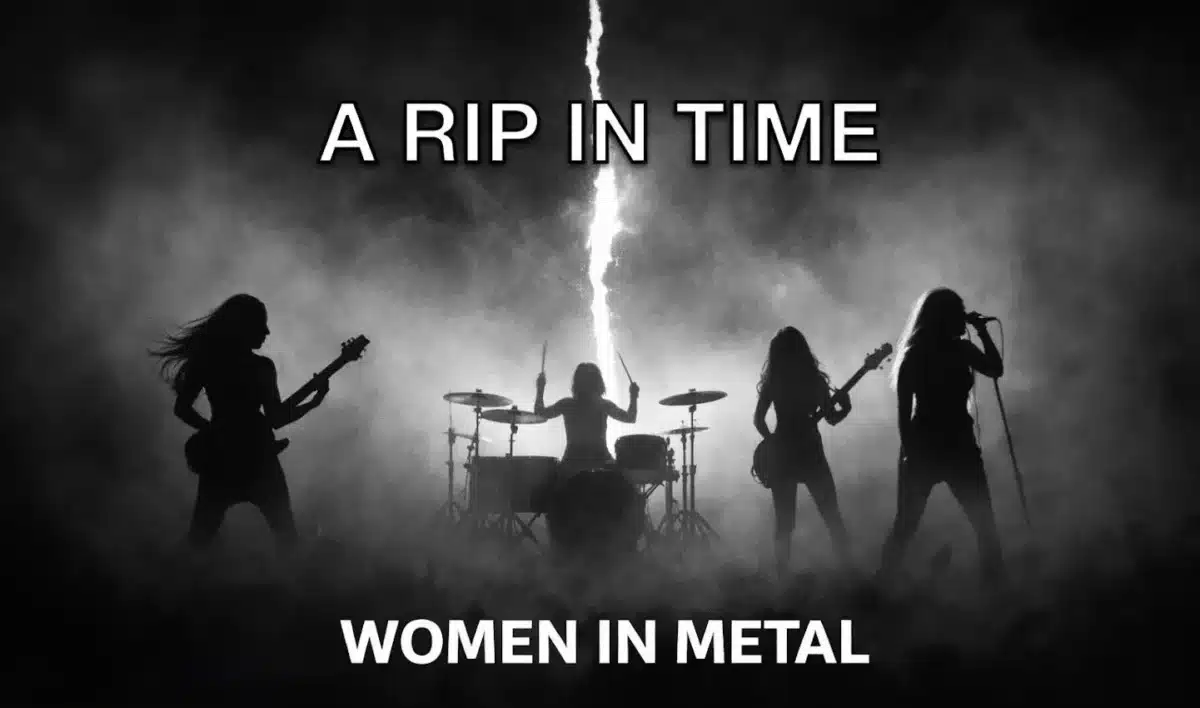
A Rip in Time: Women in Metal isn’t about celebration. It’s about impact. These aren’t artists who waited for permission, softened their edges, or played nice with expectation.
They crossed lines, burned the maps behind them, and left scorched ground where the rules used to stand.
Explore previous chapters of A Rip in Time: Women in Metal, including chapters such as The Dangerous Ones, The Rebellious Ones and The Defiant Ones.
Ann Wilson didn’t ask for authority, she took it.
Julie Christmas turned vulnerability into a weapon.
Dorthia Cottrell made restraint heavier than violence.
Stella Donnelly proves clarity can be brutal.
Sofia Isella carved discomfort into art and dares people to sit with it.
This isn’t a list. It’s a fracture line, five moments where the genre shifted and never fully recovered.
Good. It needed the damage.
Ann Wilson . Julie Christmas . Dorthia Cottrell . Stella Donnelly . Sofia Isella
A Rip in Time: Women in Metal. A Metal Lair Original Series
A Rip in Time: Ann Wilson (Heart)
Moment: Magic Man. That’s the ignition point. Not “Barracuda.” Not “Crazy on You.” Those are canon, but they came after the door was already blown off its hinges.
It was Heart’s first major hit and the song that introduced Ann’s voice to a mainstream audience.
It shattered expectations immediately. A woman singing with command, range, and erotic mystique without novelty or apology.
It announced that this wasn’t a “female-fronted band” moment, this was a band with authority, period.
Deep Cut: Dream of the Archer
Not the radio staple, but the threshold. A moment where folk mysticism and hard rock collide, where Ann’s voice feels less like performance and more like invocation.
It’s the opposite of spectacle. It’s precision intimacy. Music that doesn’t perform emotion, it contains it.
The piece opens with sonic ancient weapons of auditory destruction from the mandolin family(Nancy Wilson’s secret blade) including octave and bouzouki-adjacent textures. This piece will wreck you in the best way!
They’re not just playing together, they’re locked into perfect timing of medieval tension.
Ann begins to sing with her signature deep, velvety, full-bodied voice. She doesn’t overpower the delicacy underneath, she grounds it with precision mastery. Very few can sing authoritatively over fragile instrumentation without crushing it.
That mid 70’s modal, renaissance shimmering intro language – Dorian / Aeolian modes, droning resonance, court music tension was not common in rock at that time.
This isn’t “Heart accidentally sounding prog.” This is Heart quietly laying groundwork that metal would later pick up, amplify, and mythologize.
Why This One:
Before Ann Wilson, power was coded as masculine. Volume was coded as male. Authority belonged to men with guitars slung low and egos slung lower.
Then Ann opened her mouth and the rules broke. Not bent. Broken. Her voice didn’t ask for space in rock music, it claimed it, wide and unyielding, operatic without polish, feral without apology.
Ann Wilson didn’t just sing loudly, she sang authoritatively in a space that had no language for women who refused softness.
She erased the false binary between beauty and power, between control and abandon. Every woman who growled, wailed, screamed, or stood unflinching at the front of a heavy band after her is standing in the aftershock of that rupture.
A Rip in Time: Julie Christmas (Battles of Mice, Made Out of Babies)
Moment: At the Base of the Giant’s Throat: The track that introduced a wider audience to Julie’s ability to weaponize vulnerability, stretching tension to the breaking point and redefining what emotional extremity could sound like in heavy music.
Julie Christmas pushed past every boundary that tried to domesticate women in extreme music. She refused prettiness, refused consistency, refused the safety of genre.
Her voice is not there to comfort or impress, it is there to confront. In her wake, heaviness stopped being about volume alone and became something far more dangerous: exposure without armor.
Deep Cut: Bones in The water. This lives in the shadow of the bigger Battle of Mice moments, which is exactly where a deep cut should sit.
Where “At the Base of the Giant’s Throat” announces Julie to the world, “Bones in the Water” keeps her there, quietly, uncomfortably.
It trades overt rupture for slow dread, the feeling of being pulled under rather than struck.
It showcases Julie’s control over restraint, atmosphere, and psychological pressure, not just vocal extremity.
Why This One:
Julie Christmas arrived like a breach in the wall between sound and survival. Where others performed heaviness, she embodied it.
Her voice did not behave like an instrument meant for pleasure or control, it fractured, convulsed, retreated, and returned sharpened.
In Made Out of Babies and Battle of Mice, she tore open a space where emotional extremity and sonic violence became inseparable, where the listener was no longer passive but implicated.
A Rip in Time: Dorthia Cottrell (Windhand)
Moment: Orchard: The song that carried Windhand beyond the underground and established Dorthia’s voice as a defining force in modern doom, equal parts haze and gravity.
With Windhand, she transformed doom metal into something suffocating and intimate, not a wall of sound, but a closing room.
Her voice doesn’t dominate the mix; it haunts it, drifting through distortion like smoke through ruins.
Deep Cut: Amaranth – Reflection of the Negative (2013), Windhand’s split with Cough.
Why This One:
Dorthia pushed the boundary of what extreme heaviness could sound like without aggression.
Where others chased speed or spectacle, Dorthia Cottrell slowed everything down until heaviness became unbearable.
She made vulnerability crushing, restraint oppressive, and silence as heavy as any riff.
In a genre often obsessed with force, she proved that gravity alone is enough to pull everything under.
A Rip in Time: Stella Donnelly
Moment: “Boys Will Be Boys” – the song that propelled Donnelly into the spotlight by refusing metaphor and stating its truth plainly, forcing listeners to confront the subject without escape.
Stella Donnelly didn’t arrive screaming; she arrived unflinching. In a landscape trained to soften women’s anger or dress it up as irony, she spoke plainly.
That plainness landed like a slap. Her songs confront abuse, power, resentment, and self-preservation without metaphor as a shield. The rupture wasn’t sonic. It was ethical.
Deep Cut: Die. Often overlooked beside the cultural impact of “Boys Will Be Boys,” “Die” captures a quieter, more unsettling form of fear. The moment before harm, when the body recognizes danger the mind is still negotiating.
The song isn’t about abuse in hindsight, it’s about anticipatory dread, recklessness, and instability experienced in real time.
Donnelly writes from inside that threshold, where love, familiarity, and alarm coexist. Repeating “I don’t wanna die” isn’t dramatics, it’s the nervous system speaking plainly.
In refusing metaphor or resolution, the song documents a form of awareness that’s rarely given language, let alone legitimacy, especially with women.
Why This One:
Stella pushed the boundary of what confrontation in music could look like without distortion, volume, or threat posture.
She proved that clarity can be heavier than noise, that naming the wound is sometimes more dangerous than screaming about it.
In doing so, she carved space for a different kind of extremity, one rooted in truth, not theatrics.
A Rip in Time: Sofia Isella
Moment: Doll People. This is the rupture. The track that pushed her out of the underground and into wider cultural visibility.
Not because it was palatable, but because it was confrontational, unsettling, and impossible to ignore because she’s indicting a culture
This song is about commodification. How women are turned into objects that exist to be consumed, admired, violated, categorized, and sold, while being denied interiority.
It exposes the machinery around women’s bodies and identities with surgical precision and people shared it because it was relatable and made them uncomfortable in public.
The doll people are not men. She’s not saying men are the dolls. She’s saying the system isn’t human.
Women are allowed to be admired, consumed and desired …but not autonomous.
Art doesn’t get consent.
Art doesn’t get a voice.
Art exists for the viewer.
She’s exposing how femininity is framed as passive spectacle, even when it’s alive.
“Wife, whore, mistress, maid, mother”
This is taxonomy. A checklist. A prison with different costumes where you exist for someone else’s use.
No matter which role you’re assigned, the function is the same:
Deep Cut: Cacao And Cocaine. It’s eerie, minimal, and psychologically uncomfortable in that slow burn way. The kind of track that crawls under your skin instead of punching you in the face.
Sparse production, tension over hooks, vulnerability sharpened into something unsettling. It shows restraint, not just provocation.
The song captures the self awareness of craving danger for its intensity, and the simultaneous fear of what that craving says about how far someone is willing to go to feel alive.
Why This One:
Sofia Isella is very Metal Lair energy, even if she lives in the borderlands between indie, metal, industrial, dark pop, and theatrical menace. We are after all a rock and metal culture website. Not that I have to defend my choices here.
Sofia Isella doesn’t fit neatly into a genre box, and that’s the point. Her music lives in the space where discomfort becomes art. Where vulnerability, anger, and control all blur together.
She isn’t trying to be palatable, and she’s not performing femininity for approval. She weaponizes it, dissects it, and then leaves the pieces on the floor.
What makes Sophia compelling isn’t shock value, it’s agency. Every track feels deliberate, self-authored, and emotionally precise.
In a landscape where women are still expected to either soften themselves or over explain their power, she does neither.
She builds her own atmosphere and dares the listener to stay inside it. That tension between beauty and menace, control and exposure is exactly why she belongs here.
Metal doesn’t move forward because it wants to. It moves because someone forces it to.
Each artist isn’t there to prove women belong in metal, that argument is already dead. They’re there because they changed the physics of the space they entered.
They rejected the lie that heaviness has to look a certain way, sound a certain way, or come wrapped in masculinity to be legitimate.
They proved that power can be operatic, fractured, suffocating or surgically precise.
This series isn’t interested in approval or inclusion narratives. It documents disruption.
The line has already been crossed. The door already kicked in. The burn marks are permanent. And if metal history still feels uncomfortable with that, good.
That discomfort is the point.
Missed last weeks A Rip in Time: Women in Metal? Find it here.
FAQ – A RIP IN TIME: WOMEN IN METAL
Q: What is A Rip in Time: Women in Metal?
A Rip in Time is Metal Lair’s ongoing tribute to the women who’ve reshaped heavy music. Each installment spotlights a groundbreaking artist who challenged the genre’s boundaries from vocal ferocity to creative evolution, showing that metal’s history isn’t just told through distortion, but through defiance.
Q: What makes this series different?
It’s not a checklist of “women in music.” It’s a time-ripping journey through genres, eras, sounds, and revolutions. Each feature dives into how these artists rewrote their own rules, their riffs, their philosophies, their fire.
Q: Who’s been featured so far?
Each chapter covers a distinct voice in metal’s lineage. Figures like Doro Pesch, Floor Jansen, Angela Gossow, Sabina Classen, and Tatiana Shmailyuk and more have been featured. With more icons and unsung heroes to come.
Q: How often does the series update?
A Rip in Time appears periodically throughout the year as new chapters are researched and written. It’s designed to evolve, not just repeat.
Q: Does Metal Lair have other series like this?
Yes! Metal Lair runs several signature series that explore every corner of heavy music:
- Seven Deadly Songs – A weekly roundup of the most unholy new releases.
- Deep Cuts – Hidden gems and lost recordings from rock and metal history.
- Metalhead Horoscopes – Weekly forecasts laced with riffs, attitude, and a lucky song for every sign.
- World Metal Weekly – A global passport through the underground, one country at a time.
Explore more from the series:
A Rip in Time: Women in Metal
ABOUT THE AUTHOR
Sabbatha Ashvale is Metal Lair’s resident wildfire in eyeliner. A music journalist and storyteller who writes like she’s swinging a torch through the catacombs of heavy music. She’s equal parts historian and shit-stirrer. Her work focuses on artistry, history, and the often overlooked creators who define metal’s evolving future. She brings depth, grit, and a razor sharp perspective to every piece she writes.
Support Metal Lair
Metal Lair runs on passion, riffs, and far too much coffee. If you enjoy the interviews, reviews, and recurring series, you can support the site here: