Written By Sabbatha Ashvale
The Rebellious Ones
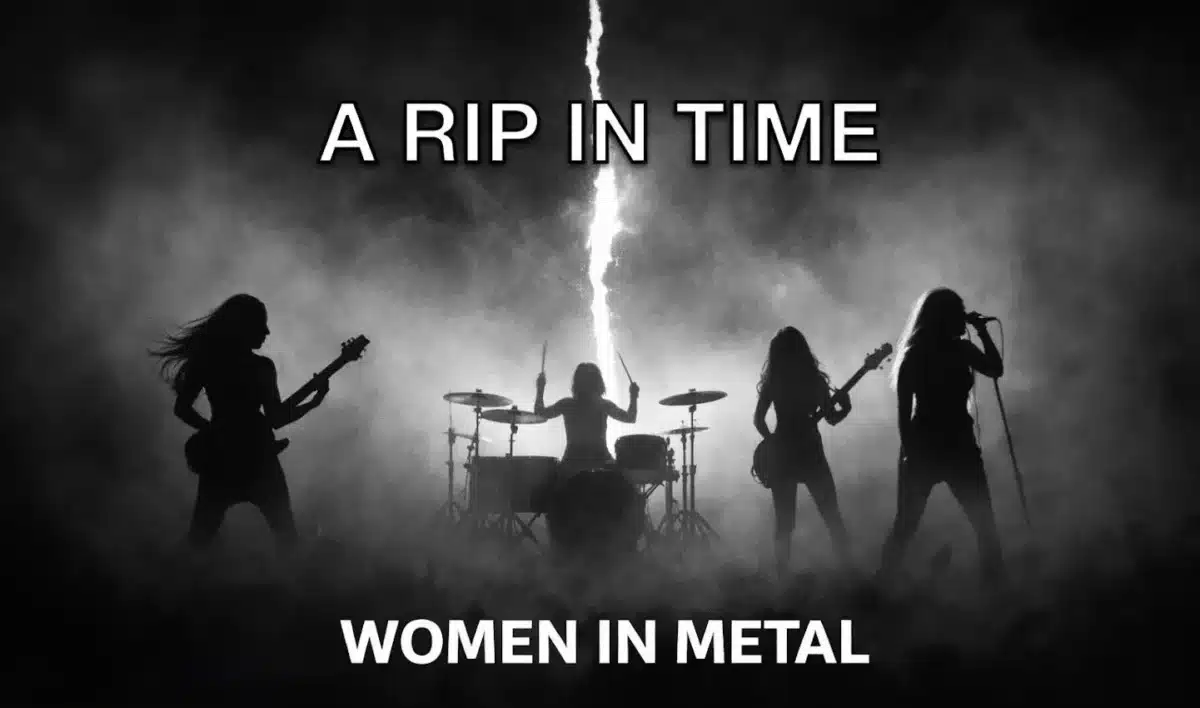
A Rip In Time: Women In Metal A Metal Lair Original Series
Metal loves to pretend it’s linear: Sabbath → Maiden → Thrash → Death Neat, tidy and chronological. But that’s a lie.
Because every major rupture in this culture was caused by someone who wasn’t “supposed” to be there.
Women didn’t ask for permission to enter metal. They just walked in, ripped the timeline in half, and left the gate open behind them.
Some changed the rules by force. Some built new ones in real time. Some don’t even bother with rules at all. This isn’t a roll call. This is a record of structural damage. the kind that reshapes the future.
Metal didn’t “make room” for them. They took it.
“Not groupies. Not guests. Architects of the sound.”
A Rip in Time — Angela Gossow (Arch Enemy, 2001–2014)
When Angela Gossow opened her throat on Wages of Sin, she didn’t “become the female face of death metal.”
She broke the sentence structure entirely. She didn’t enter the genre, she re-defined the vocal baseline. Her harsh vocals weren’t a novelty. They were canonical.
The fact that she did that in 2001, pre-YouTube, pre-social-meme virality means she carved that reputation the old way: touring, magazines, word-of-mouth. Blood and asphalt.
And the quiet twist after:
She didn’t fade.
She became the machinery.
Angela stepping into management, handling deals, touring, business architecture, is the part most people overlook.
That’s a second career most metal frontmen age into badly, if at all.
She did both.
The pivot moment wasn’t just “a woman who growled like a demon.” The scene already had extreme female vocals here and there. It was that she stepped in as the front of an already-established, already-respected, already-male-coded melodeath machine… and the band got bigger.
That’s the tell.
Moment: Wages of Sin.
Gossow steps into the lion’s den, no “female vocalist” asterisk, no gimmick and suddenly metal kids realized the gate was imaginary.
Track To Embed: “Ravenous”
Why This One:
That’s the cut where she burns the pretense right off the culture. the venom. the phrasing. the cadence. it’s like she was saying: I’m not here to be inspiring. I’m here to rip your face off.
A Rip in Time — Floor Jansen (Nightwish, Revamp, After Forever)
When Floor Jansen stepped into Nightwish, she didn’t “prove” women could front a symphonic metal titan, she made the question obsolete.
She was the moment the genre stopped asking if a woman could do it and started asking if anyone else could keep up with her.
Jansen doesn’t sing “on top of” the orchestral density. She rides it. She threads breath control and power like she’s piloting a jet through a storm and giving the storm directions.
The Part People Miss:
Floor didn’t inherit symphonic metal, she re-architected the ceiling height of what vocals could be in that arena.
Her register, her range, her head voice, her chest voice, her ability to shift operatic timbre into pop clarity into metal command. She normalized world-class technique inside a genre that often treats technique as decoration.
She wasn’t “exceptional for a woman. She was simply exceptional, period. And that’s the rip. She changed the standard, not the stereotype.
Moment: (When she became the full-time vocalist of Nightwish)
Track To Embed: “Ghost Love Score” (Live)
Why This One:
Because that’s the performance where the internet finally admitted one simple, uncomfortable truth: Floor didn’t step into someone else’s legacy. She became the reference point.
A Rip in Time — Doro Pesch (Warlock / Solo)
Before there was a scene that knew how to categorize female power in metal there was Doro Pesch. And she didn’t ask for a lane. She carved the road.
When Warlock hit in the early 1980s, the industry didn’t have language for a woman fronting a true metal band.
Journalists wrote about her like she was “breaking in.” The better story is this: She didn’t break in. She held the door open and made metal deal with her.
Her voice wasn’t fragile or “pretty.” It was a stainless steel leather-jacket timbre, smoke-and-gasoline phrasing.
Her stagecraft wasn’t seduction; it was command. And the longevity is the part people still underestimate.
Pesch didn’t become a legend because she was “first.” She became a legend because she never left. Her legacy is the one fact most metal historians whisper but rarely write:
Doro didn’t just prove women could front metal bands, she made it so normal that the question stopped being interesting.
Moment: Burning the Witches
Track To Embed: All We Are
Why This One:
That chorus is the thesis. Anthemic. Defiant. A rallying cry that wasn’t aimed at the boys. It was aimed past them.
A Rip in Time — Sabina Classen (Holy Moses)
When Sabina Classen stepped behind the mic in Holy Moses, she wasn’t “breaking into metal as a woman.” She was detonating the perimeter fence itself.
Her voice wasn’t pitched for acceptance, it was pitched to wound. Her delivery predated the internet, predated “extreme female vocals discourse,” and predated the era where screaming women became a marketing bullet point.
1987’s Finished With the Dogs is the tape that should’ve been written into the textbook but the scene was too young, too territorial, and too male to realize what was actually happening.
She was doing extreme vocals before extreme metal knew how to categorize that act. That’s the glitch in the timeline.
Sabina isn’t the footnote. She’s the preface.
Moment: Finished With the Dogs. Sabina chewed through thrash like a bone grinder.
Track To Embed: “Finished With the Dogs”
Why This One:
This is the sound of a future genre being summoned before the genre name existed. Not “female fronted, not novelty, not exception. Proto-death metal technique before the paperwork.
Sabina didn’t arrive late. Everyone else arrived late to her.
A Rip in Time — Tatiana Shmailyuk (Jinjer)
Tatiana Shmailyuk didn’t just shift vocal style. She weaponized the jump-cut. One second, molten soul/jazz phrasing…next second, blast furnace low gutturals. That wasn’t a “trick.” That was genre fluidity used as a threat vector.
Jinjer hit the ears of the scene at a moment when metal was choking on purist gatekeeping and Tatiana proved the membrane was thinner than assumed. Her transitions weren’t novelty. They were architectural.
Sudden timbral pivots became part of the composition, not garnish. This is where the stack collapsed. She didn’t compromise identity to fit subgenre, she snapped subgenres to fit her.
The message was brutal in its clarity. The scene can handle rapid identity shifts and it didn’t fracture.
Moment: “Pisces” live session (the viral ignition).
Track To Embed: Pisces — Napalm Records
Why This One:
You can literally see the moment half the old guard realized genre borders were paper walls. Tatiana didn’t cross them, she dissolved them.
We’ll see you in the next chapter of A Rip In Time: Women In Metal.
A Rip In Time: Women In Metal. A Metal Lair Original Series
If you enjoyed this you might like our Mallavora Interview – What If Better Never Comes?
Legacy isn’t the past tense in metal. It’s the fuse underneath whatever comes next. These five women didn’t just survive the genre, they altered its physics.
And every new girl who walks into a rehearsal space, a studio, a stage, a screaming pit… inherits the cracks they hammered into the foundation.
Metal evolves because someone is always daring it to go further. If the timeline breaks again…good. That’s how we know the future is still alive.
FAQ: A RIP IN TIME – WOMEN IN METAL
Q: What is A Rip in Time: Women in Metal?
A Rip in Time is Metal Lair’s ongoing tribute to the women who’ve reshaped heavy music. Each installment spotlights a groundbreaking artist who challenged the genre’s boundaries from vocal ferocity to creative evolution, showing that metal’s history isn’t just told through distortion, but through defiance.
Q: What makes this series different?
It’s not a checklist of “women in metal.” It’s a time-ripping journey through eras, sounds, and revolutions. Each feature dives into how these artists rewrote their own rules, their riffs, their philosophies, their fire.
Q: Who’s been featured so far?
Each chapter covers a distinct voice in metal’s lineage. Figures like Doro Pesch, Floor Jansen, Angela Gossow, Sabina Classen, and Tatiana Shmailyuk, with more icons and unsung heroes to come.
Q: How often does the series update?
A Rip in Time appears periodically throughout the year as new chapters are researched and written. It’s designed to evolve, not just repeat.
Q: Does Metal Lair have other series like this?
Yes! Metal Lair runs several signature series that explore every corner of heavy music:
- Seven Deadly Songs – A weekly roundup of the most unholy new releases.
- Deep Cuts – Hidden gems and lost recordings from rock and metal history.
- Metalhead Horoscopes – Weekly forecasts laced with riffs, attitude, and a lucky song for every sign.
- World Metal Weekly – A global passport through the underground, one country at a time.
ABOUT THE AUTHOR
Sabbatha Ashvale is Metal Lair’s resident wildfire in eyeliner. A music journalist and storyteller who writes like she’s swinging a torch through the catacombs of heavy music. She’s equal parts historian and shit-stirrer. Her work focuses on artistry, history, and the often overlooked creators who define metal’s evolving future. She brings depth, grit, and a razor sharp perspective to every piece she writes.