Written by Caine Blackthorn
Every musician starts somewhere. Sometimes it’s a basement with a suspicious stain on the ceiling. Sometimes it’s a local bar where the bartender has more authority than the sound engineer. Somewhere between carrying your own amplifier up three flights of stairs and seeing your name illuminated over an arena entrance, a dangerous thought takes hold: What would it feel like to play there?
The ultimate rock and metal dream venues are not necessarily the biggest, the most expensive, or the ones selling cocktails at the price of a modest guitar pedal. They are places that change the meaning of a performance. One tells an artist they’ve reached a commercial summit. Another offers acoustics carved by geology. A third lets music occupy ground that was already ancient when the electric guitar was invented.
There is no universal checklist of dream stages. An underground black-metal outfit might prefer an old stone amphitheater to a casino residency, and an arena-rock band may see the opposite as its holy grail. Good. Artistic ambition should not come in one size, especially not extra-large with a sponsored VIP lounge.
These ultimate rock and metal dream venues aren’t a numerical ranking disguised as wisdom. It’s a journey through the venues that can make an artist’s career, and the places where fans might happily bankrupt a perfectly reasonable vacation fund. The little venue verdicts below are editorial assessments of the spaces and their published characteristics, not claims that Metal Lair personally attended each show.
Sphere, Las Vegas: When the Building Joins the Band
Sphere is the stage for musicians who have run out of ordinary walls to hang their ambitions on. Its wraparound 16K display, immersive audio, haptic seating and environmental effects can make a concert feel less like watching musicians on a platform and more like standing inside their imagination. The venue accommodates up to 20,000 people. Metallica’s Life Burns Faster residency, expanded to 24 shows running into March 2027, has already answered the obvious question about whether heavy music belongs there. Sphere’s technical overview and Metallica’s residency announcement.
Behind the venue: Sphere’s exterior isn’t a conventional billboard. Its 580,000-square-foot programmable Exosphere contains roughly 1.2 million LED pucks, while the interior screen covers about 160,000 square feet. The building practically has its own stage persona, and it doesn’t need a dressing room. Source: Sphere Entertainment’s filing.
From the stage: The attraction is authorship on an enormous canvas. The penalty is that a mediocre visual concept might be exposed across every inch of the building. You cannot just throw a skull onto the screen, crank the fog machine, and call it visionary.
From the seats: Expect an immersive, highly produced experience rather than a grubby club show. For a visual-minded band, extraordinary. For fans who just want to see the drummer’s hands and feel a guitar cabinet in their ribcage, all that technology can threaten to become another headliner.
Red Rocks Amphitheatre, Colorado: The Planet Built Its Own Soundstage
At Red Rocks in Morrison, the sandstone formations do most of the introductory work. The open-air amphitheater seats 9,525 people and sits around 6,450 feet above sea level. Its setting and natural acoustic qualities have attracted artists across generations, but metal has a special relationship with dramatic landscapes. Gojira played their 1,000th show at Red Rocks on May 11, 2017, later sharing footage of the performance with fans. A thousand gigs to reach a stage that looks like it was designed for a progressive-metal fever dream. Red Rocks’ official concert listing. Red Rocks’ official history and figures.
Behind the venue: Red Rocks was built during the Great Depression with the help of Civilian Conservation Corps workers, who moved rock and earth using picks, shovels and dynamite. The amphitheater opened in 1941; 193 steps lead from the stage to the top plaza. Suddenly that walk to your seat feels like a second support act. Source: Red Rocks history.
From the stage: You don’t need to build a fantasy world when the rocks have already done it. The downside? Altitude, weather, and logistics do not care how well your album reviewed.
From the seats: Open sky, natural stone, and a view that turns arrival into an event. Those stairs, however, can turn a casual climb to the top into an unexpected cardiovascular audition.
Madison Square Garden, New York: The Name Above the Door Says Everything
Who played here: The Who brought Quadrophenia-era rock to Madison Square Garden for four concerts on June 10, 11, 13 and 14, 1974. Pete Townshend later described those dates as difficult, proving even the world’s most famous arena doesn’t guarantee an easy night at work. Imagine wrestling with one of rock’s most ambitious albums while New York watches. Source: The Who’s official 1974 history.
Some venues are beautiful. Madison Square Garden is an announcement. A show at New York’s famous arena signals that a band has moved beyond being a draw in individual cities and into the category of artists people organize major nights around. The arena lists capacity around 19,500, depending on staging and production. Its value lies not in novelty but in the accumulated weight of performances that preceded yours. Madison Square Garden venue information.
Behind the venue: This isn’t the original Garden. New York’s Madison Square Garden story began in 1879, but the present arena opened in 1968 with a circular, cable-supported ceiling that was considered an engineering breakthrough. The name stayed legendary while the actual building kept changing. Source: Madison Square Garden.
From the stage: Playing the Garden is a career sentence a musician can say without adding an explanation. The pressure of all that history may make even a veteran drummer reconsider breakfast.
From the seats: Expect New York arena energy rather than intimate romance. This is a night for singing along until the strangers beside you become temporary relatives. They will probably still elbow you for the armrest.
Slane Castle, Ireland: Rock Royalty on the Banks of the Boyne
Imagine being told your gig is taking place on the grounds of an Irish castle, with a grassy natural amphitheater falling away toward the River Boyne. Slane Castle isn’t a regular stop on the rock circuit. It’s the sort of event booking that turns a single concert into a national excursion. The estate has hosted crowds of up to 80,000, and the castle provides a backdrop a dozen digital screens could never reproduce.
Behind the venue: Slane’s first rock concert took place in August 1981, with a young U2 among the supporting acts. U2 later recorded parts of The Unforgettable Fire in the castle, while Queen headlined in 1986 and Guns N’ Roses returned in 2017, 25 years after their first Slane appearance. A castle with a centuries-old aristocratic history and a concert résumé stretching from classic rock to stadium-sized hard rock deserves its own classification of real estate. Source: Slane Castle concert history.
From the stage: The prestige comes from scarcity and lineage. Slane is a destination event rather than an interchangeable night on a routing sheet. If you’re booked here, your show needs a reason to justify the pilgrimage.
From the seats: Monumental outdoor rock energy on the grass, with the castle watching over the crowd. Expect a full-day experience, weather exposure, heavy travel planning and enough communal singing to give your voice a week off.
Wembley Stadium, London: When a Band Becomes a Public Event
Who played here: AC/DC filled Wembley Stadium for two nights in summer 2024, the sort of occasion built for enormous riffs and tens of thousands of fans yelling back in unison. When the venue itself measures the audience in something approaching a small city’s population, “Thunderstruck” isn’t just a song title. It’s a reasonable description of the noise. Source: Wembley Stadium’s 2024 concert retrospective.
Wembley is a different kind of test. With more than 90,000 seats for its usual stadium configuration, the London landmark represents an almost absurd level of audience reach, although concert capacities vary with the staging layout. It is less a room than a city briefly organized around one performance. Wembley Stadium visitor information.
Behind the venue: The current Wembley reopened in 2007, replacing the stadium remembered for its twin towers and the 1985 Live Aid concert. Its enormous arch rises 133 meters, supports the roof and allows all 90,000 seats to have unobstructed views. Not bad for a piece of architecture that looks like somebody bent a guitar string across London. Source: Wembley Stadium.
From the stage: This is scale as validation. To hold a stadium crowd, the songs have to travel beyond the people nearest the barricade. Everything from pacing to screens must be designed with the farthest fan in mind.
From the seats: The communal roar can be staggering. The tradeoff is distance. At the back, the singer may look like a particularly animated punctuation mark.
Royal Albert Hall, London: The Elegant Room That Can Still Misbehave
Who played here: Deep Purple premiered Jon Lord’s Concerto for Group and Orchestra at Royal Albert Hall on September 24, 1969, alongside the Royal Philharmonic Orchestra, conducted by Malcolm Arnold. It was a remarkable early attempt to make a hard rock band and a full orchestra share musical territory rather than simply fight for volume. Source: Royal Albert Hall’s performance archive.
Opened in 1871, the Royal Albert Hall offers the opposite kind of prestige. Its roughly 5,500-seat scale feels ceremonial compared with a stadium, and the circular architecture carries generations of classical, rock and popular music history. This is where a heavy band can prove that intensity does not depend on volume alone. String arrangements, acoustic material, and spacious progressive music can breathe in a room with that much historical gravity. Royal Albert Hall venue background.
Behind the venue: The Royal Albert Hall once had an echo so notorious that musicians joked you could hear every performance twice. Engineers eventually suspended large fiberglass acoustic diffusers nicknamed “mushrooms” beneath the dome; they were tested in 1969. A wonderful reminder that even legendary venues occasionally need somebody to fix the sound. Source: Royal Albert Hall archive.
From the stage: A prestigious booking invites a different sort of performance: one that treats dynamics, arrangement and restraint as strengths. Nobody says you can’t be loud. The building simply makes you think about what the noise is doing.
From the seats: More ceremony, sightlines and architectural character than most heavy music fans encounter on an average Friday. A proper evening out, perhaps even one where someone has ironed their black shirt.
Ryman Auditorium, Nashville: The Mother Church That Welcomes a Distortion Pedal
Nashville isn’t just a place for cowboy boots and pristine harmonies. The Ryman is an intimate dream booking for musicians whose ambitions are measured in history rather than seat count. Its wooden pews and theater acoustics turn a performance into a conversation with more than a century of songs. Playing the room is a different flex from selling out an arena, and some artists would choose it without hesitation.
Behind the venue: The building opened as the Union Gospel Tabernacle in 1892 after riverboat captain Thomas Ryman underwent a religious conversion. It became the most famous home of the Grand Ole Opry from 1943 to 1974, and rock artists from Tom Petty to Joan Jett have played its stage. Imagine telling the founders that future pilgrims would arrive carrying guitar pedals and flight cases. Source: Ryman Auditorium history.
From the stage: An unusually demanding place for songwriting and emotional honesty. The music is exposed, and there’s little reason to hide behind a mountain of production. For rootsy hard rock, blues, acoustic metal or a stripped-back set, that’s the attraction.
From the seats: A human-scale room where the architecture feels like part of the audience. The pews may remind you of church, but this is one service where a guitar solo can earn the loudest amen.
Nippon Budokan, Tokyo: The Japanese Milestone
Who played here: BABYMETAL marked their tenth anniversary with ten 10 BABYMETAL BUDOKAN performances between January and April 2021. Where the Beatles helped make Budokan a rock landmark, a Japanese metal phenomenon later made the room its own for an entire run. Source: BABYMETAL’s official tour archive.
Originally constructed for martial arts, Nippon Budokan became a rock-history landmark when the Beatles performed five concerts there in 1966. Its reputation has endured as a career-defining stop for international and Japanese artists alike. To play Budokan is not simply to add Tokyo to a routing spreadsheet. It is to step into a venue whose name means something to generations of musicians. The Beatles’ official Budokan history.
Behind the venue: Budokan opened in October 1964 for the Tokyo Olympics, where it hosted the first Olympic judo competition. Two years later, the Beatles helped transform a martial-arts hall into a landmark of rock history. From Olympic throws to guitar solos is quite a career change for a building. Source: Nippon Budokan.
From the stage: The reward is cultural prestige, not simply audience size. Touring Japan can be an artistic ambition in itself; Budokan is the place where that ambition acquires a memorable address.
From the seats: A distinctive arena steeped in musical history. The thrill comes as much from knowing where you’re standing as from the production surrounding the band.
The Gorge Amphitheatre, Washington: A Concert at the Edge of the Map
The Gorge is an approximately 20,000-capacity outdoor amphitheater perched above the Columbia River landscape in central Washington. Its sweeping views are part of the performance, and the venue has hosted Tool, Pearl Jam, Rush and Radiohead. Here the distinction between festival trip and concert trip almost disappears; people go for the music but also for the extraordinary setting around it. Grant County’s official venue description.
Behind the venue: Before the Gorge became a destination for enormous concerts, the site was associated with a winery called Champs de Brionne. The amphitheater began in 1986 with a capacity of about 3,000, a fraction of today’s crowd. Yes, one of America’s grandest concert landscapes has wine-country roots. Source: Gorge Amphitheatre history.
From the stage: A commanding landscape that can make atmospheric, psychedelic or expansive heavy music feel physically larger. The challenge is the open-air environment, where weather and distance become collaborators whether invited or not.
From the seats: An overwhelming view, especially toward sunset. Plan for travel and potentially camping; this is not a room you casually visit between errands.
The Caverns, Tennessee: Take the Gig Underground, Literally
Who played here: Blood Incantation brought their cosmic death metal to The Caverns on July 12, 2025, with Pallbearer. Their set included the sprawling Absolute Elsewhere material, underground in the most literal possible sense. Death metal beneath limestone: finally, a concert description that doesn’t require an exaggeration department. Source: documented July 2025 setlist.
Some bands claim to be underground. At The Caverns in Grundy County, Tennessee, the claim can be measured in feet of limestone overhead. The venue’s Big Mouth Cave is a real subterranean concert room, with modern sound, lighting and facilities tucked inside a natural formation that makes your average black-box theater look hopelessly conventional.
Behind the venue: The Caverns says people may have used the caves as shelter for as long as 25,000 years. These days the underground room holds about 850 seated guests or up to 1,200 standing. Humans went from hiding from the weather to paying for tickets to stand inside a cave and hear loud music. Civilization is a curious project. Source: The Caverns press information.
From the stage: A venue made for an unforgettable club-sized show, especially for doom, psychedelic, stoner and atmospheric metal. It won’t impress your booking agent with stadium numbers, but it may impress your band with an actual geological ceiling.
From the seats: An enclosed, unusually close encounter with the band. Don’t assume underground means primitive: there’s a finished floor and modern visitor facilities. It’s an excellent opportunity to tell someone you’re going to a rock concert and be entirely literal.
Dalhalla, Sweden: The Limestone Quarry That Became a Cathedral
Dalhalla began as a limestone quarry near Rättvik and was transformed into a concert venue after its acoustic properties attracted attention in the early 1990s. With configurations holding roughly 4,800 to 6,000 people, it is an extraordinary fit for music with grandeur, darkness or theatrical ambition. KISS even set its single-night attendance record in 2023, according to Dalhalla. Dalhalla’s official history and venue details.
Behind the venue: Dalhalla’s story starts long before amplifiers: a meteorite struck the region roughly 360 million years ago, shaping the surrounding geology. The quarry closed in 1990; former opera singer Margareta Dellefors helped recognize its concert potential the following year, and a first public concert followed in 1994. Some bands spend a fortune looking for a dramatic stage. Here, a meteorite got a 360-million-year head start. Source: Dalhalla.
From the stage: A dramatic, naturally enclosed setting where the rock walls are not decoration but part of the venue’s character. The name sounds borrowed from mythology; the geology did the actual work.
From the seats: The quarry provides a sense of enclosure rarely found outdoors. Swedish summer weather reserves the right to provide a cold, damp reminder that even near-Valhalla comes with a forecast.
Waldbühne, Berlin: An Amphitheater With a Complicated Past
Who played here: Rammstein performed three hometown concerts at Waldbühne on July 8, 9 and 11, 2016. The German industrial-metal giants confirmed the dates themselves, and a venue surrounded by woodland made an appropriately dramatic setting for a band whose live production rarely believes in subtlety. Source: Rammstein’s official history.
Waldbühne sits among the trees of Berlin’s Olympic Park, a natural hillside bowl holding more than 22,000 people. It gives rock, metal and orchestral performances the scale of a big outdoor event without the oppressive geometry of an ordinary stadium. But its prettiness doesn’t erase its origins, and any feature celebrating famous venues should be prepared to tell the whole story.
Behind the venue: The amphitheater was built by Nazi Germany for the 1936 Olympic Games, drawing architectural inspiration from ancient Greek theaters. After the war, it took on other uses, including cinema and boxing, before establishing itself as a major concert site from the 1960s onward. A venue shaped for authoritarian pageantry became a place where diverse audiences gather for music. History doesn’t vanish; its meaning can change. Source: Waldbühne official history.
From the stage: A striking natural acoustic bowl with the scale for serious headline production. An artist can acknowledge the history without allowing the building’s origins to define every performance.
From the seats: A woodland setting and steeply rising crowd sections create a distinctive view of the stage. A big communal concert, but with trees rather than commercial signage dominating the horizon.
Pula Arena, Croatia: Two Thousand Years of Stage Presence
Who played here: Judas Priest brought their Faithkeepers tour to the Roman arena on August 25, 2026. Rob Halford’s high-register metal shrieks under nearly 2,000-year-old stonework are a fairly compelling rebuttal to anybody claiming heavy metal has no sense of history. Source: Pula Arena’s concert listing.
Pula’s Roman amphitheater dates from the first century AD and now hosts concerts and cultural events for audiences of about 5,000. A heavy metal performance inside that preserved stone arena would have a setting no touring backdrop could honestly improve upon. Ancient architecture, modern amplifiers and the faint suspicion that the building has seen louder arguments than yours: irresistible. Pula tourism’s Arena history.
Behind the venue: Modern Croatia didn’t exist when this amphitheater was built: Pula was part of the Roman world. Dating to the first century, the Arena is among the best-preserved Roman amphitheaters anywhere, with its monumental outer walls and all four original side towers surviving. Gladiators once fought here, and its underground spaces now hold an exhibition about Roman-era life in Istria. The building may be older than your favorite genre by nearly two millennia, but it still knows how to host a crowd. Source: Pula Arena.
From the stage: Monumental context in a comparatively intimate setting. The technical constraints and conservation obligations are part of the bargain, and rightly so.
From the seats: History isn’t just nearby; you’re sitting inside it. This is the sort of place where the walk into the venue may be almost as memorable as the opening riff.
Ancient Theatre of Taormina, Sicily: Rock Music Beside an Active Volcano
Who played here: Dream Theater performed at Taormina’s ancient Greek-Roman theater on July 4, 2025. Progressive metal’s fondness for epic arrangements fits rather neatly into a setting with Mount Etna overlooking the stage. It’s hard to compete with a volcano for visual effects, though the band’s arrangements can certainly try. Source: Taormina concert archive.
There’s dramatic scenery, and then there’s a performance overlooking Mount Etna and the Ionian Sea. The Ancient Theatre of Taormina in Sicily is a rare venue where Greek history, Roman alterations and an active volcano all compete for the supporting role. A progressive-rock or symphonic-metal band could spend its entire stage budget and still not equal the view.
Behind the venue: The theater originated in the Greek period, around the third century BC, before Roman builders enlarged and adapted it. It remains a functioning performance venue more than two thousand years later. The stage has watched empires rise and fall; a rock group arguing over the setlist is unlikely to trouble it. Source: Taormina’s ancient theater history.
From the stage: An atmospheric setting for musicians who value drama, dynamics and a relationship with place. Modern production must respect an archaeological site, which means the venue, not the lighting designer, gets the final word.
From the seats: Stone seating, Mediterranean views and an imposing volcanic backdrop. The kind of night where even a fan who normally races for the merch table might sit still and look around.
Pompeii Amphitheatre, Italy: The Empty Concert That Became a Rock Legend
Pompeii has a unique claim on rock mythology. Pink Floyd played inside its ancient Roman amphitheater in 1971 with no ticket holders, no screaming crowd and almost nobody beyond the film crew. It was an empty concert that became one of the most recognizable images in progressive-rock history. For musicians who dream of making art instead of merely selling tickets, that might be the ultimate challenge.
Behind the venue: The amphitheater was built around 90 BC and buried after Mount Vesuvius erupted in AD 79. Pink Floyd’s performance became the film Live at Pompeii; guitarist David Gilmour returned for two concerts with paying audiences in July 2016, around 45 years later. The 2016 shows were the first rock concerts there with an audience. Some venues keep a guest book. Pompeii keeps the memory of an entire vanished city. Source: David Gilmour’s official announcement.
From the stage: A concert with extraordinary artistic weight, but a protected archaeological site is not a regular commercial arena. An invitation to play here means working within restrictions that safeguard the place itself.
From the seats: On the rare occasions a public performance is permitted, the appeal is almost impossible to replicate. You’re listening to modern instruments in a place shaped by ancient tragedy, and the silence between songs may be every bit as memorable as the music.
Hollywood Bowl, Los Angeles: The Classic Outdoor Curtain Call
Who played here: The Smashing Pumpkins ended their Spirits on Fire tour at the Hollywood Bowl on November 19, 2022. Billy Corgan’s towering alternative-rock catalog found a suitably theatrical backdrop in a venue where the distinctive shell is every bit as recognizable as the stage lights. Source: Hollywood Bowl’s event archive.
The Hollywood Bowl has welcomed performers since 1922 and seats about 17,500. Its recognizable shell and outdoor setting make it a particularly attractive stage for artists who want an occasion rather than just another stop on the tour. It can accommodate rock’s grand gestures without requiring a full stadium to justify them. Hollywood Bowl’s official history and capacity.
Behind the venue: The Bowl’s recognizable shell has been replaced several times. The present version dates to 2004, while a 55-ton shell built in 1929 was actually mounted on rails so tractors could move it. The venue’s iconic appearance wasn’t a fixed design handed down from the heavens; it took a few attempts and some very determined engineering. Source: Hollywood Bowl history.
From the stage: Hollywood mythology, a large audience and a stage that photographs beautifully. The drawback is that outdoor charm can come with the usual compromises of sound, weather and travel logistics.
From the seats: A memorable night beneath the California sky, with a stronger sense of place than an anonymous indoor arena. You know where you’ve been when you leave.
Hard Rock Live, Hollywood, Florida: The Guitar Hotel Has a Stage to Match
Who played here: The Sessanta tour brought Primus to Hard Rock Live on May 6, 2025, in a format where musicians rotated through performances and collaborations. There’s something appropriate about Les Claypool’s bass playing at a resort literally shaped like an enormous stringed instrument. Source: Seminole Hard Rock concert announcement.
South Florida deserves a place in this conversation, and not just because the Seminole Hard Rock Hotel & Casino can make an arriving rock musician feel as though they’ve driven into an enormous illuminated guitar. The guitar-shaped tower is the resort’s visual landmark; concerts take place in the separate Hard Rock Live venue. Renovated and reopened in 2019, the 7,000-capacity theater uses a clamshell-style seating layout and modern production facilities. It won Pollstar’s 2025 Casino/Resort Venue of the Year award. Hard Rock’s own venue announcement.
Behind the venue: The 450-foot Guitar Hotel doesn’t simply light up at night; its exterior is a gigantic programmable canvas. Patterns and colors shift with music, holidays and special occasions, from festive red and green to team-color displays. Locals even get to watch the building change character across the seasons without buying a concert ticket. The real guitar neck isn’t a tower of concrete and steel: six rooftop light cannons project more than 20,000 feet skyward, completing the guitar’s imaginary strings and neck. Designers had to reconcile the guitar shape with South Florida’s rigorous windstorm building codes, but the published engineering accounts don’t prove that a complete physical neck was rejected solely as unsafe. The Hard Rock Live theater is a separate venue within the resort, and the 2019 redevelopment was a $1.5 billion project. Whoever thought a giant illuminated guitar could be subtle has clearly never driven through Broward County after dark. Source: Seminole Hard Rock Guitar Hotel; lighting engineers DCL; Miami Herald on the building’s design.
From the stage: A polished destination booking with the kind of production resources that take pressure off artists who want their show to look and sound enormous. It is not an ancient cultural landmark, but not every career milestone needs to smell of old stone.
From the seats: A sizable room designed to feel closer than its capacity suggests, with an entire entertainment resort around it. Bonus: the hotel is shaped like the instrument your parents warned you would never pay the bills.
Dolby Live at Park MGM: The Las Vegas Residency Without the Stadium Marathon
Who played here: Aerosmith took their Deuces Are Wild residency into Dolby Live in 2022, with the show presented in Dolby Atmos. Fifty years of sleazy, stadium-tested hard rock met a sound system designed for unusually detailed immersive mixing. It’s a reminder that a residency can be an artistic production choice, not merely a retirement plan with better room service. Source: Dolby’s 2022 residency announcement.
A Las Vegas residency is a career milestone because the geography of touring reverses. Instead of hauling the production across dozens of cities, the band establishes one destination and asks the audience to come to it. Dolby Live at Park MGM seats around 5,200 and features an integrated Dolby Atmos system and flexible production configurations. The residency is not evidence that every act has achieved equal cultural status, but it is proof that a catalog can sell more than one evening in the same city. Dolby Live official venue details.
Behind the venue: Dolby Live has a fully integrated Dolby Atmos audio system with 402 speakers. Even in a 5,200-seat room, its farthest seat is listed as just 145 feet from the stage. That is a surprisingly intimate distance for a venue whose sound system could probably give an audio engineer an existential crisis. Source: Dolby Live.
From the stage: A stable production allows artists to develop visual detail, setlist variations and performance consistency. On the other hand, residency economics and repeated dates demand a dedicated audience.
From the seats: A more intimate, controlled audio experience than a football stadium, with a city that seems engineered to distract you before and after the show. Your wallet may request an intermission.
The Pyramids of Giza, Egypt: The Dream That Needs More Than a Tour Bus
Who played here: Scorpions performed at the Giza Pyramids on November 17, 2005, with a set including “The Zoo,” “Still Loving You” and “Rock You Like a Hurricane.” So a hard-rock show beneath these monuments isn’t purely hypothetical; it has already happened. That’s a much better answer to the question “Would metal work here?” than another elaborate artist rendering. Source: November 2005 concert setlist.
Now for the venue that started this whole argument. John Dolmayan recently floated the idea of a System of a Down concert by the Pyramids of Giza, alongside other extraordinary landmarks. And it is easy to understand the appeal: imagine a band’s most dramatic song unfolding against monuments thousands of years old. But the pyramids are not a permanent concert hall with a conventional box office. Events require significant permissions and temporary infrastructure. The archaeology and surrounding communities must matter more than any band’s promotional photograph.
Behind the venue: The pyramids have already hosted concerts, although not as a conventional permanent venue. Jean-Michel Jarre performed a millennium event there on New Year’s Eve 1999, with plans to project imagery onto the Great Pyramid. Dense fog largely defeated those projections. Even a production of that scale couldn’t persuade ancient Egypt to cooperate with the weather. Source: Jean-Michel Jarre’s concert history.
From the stage: Unmatched symbolic weight, but also immense environmental, cultural and logistical responsibility. A landmark should never become disposable scenery for somebody else’s ego.
From the seats: Potentially unforgettable precisely because it would be exceptional, not routine. Any actual event would need to be evaluated on its organizers, infrastructure, access and preservation safeguards, rather than just the romance of the setting.
Sydney Opera House, Australia: Where Thin Lizzy Took Over the Harbour and Opeth Brought the Darkness
Most musicians would recognize the Sydney Opera House before they could name a single opera performed inside it. Those white sails overlooking the harbour have become shorthand for Australia itself. Playing there is less about conquering a giant crowd and more about making your music part of the story of a building the entire planet recognizes. And yes, loud guitars absolutely belong here.
Behind the venue: In October 1978, Thin Lizzy performed a free concert on the Opera House steps to an estimated 100,000 people. Phil Lynott and company turned a celebrated architectural landmark into a rock gathering of almost absurd proportions. Almost half a century later, Opeth brought progressive death metal into the Concert Hall for two sold-out performances on November 17 and 18, 2025, with Caligula’s Horse supporting. The building opened in 1973, joined the UNESCO World Heritage List in 2007, and its sails wear exactly 1,056,006 ceramic tiles. Those tiles are inspected by hand every five years. Apparently, keeping an architectural icon looking immaculate requires more maintenance than the average touring van. Source: ABC’s Opera House timeline; Opeth’s Australian promoter; ABC on the tiles.
From the stage: The main Concert Hall seats up to about 2,670, remarkably intimate for a building famous around the world. Its acoustics and sound systems received major upgrades in 2022, making contemporary amplified performances easier to accommodate. A musician gets serious architectural prestige without needing a stadium’s worth of ticket sales. Source: Sydney Opera House renovation history.
From the seats: Sydney Harbour, the sails overhead, and a room whose setting makes even a familiar song feel ceremonial. A forecourt concert is a different proposition from an indoor Concert Hall performance, but both offer that rare feeling of having traveled somewhere for an experience that couldn’t happen quite the same way anywhere else. The souvenir shop is optional; the mental photograph is not.
The Biggest Venue Isn’t Always the Greatest Achievement
There is a temptation in the music business to measure success entirely by capacity. Ten thousand tickets sold? Excellent. Twenty thousand? Better. A stadium? Congratulations, the accountants can finally exhale. But this ignores what musicians are often chasing when they dream of a particular stage.
Some want to hear their songs under the stars at Red Rocks. Others dream of Budokan because a record they loved as a teenager was recorded there. A doom band might choose Dalhalla over Wembley in an instant. An ambitious visual artist might see Sphere as the first stage large enough to accommodate what exists inside their head.
And for a band that spent years playing to twelve people beside a malfunctioning ice machine, a packed hometown club can mean more than any of them. The real dream venue is where the performance becomes a memory that outlives the ticket.
So here’s Metal Lair’s question for musicians: if your booking agent called tomorrow and said you could play one venue anywhere on Earth, with the production and logistics covered, where would you go? Give us the location, the reason, and the song you’d open with. We suspect the answers would tell us more about the artist than another five questions about musical influences.
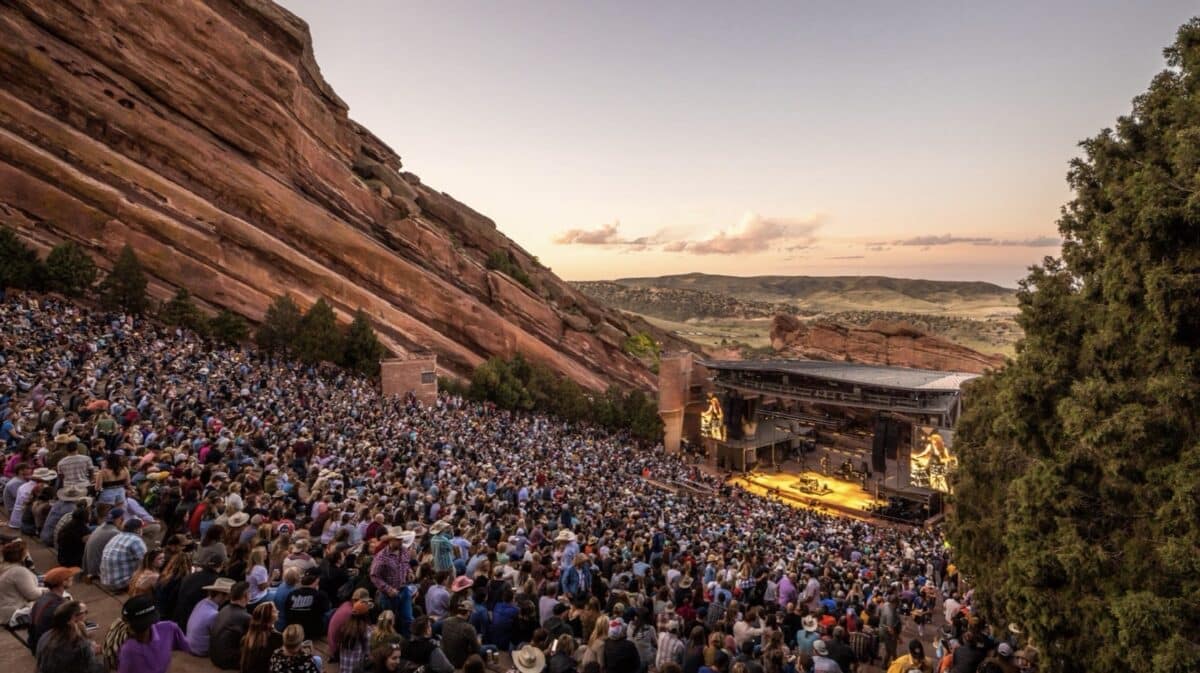
Red Rocks Amphitheatre in Morrison, Colorado. Photo courtesy of Red Rocks Amphitheatre, subject to image-use permission.
More From Metal Lair
The Most Anticipated Metal Albums of 2027
Would You Buy Festival Tickets Before Knowing the Lineup?
Metal on the Map: Explore Road Riffs
Editorial note: Venue details are drawn from venue operators and official tourism resources.
About The Author
Caine Blackthorn writes music news, trending topics, commentary, and feature pieces for Metal Lair with a focus on the shifting culture surrounding rock and heavy metal. From rising ticket prices and touring collapse to legacy artists, industry absurdity, and the changing soul of live music, his work blends sharp observation with the grit, humor, and frustration of the scene itself. Whether covering modern chaos or metal history, Caine approaches heavy music as something lived through, not simply reported on.
Read More From This Author:
Megadeth Announce Their 2027 Farewell Tour
Bruce Dickinson Reveals PsychoGod and New Solo Plans
Rammstein’s Future: Flake Says the Band Will Continue
Dying Fetus Take Their 2027 Tour Into Intimate Clubs
Vanishing Point Eremition: Progressive Metal Album Review
HAVE A METALHEAD COMPLAINT?
“People roundhouse-kicking” in the pit grinding your gears? Gatekeepers questioning whether you’re “metal enough”? Frustrated with getting hit in the head by peoples smelly shoes at a concert?
Whatever’s poisoning your particular corner of the metal community, file an unofficial complaint with The Metal Lair Complaint Department.
Vent your venom. Name the offense. Make your case. Your complaint could be featured in next week’s issue of The Metal Lair Complaint Department.

No algorithms. No fluff. No watered-down corporate metal coverage.
Subscribe to Metal Lair and get weekly underground features, Seven Deadly Songs, Deep Cuts, interviews, and original metal journalism sent directly to your inbox.

Join the patrons of Metal Lair
MetalLair.net is a metal zine muttering to itself about seo and blastbeats at 3 AM powered by caffeine, riffs, a severe lack of sleep, and a dog wondering why the human is still awake.
Sometimes it’s Kevin passing out mid Seven Deadly Songs.
Sometimes it’s digging up forgotten records no one else is talking about.
Always, it’s built for people who actually live this music.
If that sounds like you, you’re already one of us.
Supporting Metal Lair means keeping it independent, loud, and real with no corporate filters, no watered-down takes. If you want to help keep it alive…
Become a patron of Metal Lair.