Written By Derek Gann
A deep dive into the life, voice, myth and legacy of heavy metal’s noble warlock.
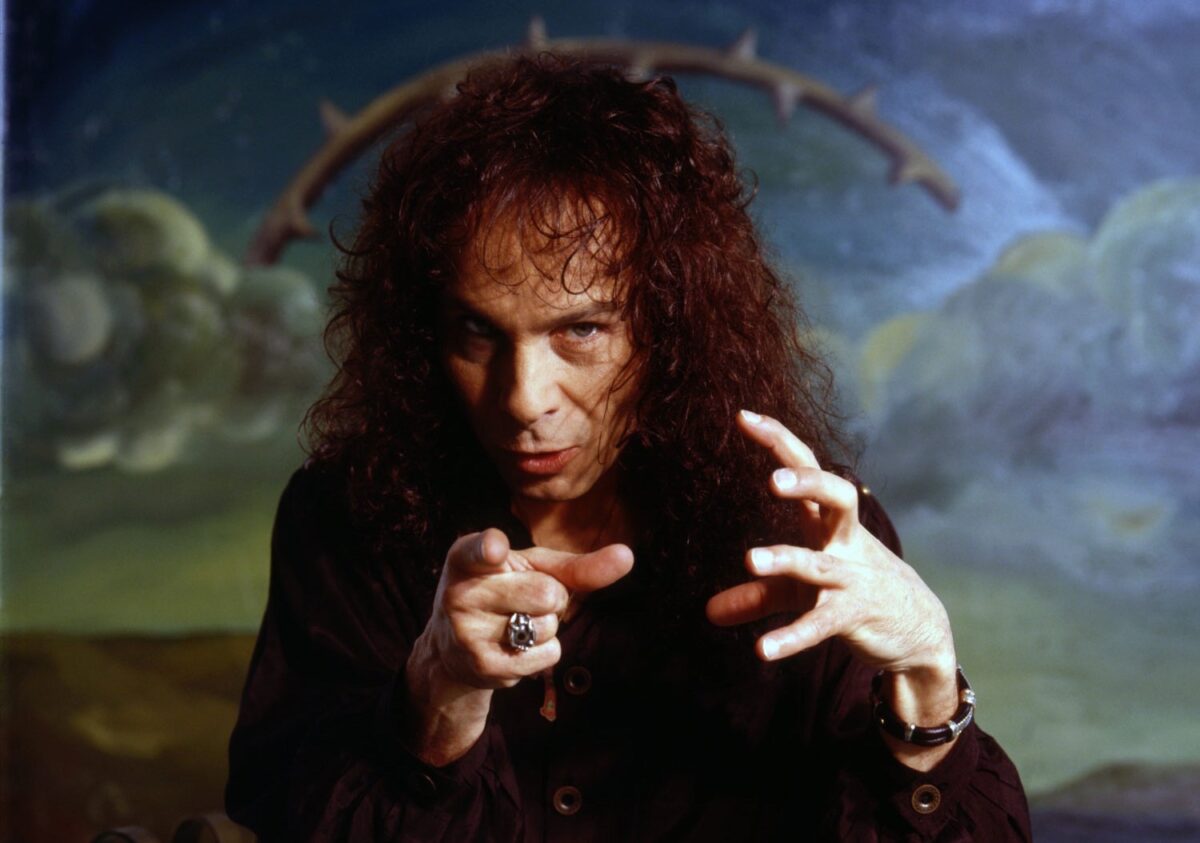
Ronnie James Dio (born Ronald James Padavona, July 10, 1942 – May 16, 2010) is a name that sits at the very bedrock of modern heavy metal. He moved through rock history like an emissary from another time, arriving out of small-town New York with an operatic sense of melody and a love for mythic storytelling, and leaving the genre indelibly changed: a new vocal standard, a lexicon of imagery (swords, wizards, banners and blood-red moons), and a gesture, the “devil horns” that became metal’s universal salute.

Origins and the shaping of a voice
Born to Italian-American parents and steeped early in opera and trad-pop, Dio’s musical instincts took shape in do-wop and 1950s rock before hard rock found him. He cut his teeth in bands like The Vegas Kings and Elf, where his towering, theatrical voice and affinity for narrative lyrics already stood out. That background , part operatic phrasing, part gritty American blues and part dramatic storyteller, is what allowed him to sit comfortably over the heavy riffing that followed throughout his career.
The big chapters: Rainbow, Black Sabbath, DIO, Heaven & Hell
Dio’s career is best read as a string of acts where he both elevated and was elevated by the musicians around him.
Rainbow (mid-1970s): Recruited by Ritchie Blackmore after leaving Deep Purple, Dio and Rainbow crafted a glittering, medieval-tinged hard rock songs that married virtuoso guitar work to Dio’s mythic vocal storytelling (albums like Rising hardened into modern classics).
Black Sabbath (1979–1982, 1991–1992): Replacing Ozzy Osbourne, Dio’s arrival on Heaven and Hell revitalized Sabbath, steering the band into more melodic, lyrical terrain without losing its doom-laden heft. The partnership produced immediate creative chemistry and two seminal studio albums (Heaven and Hell, Mob Rules).
DIO (1982 onward): When Ronnie struck out with his own band DIO, he produced Holy Diver, a record that synthesized his strengths: unforgettable hooks, cinematic lyrics and a voice that could both soar and menace. The band became the vehicle for his clearest artistic statements.
Heaven & Hell (2006): Late in life, Dio reunited with his Black Sabbath bandmates (under the name Heaven & Hell) and returned to the heavier, more collaborative sound of the early ’80s. A final vindication of the stylistic blend he helped perfect.
The voice, the image, the ritual
Dio’s singing was both technical and elemental: precise pitch control, dramatic vibrato and phrasing borrowed from operatic and pop traditions, but delivered with the raw conviction of a preacher. Lyrically, he favored archetypes and parables. knights, betrayals and celestial bargains, giving heavy metal a vocabulary borrowed from fantasy and folklore. That aesthetic helped define metal’s lyrical landscape through the ’80s and beyond.
Most famously (and culturally), Dio popularized the “devil horns” hand gesture within rock and metal circles. A sign he credited to his Italian grandmother’s apotropaic gesture (meant to ward off the evil eye). Whatever its precise origin, the symbol became one of metal’s most recognizable emblems, a visual shorthand for rebellion and camaraderie onstage and in the crowd.
Influence and cultural impact – why Dio still matters
A template for metal vocalists: Dio established a standard for how a metal singer could be both melodic and forceful, influencing vocalists across genres, from power metal to modern hard rock.
Bridging generations: By moving between Rainbow, Sabbath, and his own band, Dio connected the 1970s hard-rock virtuoso era to the guitar-driven metal of the ’80s and ’90s. That made him both a founder figure and a living bridge across decades.
Iconography and fandom: The fantasy imagery and ritualized stagecraft. Cloaks, chains, pendants and incantatory choruses helped codify metal’s visual language and fed the genre’s fan culture.
A concise discography lens – Ronnie’s top five albums (and why)
Different critics place different records at the top, but the albums below consistently appear in best-of lists and are load-bearing for both Dio’s career and heavy metal history. (Sources: artist bios, critical rankings and retrospectives.)
1. Holy Diver: DIO (1983)
Why it matters: Pure, distilled Ronnie. Holy Diver is the album where Dio’s mythic lyricism, memorable hooks (“Holy Diver,” “Rainbow in the Dark”) and theatrical vocal performance cohere into a metal classic. It’s compact, anthemic, and it set the template for 1980s American metal.
2. Heaven and Hell: Black Sabbath (1980)
Why it matters: Dio’s first Black Sabbath record. This album retooled Sabbath’s sound with more melodic vocals and vivid storytelling, producing songs that balanced doom with drama. It proved Dio could reframe an established band’s identity without erasing its essence.
3. Rising: Rainbow (1976)
Why it matters: Often cited as Rainbow’s masterpiece, Rising is where Ritchie Blackmore’s guitar fantasies and Dio’s mythic lyricism meet in perfect storm with longer songs, operatic vocals, and a heavy-metal blueprint many bands would emulate.
4. The Last in Line: DIO (1984)
Why it matters: A natural successor to Holy Diver, this album deepened the band’s thematic reach and contains powerful anthems and hooks. It reinforced Dio’s status not as a one-off hitmaker but as a true creative leader with a clear aesthetic.
5. Mob Rules: Black Sabbath (1981)
Why it matters: Darker and heavier than Heaven and Hell in places, Mob Rules further cemented the Dio-era Black Sabbath as a distinct force in metal, muscular, urgent, and laden with Dio’s apocalyptic visions.
Before Algorithms Hunting Metal Was Bloodsport
Honorable mention: Lock Up the Wolves – DIO (1990)
Though not as universally lauded as Holy Diver or The Last in Line, Lock Up the Wolves is an intriguing, transitional record. It’s notable for lineup changes and for showing Dio experimenting with different sonic textures and collaborators at the dawn of the ’90s. For collectors and completists it’s a revealing chapter. One that shows Dio never stopped trying to tweak his formula.
Criticism, complexity and later years
Not every Dio release is unanimously adored. Albums like Sacred Heart and Dream Evil drew mixed reactions for production choices or a more polished sound. But critique never erased the central fact: Dio’s presence, his voice, his imagery, and his uncompromising standards raised the bar for heavy music. In later years, he reunited with former collaborators, toured extensively, and remained a beloved figure until his diagnosis.
Final act and legacy
Diagnosed with stomach cancer in late 2009, Ronnie James Dio died in May 2010. His passing prompted a global outpouring from musicians, critics and fans who described him as more than a singer. He was a steward of metal’s grandeur. His rituals, melodies and even a simple hand gesture continue to resonate: you see the horns at stadiums and basements alike, a silent lineage back to a man who turned myth into music.
Read more from this writer: “Abigail’s Father : The Horrific Genius of King Diamond“
Ronnie James Dio: The Voice of Metal: A Definitive Playlist
I. The Early Spell: Rainbow (1975–1978)
Where fantasy met virtuosity.
1. “Man on the Silver Mountain” – Rainbow (1975)
The first spark of Dio’s mythic storytelling and his chemistry with Ritchie Blackmore’s guitar wizardry.
“I’m the man on the silver mountain, come down with fire…”
2. “Stargazer” – Rainbow (1976)
A cinematic epic, arguably one of the greatest metal songs ever written. Dio’s vocals soar like a prophet above a storm.
3. “A Light in the Black” – Rainbow (1976)
The perfect twin to “Stargazer,” an adrenaline-charged finale that showed the band’s musical muscle and Dio’s lyrical fire.
4. “Kill the King” – Rainbow (1978)
Fast, aggressive, and an early proto–speed metal gem. Bands like Helloween and Blind Guardian took notes from this one.
II. Heaven Reforged: Black Sabbath (1979–1982, 1992)
Where doom met divinity.
5. “Heaven and Hell” – Black Sabbath (1980)
The title track that redefined the band and reinvigorated heavy metal for a new decade. Philosophical, haunting, timeless.
6. “Children of the Sea” – Black Sabbath (1980)
Dio’s poetic duality, tenderness and fury displayed in a song that feels like a mythic lament.
7. “The Mob Rules” – Black Sabbath (1981)
A fierce anthem dripping with apocalyptic energy; Tony Iommi’s riffs and Dio’s fire forge an indestructible union.
8. “Time Machine” – Black Sabbath (1992) (from Dehumanizer)
A darker, cyberpunk take on Dio’s lyrical themes showing he could evolve without losing the mystique.
III. The Age of the Magician: DIO (1983–1990)
When Dio built his own kingdom.
9. “Holy Diver” – DIO (1983)
The ultimate Dio track, part allegory, part call to arms. One of metal’s most iconic riffs and vocal performances.
10. “Rainbow in the Dark” – DIO (1983)
Synth-driven and anthemic. A fusion of classic metal spirit and ’80s accessibility.
11. “The Last in Line” – DIO (1984)
Spiritually soaring and emotionally charged. The “second gospel” of Dio’s solo era.
12. “We Rock” – DIO (1984)
A defiant crowd anthem. Dio’s love letter to his fans. Live, this song felt like a ritual.
13. “Sacred Heart” – DIO (1985)
A mystical gem wrapped in big ’80s production; the dragon imagery from this era became legendary.
14. “All the Fools Sailed Away” – DIO (1987) (from Dream Evil)
A haunting, majestic track. Proof that Dio could still conjure gravitas even as metal’s trends shifted.
15. “Lock Up the Wolves” – DIO (1990)
Honorable Mention Album Track
Raw and bluesy, featuring a young Rowan Robertson on guitar. A weathered Dio embracing a darker tone.
IV. The Elder Years: Heaven & Hell (2006–2010)
The legend returns, older and more powerful.
16. “Bible Black” – Heaven & Hell (2009)
Dio’s voice, still thunderous and chilling, exploring religious obsession and darkness.
A late-career masterpiece that shows no flame dimmed.
17. “The Devil Cried” – Heaven & Hell (2007)
Brooding and massive, the band’s maturity on full display.
V. The Bloodline – Artists Inspired by Dio
His echoes through the generations.
18. “Beyond the Realms of Death” – Judas Priest (1978)
Rob Halford and Dio were mutual torchbearers for operatic, emotional metal.
19. “Keeper of the Seven Keys” – Helloween (1987)
The power metal movement, directly descended from Dio’s mix of melody and myth.
20. “Valley of the Kings” – Blue Murder (1989)
John Sykes channeled Dio’s theatrical grandeur into a guitar-driven epic.
21. “Fear of the Dark” – Iron Maiden (1992)
Bruce Dickinson’s narrative approach owes much to Dio’s vocal legacy.
22. “Rainbow Eyes” – Rainbow (1978)
To close the circle. A tender, medieval ballad. The quiet side of a voice that usually commanded storms.
Total Runtime: 2 hours 10 minutes
Perfect for an immersive drive, a writing session, or a personal ritual under low light and high volume.
Dig deeper into Derek’s Metal Legacy vault:
Lemmy Kilmister and Motörhead: The Unstoppable Force Behind Heavy Metal’s Grit and Glory
Abigail’s Father: The Horrific Genius of King Diamond
For more content like this check out our ongoing series Deep Cuts: Metal’s Hidden Gems – a descent into the vaults where legendary weirdness sleeps.