Written By kevin McSweeney
I’ve expressed my distaste for the term “post-metal” in previous diatribes to which I have subjected the long-suffering Metal Lair readership, so I won’t go over the same old ground here, but suffice to say, I wouldn’t normally have any truck with this particular subgenre.
I’m making a happy exception here, however, as you kinda have to for something so good as Above, Below and So, the third album by this Brighton-based trio named Matador, which is available from February 27th via Church Road Records.
It’s a superbly sludgy, stoner/doomy delight that is cinematic and psychedelic in equal measure, and it might just have you clacking your castanets and shouting “Olé!”
Foundation-shaking opener The House Always Wins sets out the stall nicely through the course of its near eight-minute runtime, as James Kirk’s enterprising guitar work goes on boldly throughout, with riffs as vast as desert dunes and lead guitar that soars majestically above the arid landscape.
His vocals veer from soulful croon to distorted snarl in accordance with the stoss and the slip of the music.
Like a certain other celebrated trio, they display an eagerness to dispense with the constraints of conventional time signatures, on this track at least, and drummer Scott Stronach’s blend of intricacy and intensity inevitably brings to mind the late, great Neil Peart.
Glitter Skin opens with a gloriously sludgy riff and lead guitar with a sense of aching wistfulness about it, if that makes any sense.
I’m not sure anything I write ever does. It’s going to be quite something to hear live. You’d feel Mark Ainsworth’s rumbling bass in the pit of your gut for sure.
Almost as epic in length as its predecessor, there’s a vague similarity to System of A Down’s Aerials, which is no bad thing in my book.
It’s an ornately wrought piece of understated and atmospheric music for much of its duration, before building to a cacophonous climax.
The Flood is a deluge of Biblical proportions from its super-cool Sabbath-style opening riff, through crash-heavy grooves and tom tom-driven tribal interludes.
It’s largely instrumental, and they prove themselves to be a band that truly understands the importance of dynamics, as they take you on an emotional journey up hill and down dale.
I don’t recognise the spoken-word clip that constitutes the song’s only manifestation of vocals, but it’s absolutely lovely!
It’s like a mini-version of Baz Luhrmann’s Everybody’s Free (To Wear Sunscreen) within the track, hopefully minus the irony.
I particularly like the line: “Sunshine conquers tears as well as rain.” Their native UK has been subjected to exceptionally heavy rainfall so far in 2026, even by British standards, so it’ll be a reassuring thought for when the summer finally arrives.
The fully instrumental piece O Suna proves the effectiveness of a simple riff when backed with colossal slabs of distorted bass and pummeling tom-toms and cymbal crashes.
The only trouble is, on an album on which the other songs are so long, it kind of feels like an intro rather than a track in its own right. Still, it’s hugely atmospheric and thoroughly enjoyable.
We then move from the shortest track on the album to the longest, in the form of A Virus, which weighs in at a whopping ten minutes plus.
Though it’s the penultimate song, it feels like the album’s denouement. It builds slowly, with subdued, jazzy opening bars and lead guitar with a strange sense of foreboding to it, almost like something from Jeff Wayne’s War of The Worlds, perhaps when the red creeper is taking hold.
This leads to palm-muted chugging over an unconventional time signature, bringing to mind Tool.
When the vocals arrive, they are unexpectedly abrasive, and the lead guitar is plaintive, in contrast to the intensity of the riff.
More evidence of their mastery of dynamics comes in the form of the subdued middle section, before it returns to abrasiveness, with Stronach seemingly reducing his drums to matchsticks with the speed and power with which he pummels the toms.
They catch us on the hop with a false finish, then revive the song with strange, otherworldly synths that bring it to its true conclusion, and we’re back to War of The Worlds again. Wasn’t it a virus that killed those aliens in the end?
Final track Hooks probably delivers the heaviest material of the opus, and I commend their decision to kick our arses at the end of an album in which they have lulled and soothed us at times.
Once again, Stronach beats those toms like they owe him money. It’s doom-laden heaviness with a sense of dolefulness tempering its intensity – much more the sort of thing you’d expect to be emerging from the barren bleakness of the northern moors, rather than the sun-kissed beaches of Brighton.
(OK, sun-kissed is probably a step too far, but you get the idea. Brighton was actually the location of Britain’s first official nudist beach. It’s far too cold to dispense with the duffle coat up north, never mind your swimming costume!
But I digress.) They trick us once again with a false finish, and when the song kicks back in, we are treated to some delightfully dextrous Danny Carey-style triplet-based beats, and some of the darkest riffing in show.
It brings to a close a collection of songs as elaborately wrought as Muse, as abstruse as Tool, and possessing the sand-weathered splendour of Kyuss in their pomp.
Above all else, it’s bloody hard to fault. I could take off half a horn for the post-metal label if I’m being hyper-critical, and maybe the incongruous nature of the fourth track, I suppose.
That aside, it’s not far from flawless. I can’t help feeling that a perfect score should only be awarded to those rare classics like Master of Puppets or Paranoid, but by God! I came close!
Metal Lair awards Above, Below and So by Matador four and a half Devil horns out of five, and feels somewhat parsimonious for not awarding the full five.

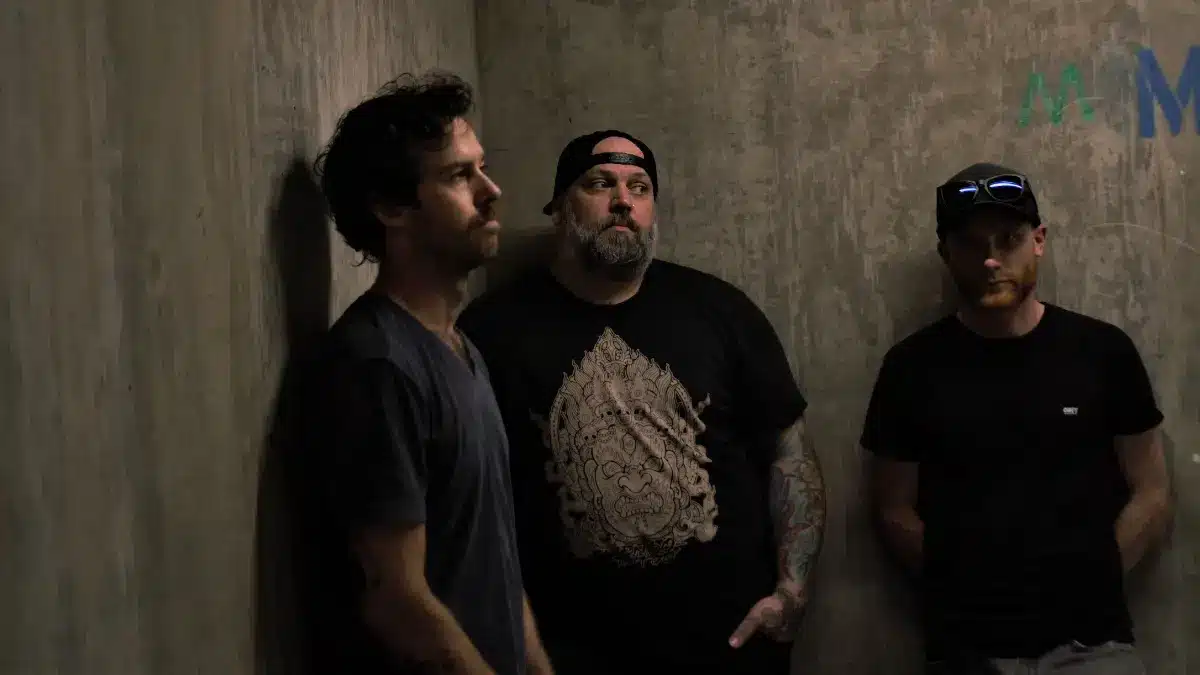
Band members:
Scott Stronach – Drums
James Kirk – Guitar/Vox
Mark Ainsworth – Bass

Tracklisting:
1. The House Always Wins
2. Glitter Skin
3. The Flood
4. O Suna
5. A Virus
6. Hooks
MATADOR ONLINE
Support Metal Lair
Metal Lair runs on passion, riffs, and far too much coffee. If you enjoy the interviews, reviews, and recurring series, you can support the site here: