By Christy Norris – Metal Lair
Some bands write music to fill the silence. Carach Angren writes to disturb it.
For over two decades, their symphonic black metal has been less about songs and more about summonings. Ghost stories set to strings, myths reborn in blast beats, history reanimated onstage. From the haunted halls of Lammendam to the grotesque experiments of Franckensteina Strataemontanus, they’ve carved a legacy not just as musicians, but as storytellers who blur the line between the living and the dead.
With The Cult of Kariba, they return to the soil where their earliest nightmares first took root. This new EP isn’t simply a sequel, it’s an excavation. Old poems, forgotten theatre scripts, 19th-century folklore, and centuries of whispered superstition converge in the tale of Kariba: a poisoner, a witch, a spirit bent on vengeance. Across five movements, Carach Angren conjure ritual and resurrection with cinematic scale and bone deep menace.
It feels like both a homecoming and a haunting. The perfect moment to sit down with the minds behind it.
Ardek, welcome to Metal Lair. Let’s open the grave and see what walks out.
Related Reading: Continue the journey: Dive into Kevin McSweeney’s review of Carach Angrens new EP: The Cult of Kariba
THE INTERVIEW
Concept & Storytelling
Metal Lair: You started this whole journey with Lammendam, and now, nearly two decades later you’re back in Schinveld’s forests with The Cult of Kariba. Does it feel like you’re closing a circle, or are you building an even larger universe from these local myths?
Carach Angren:
Well, the thing with hauntings is that they don’t really have a beginning nor an end, and this is also what led us to revisit this place again. What is so fascinating is that the stories of Lammendam and also Kariba are very intertwined or even the same, dating back as far as the Dark Ages. Folklore and ghost stories seem to develop throughout time in the sense that people keep adding and subtracting elements. Both with Lammendam and now The Cult of Kariba, we add a small piece to the history of these great stories.
Metal Lair: This time around you dug deeper than oral legend with old poems, forgotten theatre plays and obscure historical references. How much of what we hear is pulled straight from the archive, and how much is your own storytelling stitched into the fabric?
Carach Angren:
I think you can say it is fiction dressed in history. The story of the white lady clearly had an impact on the local inhabitants, as some of them performed a theatre play based on it in the 1970s. We found a group picture of the cast in an old newspaper. That gave us the idea of a Cult that would try to resurrect the ghost of the witch Kariba. So with the Cult we enter the fictional realm.
In the early days of making Lammendam, we also knew about people from local villages who were fascinated by the story. Ghost tales have a magnetic effect – they pull you in.
Metal Lair: Kariba is rooted in very old folklore, poisoner, witch, outcast. When you retell a legend like this, how do you decide what to preserve and what to reinvent?
Carach Angren:
The thing is, we really can’t know what is faithful or not because all the pieces we find are rooted in art, poems, or folklore. We don’t know, for example, if the poem we found about Kariba from the 1800s is completely fictional or referencing older works. That uncertainty actually makes the whole thing even more mysterious and interesting.
We tried to add the next piece to the myth by combining the story of the white lady with the story of Kariba the witch. Maybe in 200 years people will wonder the same thing about our work, was it fiction, or was there really a Cult back then?
Metal Lair: Your records have always balanced horror and tragedy, but Kariba feels like a resurrection story, something that refuses to stay buried. What draws you back to themes of return and haunting?
Carach Angren:
Seregor and I have always been fascinated by death. We think about it a lot and discuss it regularly in our phone calls. A couple of years ago I read The Denial of Death by Ernest Becker, and it really impacted me. Essentially, he suggests that our whole culture is built to avoid confronting the reality of death.
In recent years I’ve experienced losses more closely and saw how things people held onto for decades were suddenly left behind, given away, or thrown out. It made me realize how impermanent everything is. Maybe we deal with that by fantasizing about the undead – beings who refuse to disappear.
Ironically, one of the few things that can outlive us is art. I feel like I resurrect people by playing their music.
Maybe our ghosts live there.
Composition & Atmosphere
Metal Lair: “Ik Kom Uit Het Graf” hits with an industrial, almost EBM-like pulse, a sharp stylistic turn. What pushed you into that territory, and what emotional force were you channeling?
Carach Angren:
We’ve never let genres dictate what we do, but yes, this one was different. I wrote most of the music in one or two days and sent it to Seregor, asking if he felt it could be something for CA. He immediately got excited and wrote the infamous Dutch lyrics. It was one of those songs that simply happened.
It fit perfectly in the story, representing Kariba’s attacker returning for revenge. Lyrically and musically, it’s the uninvited guest on the EP. Seregor has always been fascinated by serial killers, people who lack any humanity. I think he really captured the essence of a psychopathic ghost returning from the grave. We were both shocked hearing the demo with full vocals. He’s like an actor, he lives the role.
Metal Lair: The EP feels cinematic, five movements instead of five songs. Did you approach Kariba like a short film in sound?
Carach Angren:
In a way, yes. We want to tell a story but also make sure every song stands on its own. We never rush music just to go on tour. From the beginning, this story felt concise, so we chose five parts. Even so, it was as much work as a full album.
There’s a misconception that “it’s just an EP.” To us, it’s a short album and we put an incredible amount of work into it.
Metal Lair: There’s a recurring violin line in “Draw Blood” and “Venomous 1666.” Was that meant to act as Kariba’s musical signature?
Carach Angren:
That’s an interesting interpretation. It wasn’t planned. In those compositions, I simply felt the moment needed solo violin instead of big orchestral strings. In “Venomous 1666” it almost feels triumphant – the soundtrack of her resurrection. The Cult succeeded and failed at the same time. She did come back… and killed everyone.
Metal Lair: You usually work with sprawling, 40-minute albums. Here, you tell a complete story in just 20 minutes. Did the tighter runtime change how you wrote?
Carach Angren:
The story always felt more dense. We didn’t want to dilute it. We already have a full album about the white lady, so this became an addition. Every track had to be perfect. There are bands who fill albums with weaker songs; we never want that.
The challenge with a shorter runtime is that every second needs to count. Even the intro. I thought a lot about its length. Double it, and it could hurt the pacing of the entire EP. Pacing can ruin a movie or a record.
Philosophy & Legacy
Metal Lair: Carach Angren has always dealt in horror with a human heart still beating inside it. Is The Cult of Kariba a cautionary tale, a revenge tragedy, or something in between?
Carach Angren:
It’s up to the listener. We approached this story with a fresh perspective. In an age dominated by short-form content, we aimed for something layered, something people can sit with and absorb.
Metal Lair: Folklore shifts with each telling. Do you see yourselves as preserving these stories, or provoking listeners to reinterpret them?
Carach Angren:
We were inspired by these stories, and that pushed us to create new art. If the end result is that people learn more about ghost stories and legends, that’s great. There’s a risk that local stories get forgotten now that the world is so connected. I hope our work helps preserve some of them.
Metal Lair: Over two decades in, has your relationship with fear evolved?
Carach Angren:
I don’t think so. I do realize that we in the Western world are very privileged. We don’t have much to fear, although the world has changed significantly in recent years.
Metal Lair: You’ve conjured ghosts, ships, alchemists, witches… but what story still intimidates even you?
Carach Angren:
We’re always looking for the next story that intrigues or intimidates us. If it doesn’t intimidate us, we probably won’t cover it. There are many famous tales out there, but you have to feel something when you read about them.
For this EP, the idea of the secret Cult was intimidating, the thought of your friends or neighbors secretly gathering without your knowledge. That simple idea provoked me from the start.
Let’s see what we uncover next.
Carach Angren continues to prove that metal can be more than music. It can be myth, memory, and theatre stitched into sound.
The Cult of Kariba stands as a testament to that vision, a reminder that stories never truly die. They wait beneath the soil, whispering, until someone is brave enough to resurrect them.
Ardek – thank you for opening the grave once more.
CREDITS
Interviewee: Ardek (Carach Angren)
Interview by: Christy Norris, Metal Lair
Provided by: Will Yarbrough at Season of Mist
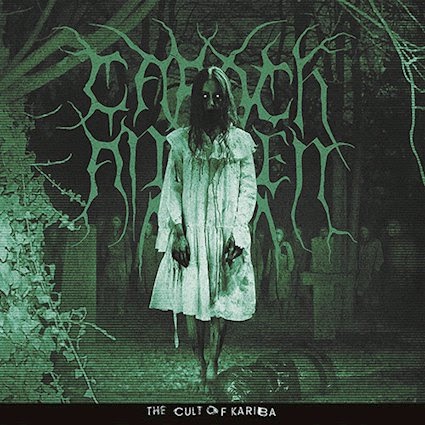
EP: The Cult of Kariba / out now via Season of Mist
Tracklist:
1. A Malevolent Force Stirs (1:16)
2. Draw Blood (5:18)
3. The Resurrection of Kariba (4:45)
4. Ik Kom Uit Het Graf (4:51)
5. Venomous 1666 (4:37)
Full runtime: 20:48
Line-up:
Seregor — Vocals, Guitars
Ardek — Keyboards, Orchestra
EP INFORMATION – The Cult of Kariba
Carach Angren · Season of Mist (2024)
Production Credits
• Main compositions: Ardek
• Pre-production, orchestral arrangements, keyboards: Ardek
• Vocals: Seregor (recorded at Tidal Wave Studio, Germany)
• Backing vocals: Ardek
• Drums: Gabe Seeber (recorded at Mayhemeness Recording Studio)
• Bass guitar & drum writing: Ardek
• Guitars (Tracks 2–3): written by Seregor
• Guitars (Tracks 4–5): written by Ardek
• Lyrics (1, 2, 5): Ardek
• Lyrics (3): Ardek & Seregor
• Lyrics (4): Seregor
• All guitars & bass performed/recorded by: Patrick Damiani at Tidal Wave Studio, Germany
• Mixed & mastered by: Patrick Damiani (Tidal Wave Studio, Germany)
• Vinyl mastering: Robert Schmidt, 24-96 Mastering, Germany
Guest Musicians
• Solo violin (Tracks 2 & 5): Nikos Mavridis
• Voice-overs: Tim Wells
• Wolf howl (Track 3): Frodo Wijers
• Lyrics proofreading: Sylvy Notermans
Artwork & Photography
• Art & design: Stefan Heilemann (Heilemania)
• Model: Lara Mauve
• Photography: Stefan Heilemann
Available Formats
• Digital Download
• CD Digipak
• 12” Vinyl Gatefold
CARACH ANGREN ONLINE:
Support Metal Lair
Metal Lair runs on passion, riffs, and far too much coffee. If you enjoy the interviews, reviews, and recurring series, you can support the site here: